 Bellingham Roofing
 Exterior Work Built for Sudden Valley's Setting
Sudden Valley sits in a heavily wooded pocket of Whatcom County along Lake Whatcom, southeast of Bellingham. That setting is part of why people live there — tall conifers, lake views, a quieter pace than town. It's also why homes there face a specific set of exterior problems that a roofer working mostly on open, treeless lots in other parts of the county won't deal with as often. Deep shade, needle and leaf litter, and the moisture that lingers under a forest canopy all shape how a roof, siding system, or set of windows ages out here.
We work throughout Bellingham and greater Whatcom County, and Sudden Valley is a community we're familiar with — the tree cover, the terrain, and the way homes are sited relative to the lake and the surrounding slopes. That local familiarity matters when you're diagnosing a roof leak or figuring out why moss keeps coming back no matter how many times it's been treated.
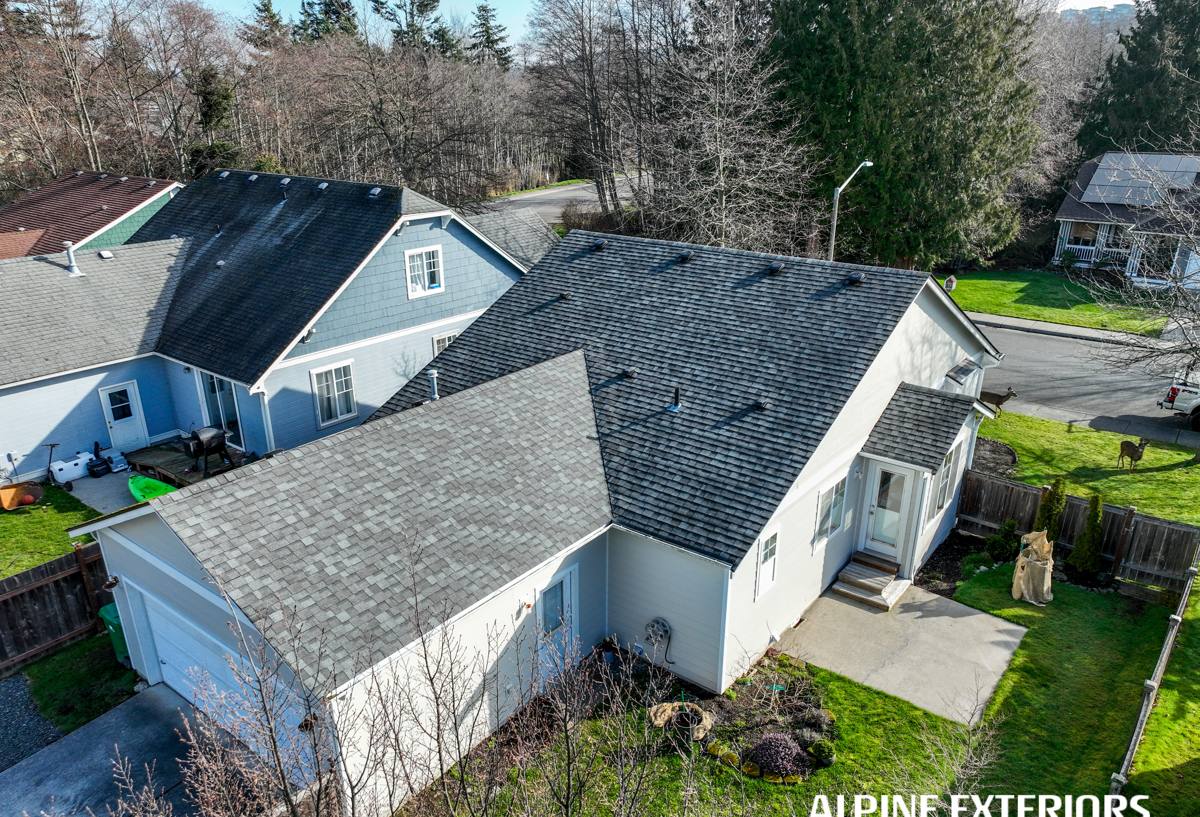
What the Climate Does to Homes Here
Whatcom County's marine climate means homes deal with a long wet season, salt-influenced air moving in off the Puget Sound and Georgia Strait, and driving rain that comes in sideways during winter storms. In a wooded, lake-adjacent community like Sudden Valley, those regional patterns get amplified by the local setting:
- Shade and moisture retention. Tree cover keeps roofs and siding from drying out between rain events, which is the single biggest driver of moss and algae growth.
- Needle and debris buildup. Conifer needles and leaf litter collect in valleys, behind chimneys, and in gutters, creating dams that force water backward under shingles or siding.
- Extended moss season. Where open, sunny lots might see moss mainly in late fall through early spring, shaded lots near the lake can support moss growth for most of the year.
- Salt-laden, humid air. Even at a distance from open water, the region's marine air carries moisture and salt that accelerates corrosion on fasteners, flashing, and exposed metal.
- Wind-driven rain. Storms moving through the county push rain at an angle, testing every seam, lap, and penetration on a roof or wall — not just the flat surfaces.
None of this means a home in Sudden Valley is destined for problems. It means the materials, the installation details, and the maintenance schedule need to account for a wetter, shadier microclimate than a lot of standard specs assume.
Roofing in a Moss-Prone, Tree-Covered Setting
Why Moss Is the Recurring Issue
Moss doesn't just sit on top of shingles — it holds moisture against the roof surface, works into laps and granule surfaces, and over time can lift shingle edges enough to let wind-driven rain get underneath. On a shaded roof, moss can reestablish within a season or two even after a cleaning, which is why we think about moss control as an ongoing plan rather than a one-time fix.
What We Look At
- Roof slope and orientation relative to tree cover — north-facing and heavily shaded sections need more frequent attention
- Valley and gutter condition, since debris buildup is often the real root cause behind a moss or leak complaint
- Flashing at chimneys, skylights, and roof-to-wall transitions, which are the most common leak points regardless of climate
- Ventilation, since a poorly ventilated attic traps moisture from inside the home and accelerates deck rot from underneath
For re-roofs, we install products suited to sustained moisture exposure and talk through realistic maintenance expectations up front — including how often gutters and valleys should be cleared given the specific tree cover on a given lot.
Siding for Shaded, Humid Lots
Siding on a shaded lot faces a similar problem to roofing: it stays damp longer after every rain, which gives algae, mildew, and moss more time to take hold, and it's more exposed to splash-back moisture from surrounding vegetation and soil. We favor siding systems and installation details that manage moisture actively — proper rainscreen or drainage gaps behind the cladding, correctly lapped house wrap, and flashing at every window, door, and penetration — rather than relying on the siding material alone to keep water out.
We're conservative about product choices that trap moisture against the wall assembly in a shaded, wet setting. That's a maintenance and moisture-management call, not a knock on any particular manufacturer — some siding types simply need more airflow and more attentive detailing to perform well in conditions like these, and we'll walk through those trade-offs honestly rather than push a product that looks good on a sunny showroom wall but struggles under a tree canopy.
Windows: Sealing Out Wind-Driven Rain
Older windows in a home exposed to regular wind-driven rain often show their age around the frame and sill first — that's usually where failed seals or degraded flashing let moisture in, long before the glass itself is the problem. When we replace windows in a setting like Sudden Valley, flashing and sealing at the rough opening get as much attention as the window unit itself, because a well-built window installed with poor flashing will still leak.
Energy performance matters too. Homes tucked into tree cover can run cooler and damper inside, and older single-pane or poorly sealed windows contribute to condensation issues that, over time, affect nearby trim and framing.
Deck Building and Repair in Wet, Shaded Yards
Decks in a wooded setting deal with the same moisture retention problem as roofs and siding, plus the added stress of standing on or near soil that stays damp for long stretches. Ledger board attachment, joist protection, and gap spacing between boards all matter more here than they would on an open, sunny lot, because a deck built without those details in mind will trap moisture against structural wood and shorten its own lifespan. We build and repair decks with drainage and airflow as a starting assumption, not an afterthought.
Cost Factors for Sudden Valley Homes
Every project is different, but a few factors specific to this kind of setting tend to move the price more than they would elsewhere in the county:
| Factor | Why It Matters Here |
|---|---|
| Tree cover and access | Overhanging branches and tight, wooded lots can affect equipment staging and may call for extra care or trimming coordination before work starts |
| Roof complexity | Valleys, dormers, and multiple roof planes collect more debris and take longer to flash correctly |
| Existing moisture damage | Hidden rot found once old roofing, siding, or decking is removed adds cost to repair before new material goes on |
| Material choice | Products rated for sustained moisture exposure sometimes cost more up front but reduce maintenance and moss-related callbacks |
| Site access for materials/equipment | Community roads and driveway layout in a lake-adjacent, wooded neighborhood can affect delivery and staging logistics |
We give straightforward, itemized estimates so homeowners can see exactly what's driving the number, rather than a flat lump sum that hides the reasoning.
Maintenance That Actually Fits This Setting
A maintenance plan written for a sunny, open lot doesn't hold up under tree cover. For homes in Sudden Valley, we generally recommend:
- Gutter and valley clearing more often than the standard twice-a-year schedule, especially near heavy conifer cover
- Periodic moss treatment on roof sections that stay shaded most of the day, done gently enough not to strip granules or damage the roofing material
- A visual check of siding and trim after major wind-driven rain events, looking for staining or soft spots near the base and around penetrations
- Keeping branches trimmed back from rooflines and siding to reduce both debris and abrasion damage
- Checking deck boards and ledger connections annually for softness or gapping, particularly on decks close to grade or shaded most of the day
Why a Local Crew Makes a Difference
A roofer or siding crew that mostly works open lots in drier microclimates will sometimes underestimate how aggressively moss and moisture move in a setting like Sudden Valley. We're based in Bellingham and work across Whatcom County regularly, which means we've seen how homes in shaded, lake-adjacent neighborhoods actually age over time — not just how they're supposed to perform on paper. That shapes the material recommendations we make, the flashing details we insist on, and the maintenance advice we give after the work is done.
If you're dealing with a stubborn moss problem, a roof or siding issue you can't quite pin down, or you're planning ahead for a re-roof, new siding, replacement windows, or deck work, we're happy to come take a look. Reach out for a free, no-pressure estimate — the form below is the fastest way to get started.