 Bellingham Roofing
 Two Shingle Types, One Big Decision
If you're re-roofing a home in Bellingham, you'll almost certainly be choosing between two categories of asphalt shingle: traditional 3-tab shingles and architectural (also called "dimensional" or "laminate") shingles. Both are asphalt-based, both are installed by the same trade, and both show up on quotes across Whatcom County. But they are not interchangeable products, and the difference matters more here than it does in drier climates. Salt air off Bellingham Bay, driving rain that comes in sideways during winter storms, and a long moss season that can run from October through May all put real stress on a roof. The shingle you choose affects how well your roof handles that stress for the next 20 to 30 years.
This page walks through what separates the two products, how each holds up under our specific weather pattern, and what actually drives the cost difference — so you can make a decision based on your roof, your budget, and how long you plan to own the home, rather than on whatever happens to be cheapest at the yard that week.
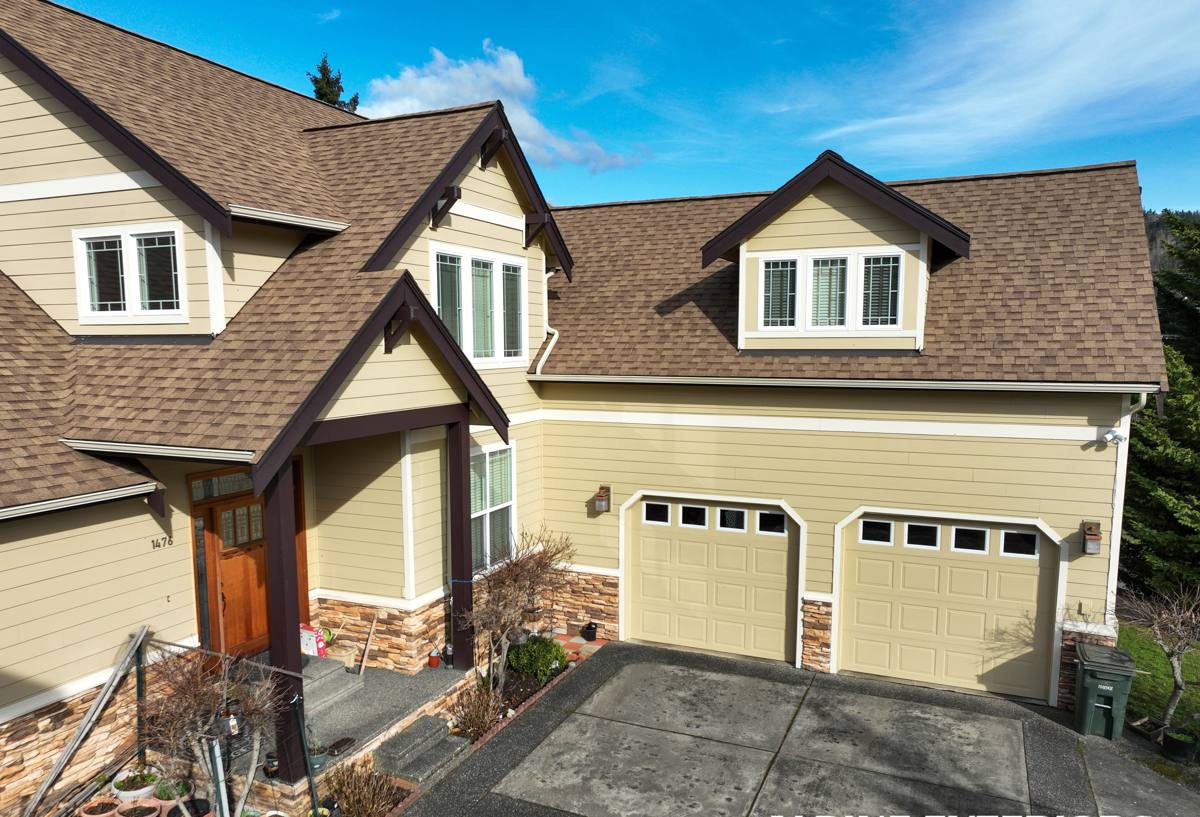
What Makes Them Different
3-Tab Shingles
3-tab shingles are a single layer of asphalt cut into uniform tabs, giving the roof a flat, evenly patterned look. They're lighter, thinner, and have been the standard budget option in residential roofing for decades. The manufacturing process is simple, which is part of why they cost less both to buy and to install.
Architectural Shingles
Architectural shingles are built from two or more laminated layers of asphalt, fused together to create a thicker, contoured shingle. That extra layer isn't cosmetic — it adds mass, rigidity, and a dimensional shadow effect that mimics the look of wood shake or slate. The added thickness also changes how the shingle handles wind uplift, water shedding, and impact.
The Core Trade-Off
In plain terms: 3-tab is a lighter-duty, lower-cost product with a shorter realistic service life. Architectural is a heavier-duty product with a longer realistic service life and better wind performance, at a higher upfront cost. Neither is "wrong" — but for a roof that has to deal with Pacific Northwest weather year after year, the two products age very differently.
Why This Matters More in Bellingham
Whatcom County roofs deal with a specific combination of stressors that not every region has to plan for:
- Salt air: Homes closer to Bellingham Bay and the Puget Sound shoreline are exposed to airborne salt, which accelerates granule wear and metal fastener corrosion over time.
- Driving rain: Winter storms here often bring wind-driven rain rather than straight-down rainfall, which tests a shingle's ability to shed water sideways at seams, valleys, and edges.
- Extended moss season: Our mild, damp fall-through-spring stretch creates ideal conditions for moss and lichen growth, especially on north-facing slopes and roofs shaded by evergreens.
- Wind exposure: Coastal and hillside properties see gusts that put real uplift pressure on shingle edges and tabs.
A thinner 3-tab shingle has less material holding it down against wind and less mass resisting the freeze-thaw and wet-dry cycling that comes with our climate. That doesn't mean 3-tab shingles fail quickly here — plenty of them last their expected lifespan with normal maintenance — but the margin for error is smaller.
Moss, Algae, and Shingle Choice
Moss doesn't care what shingle type you have; it will grow on anything organic-adjacent with enough shade and moisture. But the shingle's surface texture and thickness do affect how moss and algae behave once established. Architectural shingles' contoured profile creates slightly more surface texture, which can hold moisture a bit longer in shaded areas compared to the flat surface of 3-tab. In practice, the bigger factors are roof slope, tree cover, and how much direct sun a section gets — not shingle type alone.
Many manufacturers offer algae-resistant (AR) shingle lines in both 3-tab and architectural formats, using copper-infused granules that slow algae and moss growth. For a Bellingham roof — especially anything under fir or cedar canopy — we consider AR-rated shingles close to a must, regardless of which tier you choose.
Moss Prevention Checklist
- Choose algae-resistant (AR) shingles if any part of the roof sits under tree cover
- Keep gutters clear so water doesn't back up under shingle edges
- Trim overhanging branches to let more sun and airflow reach shaded slopes
- Have moss physically removed (not just chemically treated) every couple of years on north-facing sections
- Avoid pressure washing shingles — it strips granules and shortens shingle life
Wind and Rain Performance
Wind resistance is rated by manufacturers, and architectural shingles generally carry higher wind ratings than 3-tab shingles of the same product line, largely because of their thicker laminate construction and the way they're designed to lock together. In a region where winter windstorms can strip loose or aging shingles off a roof, that difference shows up over the roof's lifespan, particularly on exposed gables, ridgelines, and homes without much wind break.
Water shedding is a similar story. Architectural shingles' dimensional profile does a better job directing water away from seams and fasteners during heavy, wind-driven rain. 3-tab shingles perform fine under normal rainfall, but during the kind of sideways winter storms Whatcom County sees, the added thickness and overlap of an architectural shingle gives a bit more margin against wind-driven water intrusion at vulnerable points like valleys and roof-to-wall transitions.
Cost Comparison
Material cost is only part of the picture — labor, underlayment, and long-term maintenance all factor into the real cost of a roof over its lifespan. Here's a general breakdown of how the two compare. Treat these as broad, honest ranges, not a quote; every roof's pitch, access, tear-off scope, and complexity change the final number.
| Factor | 3-Tab Shingles | Architectural Shingles |
|---|---|---|
| Typical material cost | Lower | Moderate to higher |
| Expected service life | Shorter end of asphalt range | Longer end of asphalt range |
| Wind rating (typical) | Lower | Higher |
| Visual profile | Flat, uniform | Dimensional, shadow-line look |
| Manufacturer warranty terms | Generally shorter | Generally longer, often with better wind coverage |
| Resale/curb appeal impact | Neutral | Often viewed favorably by buyers |
Because architectural shingles typically last longer, the cost-per-year over the life of the roof often narrows the gap between the two options — sometimes to the point where architectural comes out ahead on long-term value, even with the higher upfront price.
Warranty Structure
Warranty length and coverage tend to track with product tier. 3-tab shingles typically carry shorter manufacturer warranties, while architectural shingles are often backed by longer warranties with better wind-speed coverage. It's worth reading the fine print on any warranty rather than assuming — coverage terms, prorated periods, and wind-speed thresholds vary by manufacturer and product line, and installation quality is usually a condition of keeping the warranty valid. A shingle warranty is only as good as the installation behind it.
Which One Fits Your Situation
There's no single right answer — it depends on the roof and the homeowner's priorities.
3-Tab May Make Sense If:
- You're working with a tighter budget and need a straightforward, code-compliant roof
- The home is a rental or investment property where lowest reasonable cost is the priority
- The roof has good sun exposure and less wind exposure (interior lots, tree-sheltered from prevailing storms)
- You plan to sell within the next several years and want to match cost to expected ownership period
Architectural May Make Sense If:
- You're planning to stay in the home long-term and want to minimize how many times you re-roof
- The property is exposed to wind — waterfront, hilltop, or open lot
- You want the dimensional, higher-end appearance for curb appeal or resale
- You want the stronger wind and warranty coverage as a buffer against Whatcom County storm seasons
What We Recommend as a Standard Practice
As a matter of professional standard, we lean toward architectural shingles as our default recommendation for most Bellingham homes, particularly anything with meaningful wind exposure or tree cover. It's not that 3-tab shingles are a poor product — installed correctly, they do their job. It's that the added durability, wind rating, and warranty coverage of architectural shingles tend to be worth the difference in a climate where the roof is working against salt air, driving rain, and moss pressure for most of the year. That said, we'll always lay out both options honestly for your specific roof, budget, and timeline rather than push one product across the board.
If you're weighing this decision for your own roof, we're happy to take a look, walk the roof line, and talk through what makes sense for your home's exposure, age, and budget — no pressure, no obligation. Use the form below to request a free estimate.