 Bellingham Roofing
 Why Attic Ventilation Matters More Than Most Homeowners Realize
Most people think about their roof in terms of shingles, flashing, and gutters — the parts you can see. Attic ventilation is the part you can't see, and it's often the difference between a roof system that lasts its full service life and one that fails early from the inside out. A well-ventilated attic moves air continuously, pulling in cool, dry air low on the roof and pushing out warm, moist air up high. When that exchange doesn't happen, moisture and heat build up in the attic space, and that buildup works against your roofing materials, your insulation, and your framing year-round.
In Bellingham and the rest of Whatcom County, this isn't a minor detail. Our climate combines salt air off the Sound, long stretches of driving rain, and a moss season that can run most of the year in shaded, north-facing roof sections. An attic that can't breathe properly holds onto that moisture longer than it should, and trapped moisture is what accelerates sheathing rot, rusts fasteners, and shortens the life of an otherwise good roof.
How Ventilation Actually Works
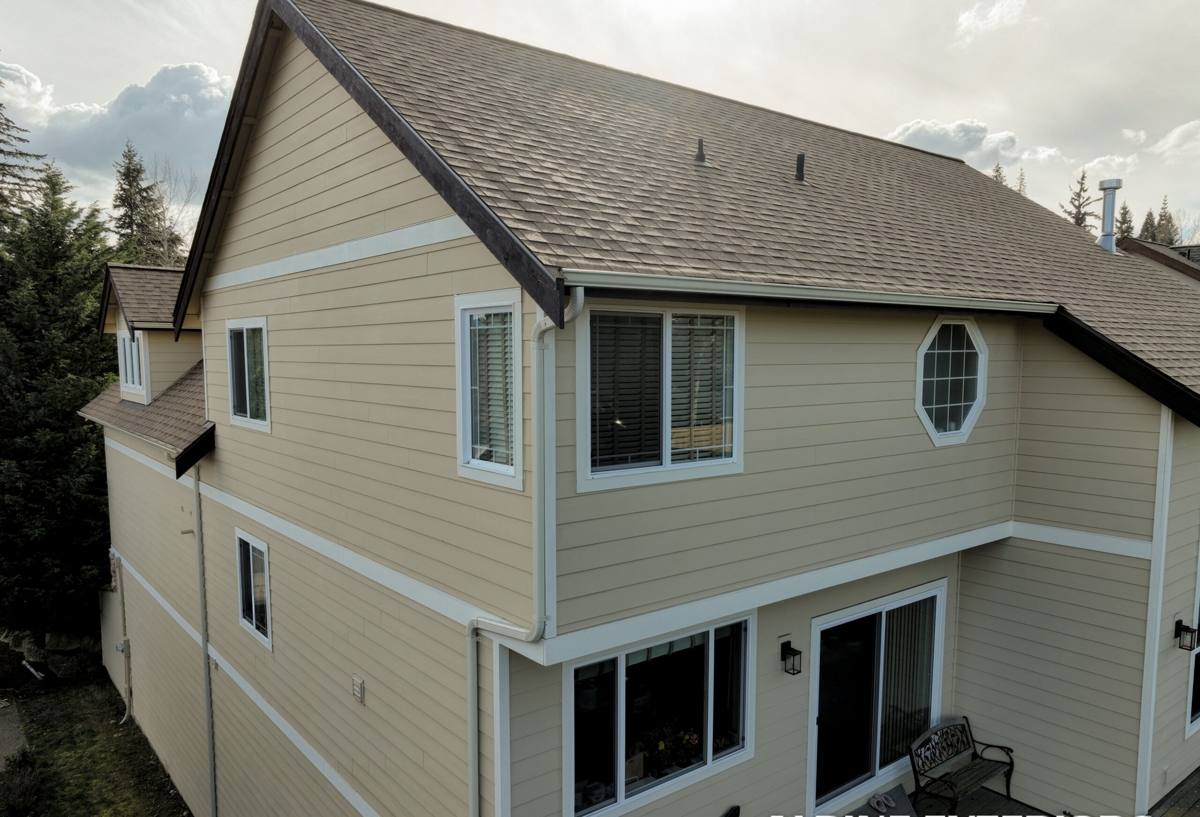
Attic ventilation depends on two things working together: intake and exhaust. Intake vents — usually soffit vents along the eaves — let cooler outside air into the attic at the lowest point of the roof. Exhaust vents — ridge vents, gable vents, or box vents — let warm, moist air escape at the highest point. Warm air naturally rises, so as it exits near the ridge, it draws fresh air in through the soffits behind it. That continuous loop is what keeps the attic close to outdoor temperature and humidity instead of turning into a stagnant, damp box under your roof deck.
Balance Is the Part People Miss
A common mistake is adding exhaust vents without matching intake, or vice versa. If you have plenty of ridge vent but the soffits are blocked by insulation, paint, or old vent covers, the ridge vent has nothing to pull from — it can even start pulling conditioned air out of your living space instead. Building codes and most manufacturers call for a roughly even split between intake and exhaust, calculated against your attic's square footage. Getting that balance right is a calculation, not a guess, and it's one of the first things worth checking before assuming your ventilation is "fine."
What Happens When Ventilation Fails
The consequences of poor attic ventilation show up slowly, which is part of why they're easy to ignore until they're expensive.
- Sheathing rot: Trapped moisture soaks into the underside of the roof deck over repeated wet seasons, softening plywood or OSB until it no longer holds fasteners securely.
- Mold and mildew: A damp, poorly circulated attic is exactly the environment mold needs. It can spread across framing and insulation long before it's visible from inside the house.
- Shortened shingle life: Heat trapped in an unventilated attic bakes shingles from underneath, accelerating the same aging process that sun exposure causes from above.
- Ice and moisture cycling: Even without heavy snow, our region's freeze-thaw swings and constant damp air mean condensation can form and refreeze in attic spaces, adding stress to framing and fasteners over time.
- Higher energy bills: A hot, humid attic in summer and a poorly insulated, poorly vented one in winter both make your HVAC system work harder than it should.
None of these show up overnight. That's what makes ventilation problems different from a leak — by the time you notice a sagging ridge line or a musty smell in an upstairs closet, the damage has usually been building for years.
Common Ventilation Types on Whatcom County Roofs
Not every ventilation system looks the same, and the right combination depends on your roof's shape, attic layout, and how the house was originally built. Here's how the main options compare.
| Vent Type | Function | Best Fit | Watch-Outs |
|---|---|---|---|
| Ridge vent | Continuous exhaust along the roof peak | Roofs with a long, unobstructed ridge line | Needs matched soffit intake to work correctly |
| Soffit vent | Continuous or individual intake along the eaves | Nearly every roof, as the intake half of the system | Easily blocked by insulation or paint; needs baffles to stay clear |
| Box/static vent | Spot exhaust, roof-mounted | Roofs without a long ridge, or as supplemental exhaust | Less effective than ridge vent per square foot; can look patchwork if overused |
| Gable vent | Exhaust at the wall peak | Older homes originally designed around gable ventilation | Can short-circuit ridge vent airflow if both are installed without planning |
| Powered/fan vent | Mechanically forced exhaust | Attics where passive airflow can't be achieved | Can depressurize the attic and pull conditioned air from the house if intake is insufficient |
On many of the older homes around Bellingham's central and southside neighborhoods, we still find a mix of gable vents and undersized or painted-shut soffit vents from a prior renovation. Neither is a failure by itself, but combined they often add up to an attic that isn't moving air the way it should.
Signs Your Attic Ventilation Needs a Look
You don't need to climb into the attic yourself to catch the warning signs. A few things are worth checking from the ground or with a flashlight at the attic hatch:
- Visible moss or dark streaking concentrated on north-facing or shaded roof sections
- A musty smell when you open an attic hatch or upstairs closet
- Frost or condensation on the underside of the roof deck on cold mornings
- Discolored or stained insulation, especially near the eaves
- Ice or heavy condensation buildup around bathroom or kitchen exhaust vents that terminate in the attic instead of outside
- Noticeably hotter upstairs rooms in summer compared to the rest of the house
Any one of these on its own isn't necessarily a crisis, but they're worth a proper inspection rather than a guess, especially before a re-roof — venting problems are far cheaper to fix while the roof is already open than to retrofit later.
What a Proper Ventilation Assessment Looks Like
A real assessment isn't just glancing at the roof from the driveway. It should include measuring your attic's square footage against the net free area of your existing intake and exhaust vents, checking whether soffit vents are actually open behind the insulation (baffles are frequently missing or crushed), and confirming that bathroom and kitchen exhaust fans vent outside the building rather than dumping moist air straight into the attic — a surprisingly common shortcut in older construction. From there, the fix is usually a matter of adding or clearing intake, adding proper exhaust, and making sure the two are balanced — not tearing the whole roof apart.
Why We Don't Just Add More Roof Vents and Call It Done
It's tempting to treat ventilation as "more vents = better," but an unbalanced system can do more harm than good. Our standard is to calculate the actual intake and exhaust need for your attic first, then design the vent layout around that number — not to install a fixed package regardless of the roof. That's slower than a one-size-fits-all approach, but it's the difference between ventilation that actually protects the roof deck and ventilation that just looks like it's working.
Ventilation and Insulation Work Together
Ventilation and insulation are often discussed separately, but they're really one system. Insulation keeps conditioned air where it belongs — inside the living space — while ventilation manages the attic air above it. If insulation is packed too tightly against the roof deck at the eaves, it blocks the soffit intake even if the vents themselves are clear. This is one of the most common issues we find in attics that have had insulation added or topped up over the years without anyone checking whether the original airflow path was preserved. A quick check with a baffle or vent chute at each rafter bay usually resolves it.
What This Means for Your Roof's Lifespan
Shingle and underlayment manufacturers generally base their warranty expectations on the assumption that the attic beneath the roof is properly ventilated. A roof installed over a poorly vented attic can age faster than its rated lifespan, sometimes voiding warranty coverage in the process, regardless of how well the shingles themselves were installed. Given how much of Whatcom County's weather — the rain, the humidity, the long moss-friendly stretches — works against a roof from below as much as from above, ventilation deserves the same attention as the shingles on top.
If you're not sure whether your attic is ventilated correctly, or you've noticed any of the warning signs above, we're happy to take a look and walk you through what we find — no pressure, no obligation. A free estimate is a good starting point whether you're dealing with an active issue or just want to know where things stand before your next roofing project.