 Bellingham Roofing
 Custom Decks Built for Barkley's Climate
Barkley sits close enough to Bellingham Bay and the surrounding Whatcom County lowlands that its decks live under a very specific set of conditions: salt-tinged air rolling in off the water, long stretches of driving rain from fall through spring, and short, intense summers that dry wood out fast after months of saturation. A deck built here isn't just a place to put a grill and some patio furniture — it's an outdoor structure that has to survive a genuinely demanding coastal Pacific Northwest climate, year after year, without rotting, graying prematurely, or turning into a slip hazard every winter.
We build and rebuild decks for homeowners throughout the Barkley area, and most of the problems we get called out to fix trace back to the same root cause: the deck was built to a generic spec, not to the conditions it actually has to survive here. This page covers what a correctly built deck in Barkley actually requires, the material and framing choices that hold up, and how our process works from first conversation to final walkthrough.
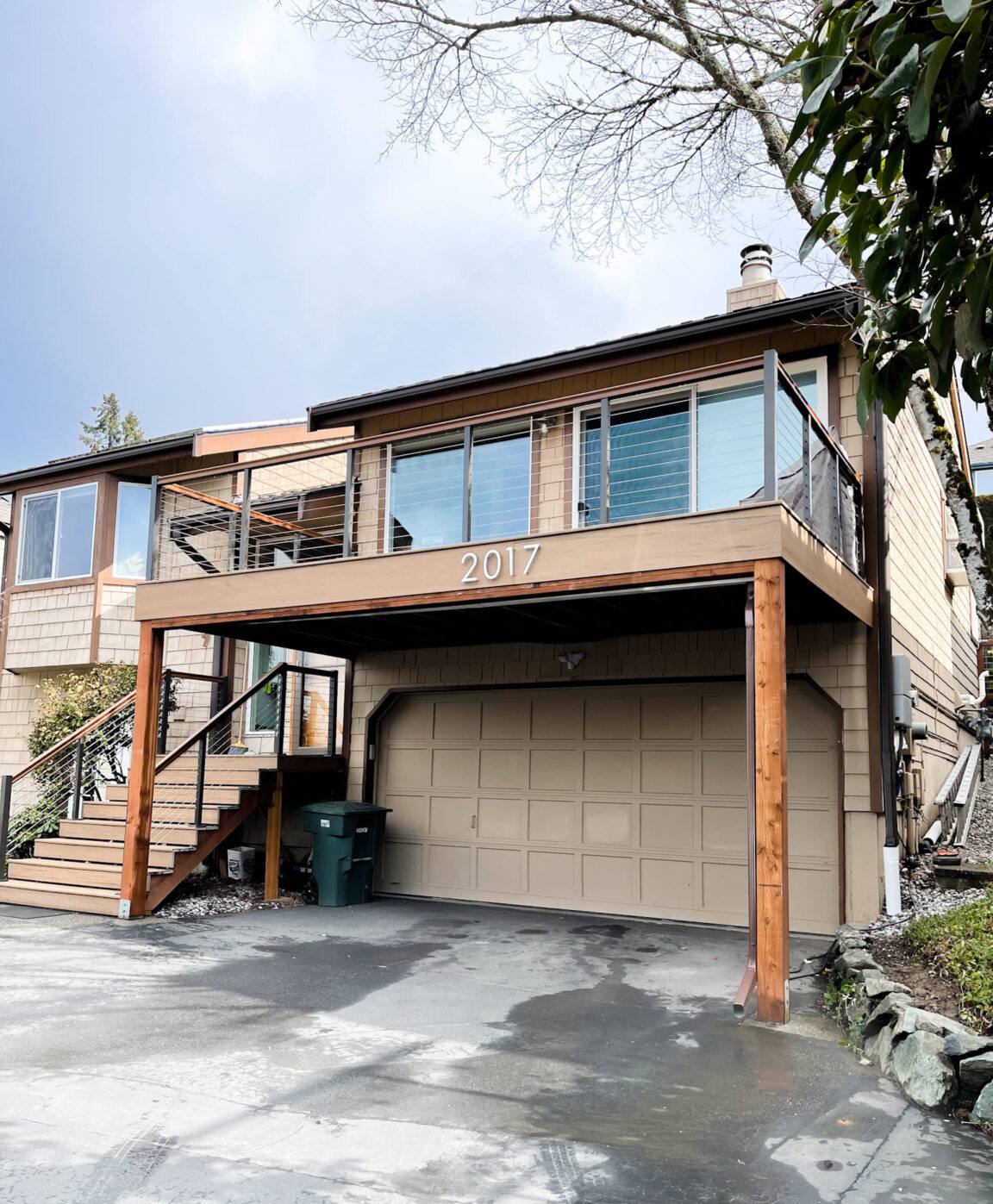
Why Local Conditions Are Hard on Decks
Salt Air and Metal Fatigue
Proximity to Bellingham Bay means a steady low-level exposure to salt-carrying air, even away from the immediate waterfront. Over years, that salt content accelerates corrosion on unprotected or poorly coated fasteners, hidden clips, and structural hardware. A deck that looks fine on the surface can have fasteners quietly weakening underneath if the wrong grade of hardware went in during the build.
Driving Rain and Moisture Load
Whatcom County gets long, sustained rain events rather than short downpours, which means wood and decking surfaces stay wet for extended periods instead of drying out between storms. Ledger board connections, joist tops, and any horizontal wood surface without proper drainage or flashing are the first places that moisture finds a way in.
The Long Moss Season
Shade, dampness, and mild temperatures give moss and algae a long growing window in this area — often close to eight or nine months out of the year on decks that don't get much direct sun. Moss holds moisture against the decking surface, stains material, and turns smooth boards into a slip hazard well before winter ice ever becomes a factor.
What a Correctly Built Deck Requires Here
A deck that's going to hold up in Barkley's climate needs to get several things right at the structural level, not just look good on day one. These are the fundamentals we won't skip:
- Ledger flashing done properly — a metal flashing detail and a gap or membrane between the ledger board and the house siding, so water sheds away from the wall rather than pooling behind the deck attachment.
- Footings sized and set to depth — concrete footings poured below frost depth and sized for the actual load of the structure, not guessed at.
- Corrosion-resistant fasteners and hardware — stainless steel or heavy hot-dip galvanized hardware rated for exterior and coastal-adjacent use, not standard interior-grade coated screws.
- Joist protection — a tape or coating on top of framing lumber so screw penetrations don't become entry points for standing water.
- Deck board spacing for drainage and airflow — consistent gaps that let water pass through instead of sitting on the surface, and enough airflow underneath to let the structure dry out between rain events.
- A slight slope away from the house — usually a small fraction of an inch per foot, enough to keep water moving off the deck instead of back toward the structure.
Choosing the Right Decking Material
There's no single "best" decking material — the right choice depends on how much upkeep you want to do, your budget, and how much direct sun or shade the deck actually gets. Here's how the common options compare for a climate like ours:
| Material | Moisture Behavior | Maintenance | Typical Lifespan Here |
|---|---|---|---|
| Pressure-treated wood | Resists rot with proper sealing; absorbs and releases moisture seasonally | Annual cleaning and re-sealing recommended | 15–20 years with upkeep |
| Cedar | Naturally moisture- and insect-resistant, but surface still needs protection | Periodic staining or oiling to prevent graying | 15–25 years with upkeep |
| Capped composite | Shell resists moisture absorption; core is protected from the elements | Occasional washing, no staining or sealing | 25–30+ years |
| PVC / cellular decking | Fully synthetic, essentially non-absorbent | Lowest — washing only | 25–30+ years |
In a neighborhood like Barkley, where mature trees create shaded, damp pockets in many yards, we lean toward recommending capped composite or PVC for anyone who's tired of re-staining a deck every year or two. That said, plenty of homeowners still prefer the look and feel of real wood, and a well-built cedar or treated-wood deck with a realistic maintenance routine will serve you well — it just asks more of you over time.
A Note on Fasteners and Hardware
Whatever decking material you choose, we treat fastener selection as a separate decision, not an afterthought. Given the salt-air exposure common to this part of Whatcom County, we standardize on stainless steel or heavy-duty coated fasteners for structural connections rather than the lighter-grade hardware sometimes used in drier inland climates. It costs a little more up front and saves a full re-fastening job a decade down the road.
Our Custom Deck Process
1. On-Site Assessment
We walk the property, look at drainage patterns, sun and shade exposure, existing grade, and how the deck will tie into the house. In an established neighborhood like Barkley, mature landscaping and existing structures often shape what's practical — we account for that from the start instead of designing in a vacuum.
2. Design and Material Selection
We talk through layout, size, railing style, and decking material based on your budget and how much maintenance you actually want to do. This is also where we flag anything the site conditions demand — extra footings for a steep grade, additional flashing detail for a shaded wall, that kind of thing.
3. Permitting
Most new and rebuilt decks require a permit through the local building department, particularly when the deck attaches to the house or sits above a certain height. We handle the permit application and coordinate inspections so you're not the one chasing paperwork.
4. Construction
Footings, framing, ledger attachment, decking, and railings, built to the details covered above rather than the minimum required to pass inspection.
5. Final Walkthrough
We go over the finished deck with you, including basic care guidance specific to whatever material you chose, so you know what upkeep to expect and what's genuinely optional.
Permits and Code Basics
Decks attached to a house, or built above a certain height off grade, generally require a building permit and inspection in this area. Guardrails are required above a set height difference from grade, with minimum rail heights and maximum baluster spacing set by code to keep gaps too small for a small child to pass through. Stair geometry, guardrail strength, and ledger attachment are the details inspectors look at most closely — and they're also the details that cause the most problems later if they're done wrong. We build to pass inspection because the code minimums exist for real safety reasons, not just as a hoop to jump through.
Maintenance in a Wet Climate
Whatever material you choose, a little seasonal attention goes a long way toward keeping a deck safe and good-looking in a climate like ours. A realistic annual routine looks like this:
- Sweep debris and standing leaves off the deck surface regularly, especially in fall when trees are dropping
- Wash the surface at least once a year to remove moss, algae, and organic buildup before it stains or gets slick
- Check and clear drainage gaps between boards so water isn't pooling
- Inspect ledger board flashing and any visible fastener heads for rust or lifting
- For wood decks, re-seal or re-stain on the schedule the product calls for — don't wait until it's visibly gray
- Check railings and stair connections for looseness once a year, particularly after a hard winter
Why Hire a Crew That Already Works in Barkley
A deck built by someone unfamiliar with this specific stretch of Whatcom County climate can look identical to a properly built one on the day it's finished — the difference shows up two, five, and ten years later, in fastener corrosion, moss buildup in the wrong spots, or a ledger connection that was never properly flashed for this much sustained rain. Working with a crew that already builds and repairs decks throughout Bellingham and the Barkley area means the material choices, flashing details, and fastener specs aren't guesswork — they're based on what actually holds up here, not what holds up in a drier or milder region.
It also means straightforward permitting, since we're already familiar with local requirements and inspection expectations, and a build that accounts for the shaded, damp yard conditions common to established Bellingham neighborhoods rather than a one-size-fits-all approach.
Get a Free Estimate
If you're planning a new deck or need to replace one that's showing its age, we're happy to come take a look and talk through honest options for your property. Use the form below to request a free, no-pressure estimate for custom deck work in Barkley.