 Bellingham Roofing
 Barkley's Climate Is Harder on Siding Than It Looks
Barkley sits close enough to Bellingham Bay and the broader Puget Sound to catch the same marine air that works over every exterior surface in Whatcom County, while also getting the wind-driven rain that rolls in off the Pacific through the fall and winter. Add in the shade and moisture that come with mature trees and landscaped lots common to the neighborhood, and you have a set of conditions that will find every weak point in a siding installation — usually within a few winters, not a few decades.
Salt Air and Marine Moisture
Salt-laden air doesn't just affect homes sitting right on the water. It drifts inland on prevailing winds and settles on siding, trim, and fasteners across greater Bellingham, including neighborhoods like Barkley that aren't directly waterfront. Over time it accelerates corrosion on metal fasteners and flashing, and it keeps painted and coated surfaces perpetually a little damp, which is exactly the environment mold, mildew, and coating failure need to get started.
Driving Rain and Wind-Driven Water
Bellingham doesn't just get a lot of rain — it gets rain pushed sideways by wind off the Sound, which means water gets forced up under laps, around trim, and into gaps that would stay dry in a calmer climate. Siding systems here need to shed water aggressively at every seam, not just rely on gravity and a good paint job.
The Long Moss Season
Cool temperatures, shade, and near-constant moisture add up to a moss and algae season that runs most of the year in this part of Whatcom County. Moss doesn't just look bad — it holds water against the siding surface for weeks at a time, which is a slow but steady path to rot and coating breakdown on anything that isn't built to handle sustained dampness.
What Barkley Homes Actually Need From Their Siding
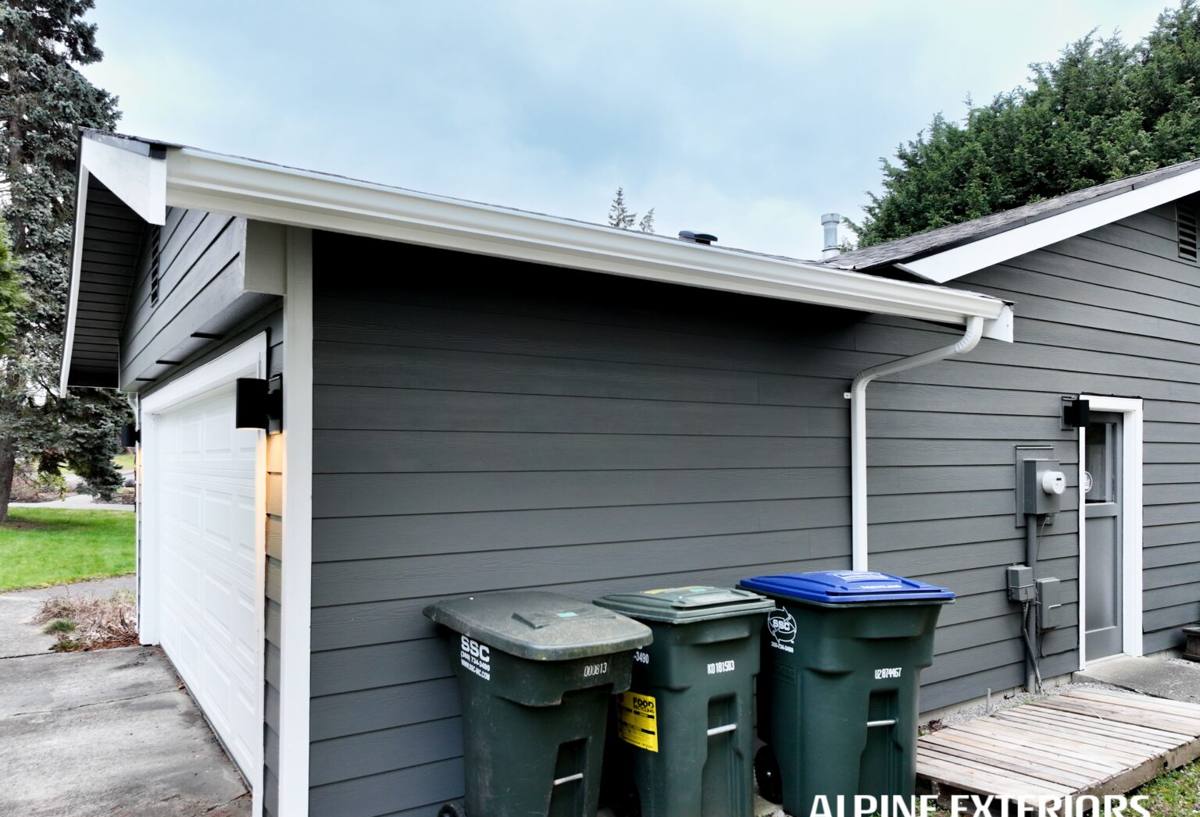
Given those conditions, the priority list for a Barkley home is straightforward: a siding material that doesn't absorb and hold water, a finish that resists mold and mildew growth rather than just hiding it, and an installation that manages water at every joint, corner, and penetration instead of hoping caulk will do the job forever. That's a materials question and an installation question — you need both right, not just one.
What a Correct Siding Installation Involves
Siding installation is often talked about like it's just cladding — panels going up over a wall. In a climate like this one, the parts you don't see matter more than the parts you do.
Weather-Resistive Barrier and Flashing
Before any siding goes up, the wall needs a continuous weather-resistive barrier, properly lapped so water always drains outward and down, never into a seam. Every window, door, and penetration needs flashing detailed to shed water past that opening, not toward it. This is the layer that actually keeps a house dry — the siding is the second line of defense, not the first.
Fastening and Gaps
Fiber cement siding needs to be fastened per the manufacturer's specifications for exposure and framing, with the correct nail type and placement to avoid splitting or overdriving. It also needs proper clearance at the bottom edge, at grade, and around trim so water and moss-holding debris don't sit against the material. Panels installed too tight, with no room to manage moisture, are one of the most common causes of early failure we see on homes that weren't originally installed to spec.
Finish Coatings
A factory-applied finish that's engineered to resist UV, moisture, and mildew will consistently outperform a field-painted finish over time, especially in a climate where the siding rarely gets a long dry stretch to fully cure a job-site coating.
Why We Install Only James Hardie Fiber Cement
We standardized on James Hardie fiber cement siding and don't install vinyl, LP SmartSide, or other fiber cement alternatives. It's a deliberate professional standard, not a sales pitch. Fiber cement doesn't absorb water the way engineered wood products can, and it's non-combustible, which matters to a lot of homeowners regardless of climate. Hardie's ColorPlus factory finish is built specifically to resist the fading, chipping, and mildew staining that field-applied paint struggles with in a wet, low-sun climate like ours, and their HZ5 product line is engineered for the freeze-thaw and moisture cycles typical of the Pacific Northwest. Combined with a strong transferable warranty, it's the system we're willing to put our name behind on a Barkley roof line.
Our Barkley Installation Process
- On-site evaluation. We look at the existing siding or sheathing condition, drainage around the foundation, tree cover and shade patterns, and any moisture or moss issues already showing up.
- Tear-off and substrate check. Old siding comes off and we inspect the sheathing underneath for rot or water damage before anything new goes up — this is where problems that have been hidden for years get caught.
- Weather barrier and flashing. A new, continuous weather-resistive barrier goes on with properly lapped and sealed flashing at every window, door, and penetration.
- Hardie panel or plank installation. Installed to manufacturer spec for fastening, clearance, and exposure, with attention to the details — inside corners, outside corners, and trim — that determine how well the system sheds water for the next several decades.
- Caulking and final detailing. Sealant is used where it belongs, not as a substitute for proper flashing underneath it.
- Walkthrough. We go over the finished job with the homeowner and cover basic care going forward.
Signs Your Current Siding Is Failing
A lot of Barkley homeowners call us after noticing one or two of these signs, not because they know exactly what's wrong but because something looks off:
- Soft or spongy spots when you press on the siding near the bottom edge or below windows
- Persistent moss or dark streaking that comes back within weeks of cleaning
- Paint or coating that's peeling, bubbling, or chalking unevenly
- Visible gaps, warping, or swelling at seams and corners
- Water stains or discoloration on interior walls near exterior corners
- Siding that feels damp or cool to the touch well after a dry stretch
Any one of these on its own isn't necessarily an emergency, but they're worth having looked at before the next wet season adds to the damage.
What Siding Installation Costs Depend On
We don't publish flat pricing because every home is different, but the main cost drivers are consistent from job to job:
| Factor | Why It Matters |
|---|---|
| Home size and wall complexity | More corners, gables, and trim details mean more labor and material cuts |
| Existing siding removal | Tear-off and disposal adds time and cost versus installing over new construction sheathing |
| Sheathing or framing repair | Hidden rot found during tear-off has to be fixed before new siding goes on |
| Product line and profile | Hardie plank, panel, and shingle-style profiles vary in material and labor cost |
| Trim and accessory scope | Fascia, soffit, and trim replacement alongside siding changes the total project size |
| Access and site conditions | Steep grades, tight lot lines, or heavy tree cover can affect staging and labor time |
An accurate number only comes from seeing the house in person, which is what a free estimate is for.
Why a Crew That Already Works Barkley Matters
Siding installation isn't a one-size-fits-all trade. A crew that's worked other homes in Barkley and similar Bellingham neighborhoods already understands the drainage patterns, the shade and moss dynamics on tree-lined lots, and how the local wind and rain direction tend to stress a wall. That familiarity shows up in small decisions on a job site — where extra flashing attention is worth it, which corners tend to take the most water, how much clearance to leave at grade — that a crew unfamiliar with this specific climate might not think twice about.
After Installation: Keeping Barkley Siding Looking Right
Correctly installed Hardie siding is low-maintenance, not no-maintenance. A little routine care keeps it performing the way it's designed to:
- Rinse siding down once or twice a year to keep moss, pollen, and grime from building up
- Trim back tree branches and shrubs that keep siding shaded and damp
- Keep gutters clear so overflow doesn't run down or pool against the wall
- Check caulking at trim and penetrations periodically and touch up if it's cracking
- Address any soft spots, staining, or coating damage early rather than waiting
If you're weighing a siding project on a Barkley home and want a straight answer about what your house actually needs, we're happy to take a look. Fill out the form below for a free, no-pressure estimate.