 Bellingham Roofing
 What Birchwood Homes Are Up Against
Birchwood sits close enough to Bellingham Bay and the Salish Sea that salt-laden air is a constant factor in how exterior materials age here, not an occasional nuisance. Add Whatcom County's long wet season — steady driving rain off the water for months at a stretch — and a climate that favors moss and algae on anything shaded or slow to dry, and you've got a punishing combination for siding. Wood fibers swell and split. Vinyl chalks and can warp in sustained damp-cold cycles. Caulk joints fail years before their rated life. None of this is dramatic on its own, but it compounds year after year, and it's why siding choice matters more in a neighborhood like Birchwood than it does in drier parts of the country.
The homes here run the range from older single-story ramblers to newer infill construction, many with mature tree cover that keeps north- and west-facing walls shaded and slow to dry after a storm. That shade is good for the trees and rough on siding — it's exactly the condition that lets moss and mildew get a foothold and keeps moisture sitting against a wall longer than it should.
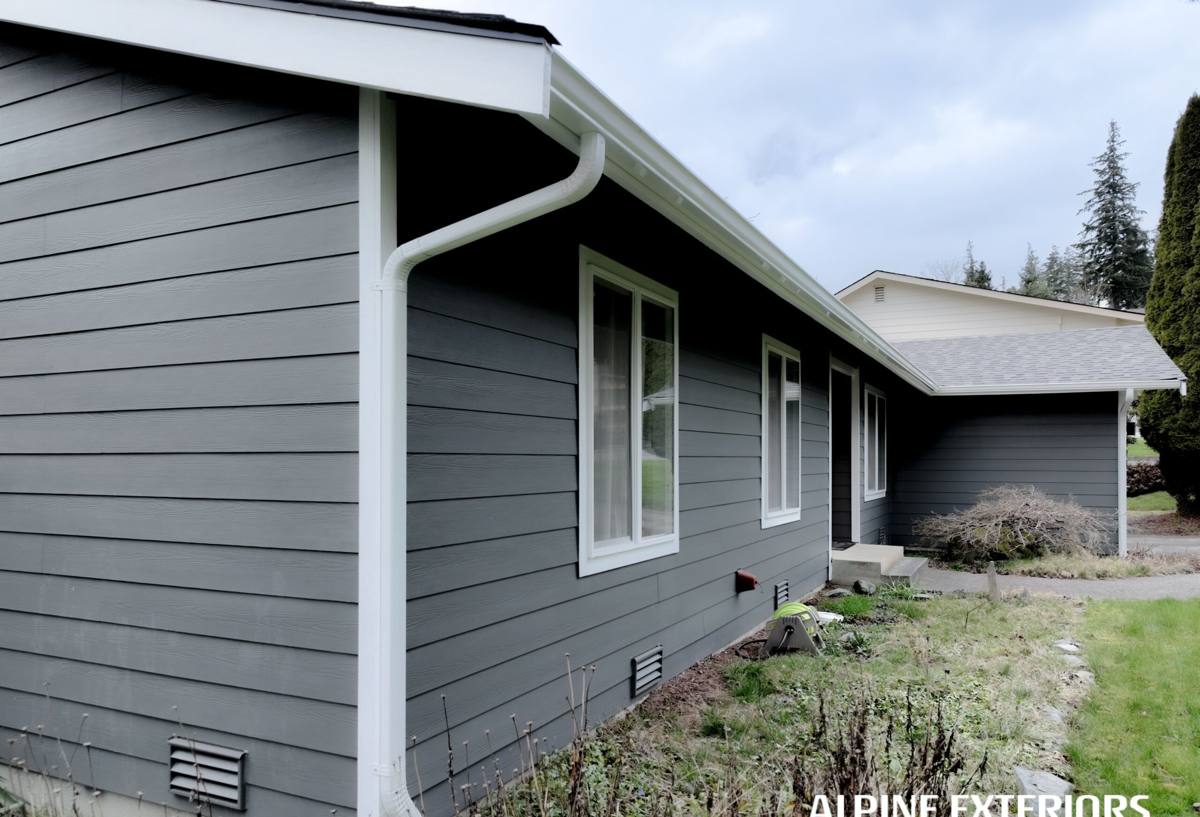
Why Fiber Cement Is the Right Material Here
Fiber cement siding is made from cellulose fiber, sand, and Portland cement, pressed and cured into planks and panels. Because it's cement-based rather than wood- or petroleum-based, it doesn't absorb water the way wood does, doesn't feed rot fungus, and doesn't become brittle or discolor under UV and salt exposure the way vinyl can. It also holds paint and factory finish far better over time than wood siding, which matters on a coastline where finishes take a beating from both sun and salt spray.
We get asked regularly why we don't install LP SmartSide, vinyl, or the lower-cost fiber cement alternatives like Cemplank or Allura. Those are legitimate products and each has a place — but we've standardized on one system for a reason:
- LP SmartSide is an engineered wood product. It performs well when detailing is perfect, but wood-strand cores are still wood — they're vulnerable at cut edges and butt joints if caulking and flashing aren't maintained, and Birchwood's rain load leaves little margin for error over decades.
- Vinyl siding is inexpensive and low-maintenance in the short term, but it's a thin plastic product that flexes, can crack in cold snaps, fades under UV, and simply doesn't have the mass or rigidity to stand up to sustained coastal weather the way fiber cement does.
- Other fiber cement brands (Cemplank, Allura) use similar core chemistry to James Hardie but don't offer the same factory-finish warranty structure, regional engineering, or track record we've come to rely on for coastal Pacific Northwest installs.
We're not saying these products fail — we're saying that after years of doing this work in Whatcom County's climate, we won't put our name on an install we're not fully confident will hold up. That's why we install James Hardie exclusively.
Why James Hardie Specifically
James Hardie engineers its siding by climate zone, and the HZ5 product line is built for regions like ours — sustained moisture, salt exposure, and freeze-thaw cycles. The fiber cement core is non-combustible, which matters increasingly for insurance underwriting, and it resists moisture intrusion, pest damage, and warping far better than wood-based or vinyl alternatives.
The factory finish, ColorPlus Technology, is baked on in a controlled environment rather than field-applied. That matters directly for Birchwood: field-applied paint has to cure in real weather, and a rainy stretch during a repaint can compromise adhesion. A factory finish avoids that risk entirely and holds color and sheen longer under salt air and UV than most site-applied paint jobs. James Hardie also backs its products with a strong transferable limited warranty — worth understanding in detail if you're comparing siding systems, since warranty terms vary widely between manufacturers and often hinge on installation being done to spec.
Product Lines We Use Most in This Area
| Product | Best Use | Why It Fits Birchwood |
|---|---|---|
| HardiePlank Lap Siding | Most home exteriors | Traditional look, HZ5 engineering for wet coastal climates |
| HardiePanel Vertical Siding | Accent walls, modern facades, gable ends | Clean lines, fewer horizontal joints for water to track along |
| HardieTrim | Corners, window and door trim, fascia | Matches durability of field siding so trim doesn't fail first |
| HardieSoffit | Eaves and overhangs | Resists the moisture and moss buildup common under shaded eaves |
What a Correct Installation Actually Involves
Fiber cement siding is only as good as the install behind it. Most siding failures we're called to look at in this area aren't material failures — they're installation shortcuts that let water get behind the cladding. Getting it right means:
Water Management First
Before a single plank goes up, the wall needs a correctly lapped weather-resistive barrier, properly integrated window and door flashing, and rainscreen or drainage-plane detailing where the wall assembly calls for it. In a climate with Bellingham's rainfall totals, the siding is the second line of defense, not the first — the drainage plane behind it is what actually keeps a wall dry over 30 years.
Fastening and Clearances
James Hardie specifies fastener type, spacing, and penetration depth by product and climate zone, and those specs aren't optional extras — they're what the warranty is conditioned on. Ground clearance, deck and patio clearance, and gaps at trim and flashing all need to meet minimum standards so the bottom edge of the siding isn't sitting in standing water or splash-back, which is a common problem on Birchwood lots with limited grade slope away from the foundation.
Joints, Caulking, and Touch-Up
Butt joints, corners, and penetrations (vents, hose bibs, light fixtures) are where most long-term leaks start. Correct caulking, factory-matched touch-up paint at cut edges, and proper joint treatment are what keep those points sealed through years of driving rain.
Our Process, Start to Finish
- Walk-through and assessment — we look at your current siding, wall assembly, moisture points, and any rot or shading issues specific to your lot.
- Written estimate — clear scope, product selections, and pricing, no surprise change orders for things we should have caught up front.
- Prep and tear-off — removal of old siding, inspection of sheathing for hidden rot (common on shaded walls in this neighborhood), and repair before anything new goes on.
- Weather barrier and flashing — the water management layer, done to spec, before siding installation begins.
- Hardie installation — fastened, spaced, and clearanced to manufacturer requirements and Whatcom County code.
- Final detailing — caulking, trim, touch-up paint matched to ColorPlus finish, and a final walk-through with you.
What Maintenance Looks Like Afterward
Fiber cement isn't zero-maintenance, but it's low-maintenance compared to wood, and more durable long-term than vinyl in this climate. A rinse-down once or twice a year keeps salt residue and moss spores from building up, especially on shaded elevations. Caulking at joints and penetrations should be checked periodically — it's the first thing to wear, not the siding itself. Because the ColorPlus finish is factory-applied, you're not looking at a repaint cycle every five to seven years the way you would with field-painted wood or fiber cement.
Signs Your Birchwood Home May Need New Siding
- Soft or spongy spots when you press on the siding, especially near the bottom edge or around windows
- Persistent moss or algae staining that comes back within weeks of cleaning
- Paint that's peeling, bubbling, or chalking heavily on shaded walls
- Visible gaps or separation at butt joints, corners, or trim
- Warping, cupping, or delamination on wood or engineered wood siding
- Rising energy bills that suggest the wall assembly is no longer sealing properly
Why Local Experience in Birchwood Matters
A crew that already works this neighborhood knows how the shade patterns from mature trees affect drying time on different elevations, how close to the water a given lot sits, and what typical grading and drainage issues look like on older Bellingham foundations. That's not something you can fully account for from a generic estimate — it comes from having done the work here before, on homes with the same rain exposure and the same moss pressure yours deals with every winter.
If you're weighing your options for siding in Birchwood, we're happy to walk your property, look at what your walls are actually dealing with, and give you a straightforward, no-pressure estimate — fill out the form below to get started.