 Bellingham Roofing
 Siding in Columbia Faces a Different Climate Than People Think
Columbia sits close enough to Bellingham Bay that homes here deal with a combination most siding products were never engineered for: salt-laden air off the water, long stretches of driving rain pushed in by Pacific storms, and a moss season that can run nine months out of the year in shaded, north-facing exposures. Whatcom County's marine climate is mild on temperature but relentless on moisture, and that combination is exactly what breaks down the wrong siding material years before it should fail.
Salt air accelerates corrosion on fasteners and trim hardware, and it holds moisture against a wall surface longer than dry inland air would. Driving rain — the kind that comes in sideways off the bay rather than straight down — tests every seam, joint, and piece of flashing on a house. And moss doesn't just grow on roofs. On siding, moss and algae take hold anywhere a wall stays damp and shaded, and once established they hold water against the surface constantly, which is a slow but steady path to rot on any wood-based product. A Columbia home needs a siding system that can shrug off all three at once, not just survive one of them.
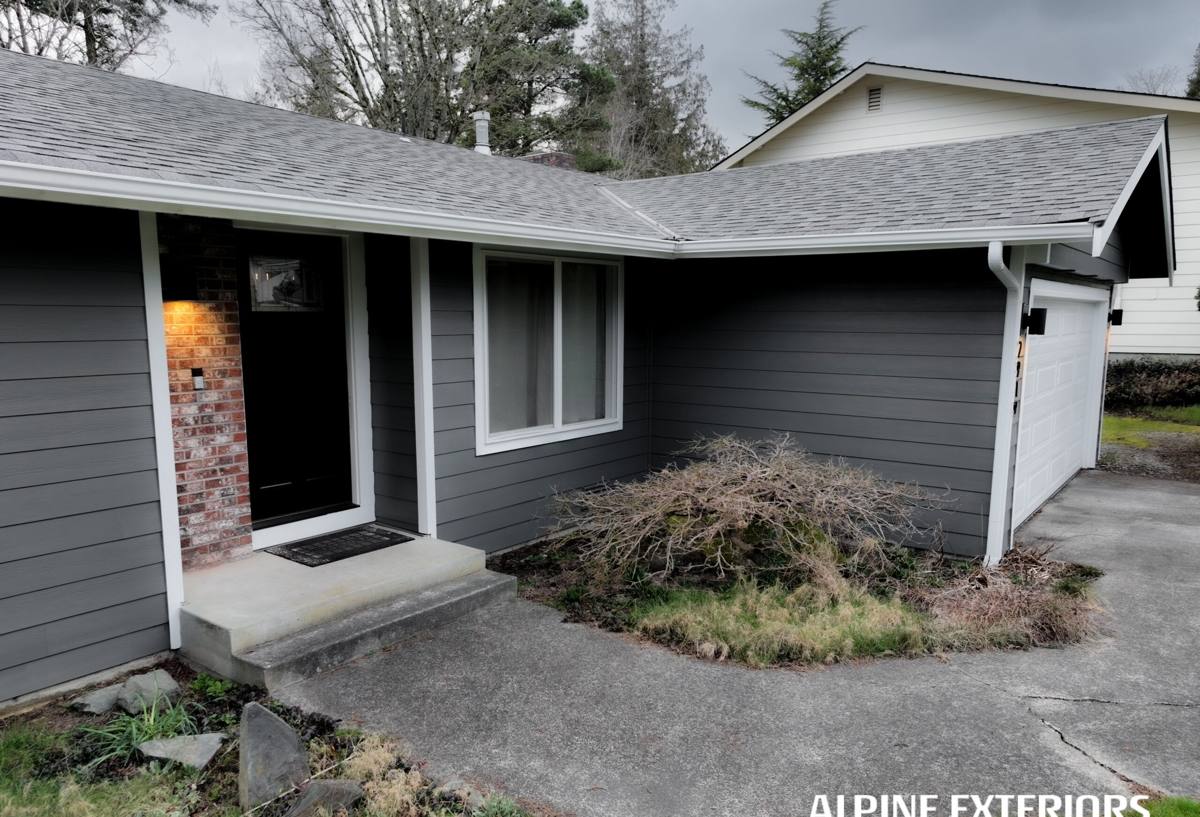
Why We Install Only James Hardie Fiber Cement
We standardized this company on James Hardie fiber cement siding and nothing else. We don't install vinyl, LP SmartSide, Cemplank, Allura, primed spruce, or cedar. That's not a marketing position — it's a decision based on what actually holds up in this climate over decades, not just the first few years.
Fiber cement is made from cement, sand, and cellulose fibers, which means it does not absorb water the way wood-based siding does and it will not rot. It's also non-combustible, which matters more each year as wildfire smoke and ember exposure become a bigger part of Pacific Northwest summers, even in a wet county like Whatcom. James Hardie's ColorPlus factory-applied finish is baked on under controlled conditions rather than field-painted, which gives it far better resistance to fading, chipping, and the kind of moisture-driven finish failure that shows up first on wood and engineered-wood products exposed to salt air and prolonged dampness.
What This Means Specifically for Columbia
- Non-combustible core — no risk of rot from trapped moisture the way wood or wood-composite siding can develop
- Factory finish holds color and integrity against salt air exposure better than field-applied paint
- Engineered moisture management in the panel system reduces the chance of water tracking behind the siding during driving rain
- Dense, stable material resists the surface breakdown that lets moss and algae get a foothold
- Backed by a strong, transferable manufacturer warranty when installed to Hardie's published specifications
What a Correct James Hardie Installation Actually Involves
Fiber cement siding is only as good as the installation behind it. James Hardie publishes detailed installation requirements, and skipping steps is the single biggest reason any siding job — Hardie or otherwise — fails early in a wet climate like ours. A correct job on a Columbia home includes several things that aren't optional, even though they're easy to shortcut if a crew is moving fast.
Weather-Resistive Barrier and Flashing
Every wall needs a continuous weather-resistive barrier behind the siding, with flashing detailed correctly at every window, door, and penetration. In a neighborhood taking direct driving rain off the bay, this layer is what actually keeps water out of the wall assembly — the siding itself is the first line of defense, not the only one.
Proper Clearances and Gaps
Hardie specifies minimum clearances from grade, roofing, decks, and other abutting surfaces, plus gaps at butt joints and around penetrations that allow the material to handle moisture and movement correctly. Get these wrong and you create the exact trap points where standing water sits against the board — which, ironically, is how you make even a rot-resistant product develop problems over time.
Fastening
Fasteners need to be corrosion-resistant and set to the correct depth and spacing — over-driven or under-driven nails are a common defect that shows up as cracking or loosening years later. Given the salt air in this area, using the right fastener material isn't a detail to skip; it's the difference between hardware that lasts the life of the siding and hardware that starts corroding within a decade.
Caulking and Joint Treatment
Joints, seams, and trim transitions need to be sealed per Hardie's specifications using compatible sealants. This is another place where rushed work shows up first — usually as hairline gaps that let water behind the panel long before anything looks visibly wrong from the ground.
Our Process for a Columbia Siding Project
We keep the process straightforward and we don't skip steps to move faster, because the steps are what make the warranty and the performance real.
- On-site assessment — we walk the exterior, check current siding and sheathing condition, note exposure to prevailing wind-driven rain and shaded moss-prone areas, and identify any wall assembly issues that need to be addressed before new siding goes on.
- Product and color selection — we help you choose the right Hardie board profile and HZ product line for your home's exposure, along with a ColorPlus finish that fits the look you want.
- Tear-off and wall prep — old siding comes off, sheathing is inspected and repaired as needed, and a new weather-resistive barrier goes on correctly before anything else happens.
- Flashing and detailing — windows, doors, and penetrations get flashed to spec, since this is the layer that does the real work keeping water out.
- Installation — Hardie boards are installed with correct clearances, fastener spacing, and joint treatment, following manufacturer specifications throughout.
- Final walkthrough — we review the finished job with you and confirm everything meets the standard needed to keep the manufacturer's warranty intact.
HZ5 Versus HZ10: Which Fits a Columbia Home
James Hardie engineers its HZ product lines for different climate zones, and Whatcom County generally falls into a zone where either HZ5 or HZ10 products are relevant depending on the home's specific exposure. The table below is a general guide — the right call depends on your home's orientation, shading, and proximity to the water.
| Factor | Lower Exposure Areas | High Exposure (Near Water, Shaded, Wind-Driven Rain) |
|---|---|---|
| Moisture exposure | Moderate | High — salt air and driving rain compound the effect |
| Moss/algae risk | Lower, more sun exposure | Higher — shaded, damp walls hold moss longer |
| Recommended approach | Standard HZ engineering, careful detailing | Prioritize flashing detail, drainage plane, and fastener corrosion resistance |
| Maintenance expectation | Periodic wash, standard inspection | More frequent moss/algae wash on shaded elevations |
What Happens When Siding Isn't Right for This Climate
We don't need to name specific products to explain the pattern homeowners run into with the wrong material in a marine climate like Columbia's. Vinyl siding can warp and become brittle under repeated wet-dry cycling and doesn't hold up structurally to wind-driven rain the way a rigid fiber cement panel does. Wood-based and engineered-wood products need consistent painting and sealing maintenance, and once moisture gets past a compromised seam or a spot where paint has worn thin, rot can set in and spread before it's visible from outside. Primed spruce and cedar both look good going up, but they carry an ongoing maintenance burden — repainting, resealing, checking for soft spots — that's harder to keep on top of with the amount of rain this area sees for most of the year. None of this means those products are junk; it means they ask more of the climate they're installed in than this climate wants to give back, and that's the trade-off we decided we didn't want to put on our customers' homes.
Maintenance Homeowners in Columbia Should Actually Expect
Even the right siding still needs some upkeep in a wet marine climate. Here's a realistic checklist for keeping a James Hardie installation performing the way it's designed to:
- Rinse siding periodically, especially on shaded north- and west-facing walls where moss and algae are most likely to establish
- Keep gutters clear so overflow doesn't run down and pool against siding at corners and trim
- Trim back landscaping that keeps a wall section shaded and damp longer than the rest of the house
- Inspect caulking at trim and joints every year or two and have any cracked sections resealed
- Watch for staining or discoloration near grade, which can signal splashback or a drainage issue worth addressing early
Why a Crew That Already Works Columbia Matters
Correct installation isn't abstract — it's specific to the conditions a house actually faces. A crew that's worked other homes in Columbia and the surrounding Bellingham waterfront-adjacent neighborhoods already knows which elevations tend to take the worst of the wind-driven rain, where moss problems show up first, and how to detail flashing so it holds against the kind of weather this area gets for most of the year. That local pattern recognition is the difference between a crew following a generic install checklist and one that's actually solving for Whatcom County's climate on every job.
It also matters for warranty support down the road. If a question comes up five or ten years after installation, working with a crew that's local, reachable, and has a track record in this specific area is worth more than a lower bid from a company that isn't going to be easy to reach later.
Get a Straightforward Estimate
If you're weighing a siding project on a Columbia home, we're happy to walk the exterior with you, talk through what your specific exposure calls for, and give you a straightforward estimate — no pressure, no upsell games. Use the form below to get started.