 Bellingham Roofing
 Why Ferndale Decks Wear Out Faster Than the Brochure Says
Ferndale sits close enough to the water and low enough in the valley that decks here take a different kind of beating than decks fifty miles inland. Salt-laden air off the bay corrodes fasteners and hardware years before a homeowner expects it. Driving rain off Bellingham Bay doesn't fall straight down — it comes in sideways against ledger boards and rim joists, finding the smallest gap in flashing or caulk. And Whatcom County's moss season isn't a few weeks in spring; on a shaded deck it can run from October through May, feeding on trapped moisture in decking grooves, fastener heads, and anywhere two boards meet without a drainage gap.
None of that means Ferndale is a bad place to have a deck. It means a deck built or repaired without accounting for this climate ages faster than it should. We've replaced plenty of decks that were structurally sound on the surface but rotten at the ledger, the footings, or the joist hangers — the parts nobody sees until they fail.
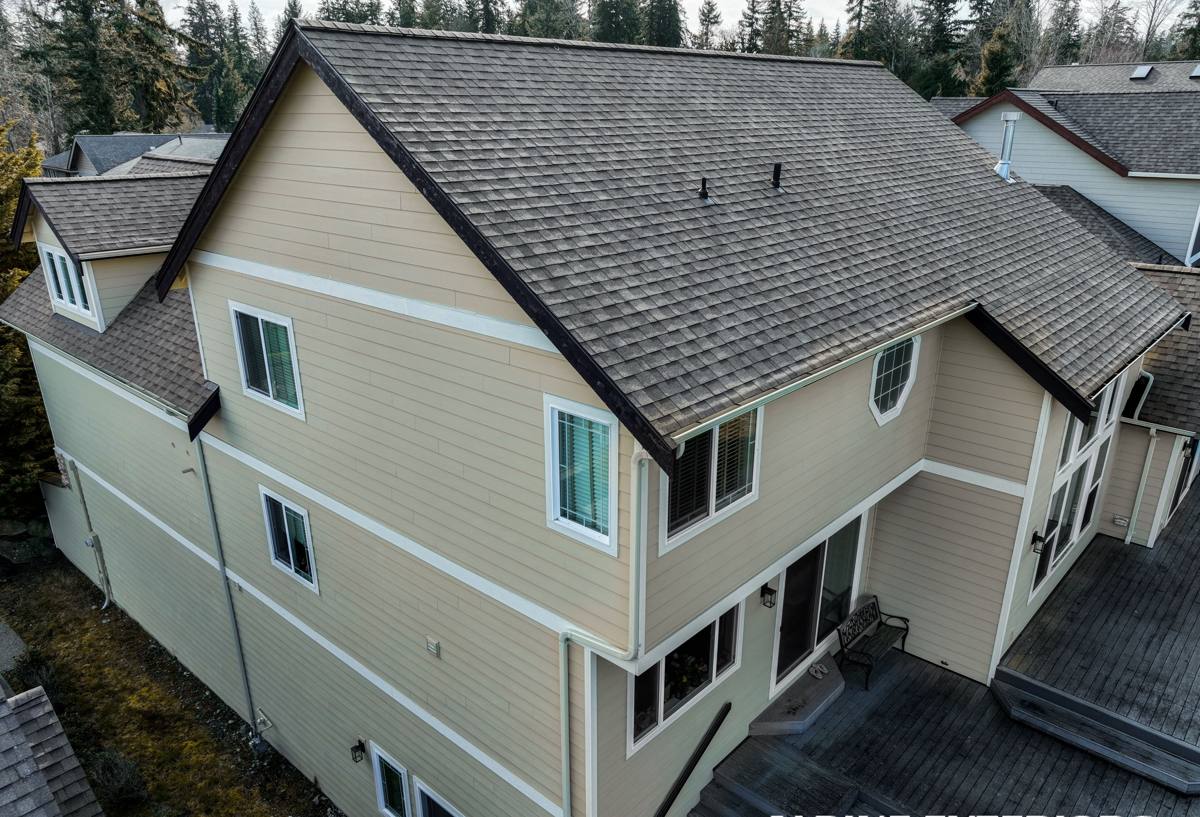
Signs a Deck Needs Replacing, Not Just Patching
Homeowners often call us for a repair and end up needing a replacement once we're under the boards. It's worth knowing the difference before you spend money on the wrong fix.
- Soft, spongy decking boards, especially near the house or in shaded corners — usually means moisture has been sitting there for more than one season
- Rust streaks running down from screw heads or joist hangers — a sign the galvanizing or coating has already failed
- Gaps or separation where the deck ledger meets the house — the single most common source of hidden rot in this region
- Visible mold or black staining that returns within weeks of cleaning
- Wobble or movement in the railing posts, which often points to post rot below the surface, not just a loose bolt
- A deck older than 15–20 years built with untreated fasteners or no flashing at the ledger — common on homes built before current code required it
If one or two boards are bad and the frame underneath is solid, a repair makes sense. If the ledger, joists, or footings are compromised, patching the surface just hides the problem for another season.
What a Correct Deck Replacement Actually Involves
A deck is only as good as the parts you never see once it's finished. Doing this right in a wet coastal climate means paying close attention to a few specific details.
Ledger and flashing
The ledger board — where the deck attaches to the house — is the number one failure point we find in this region. It needs proper flashing that directs water away from the house sheathing, not caulk alone. Caulk fails; flashing, installed correctly, doesn't rely on staying intact to keep water out.
Footings and posts
Whatcom County soil holds moisture longer than sandier ground further south, so footing depth and drainage matter. Posts need to sit on top of footings, not buried in contact with wet soil, and any hardware at the base should be rated for ground contact and exterior exposure.
Joists and hangers
We use hardware rated for the fastener and lumber combination, not mismatched pieces that can set up galvanic corrosion — a real issue when salt air is part of the equation. Joist tops get protected with a membrane strip so screws don't create a direct path for water into the wood grain.
Decking gaps and airflow
Boards installed too tight trap moisture and grow moss faster. Correct spacing, and where possible a substructure that allows airflow underneath, cuts down significantly on the moss and mildew buildup that's constant in shaded Ferndale yards.
Choosing a Decking Material for This Climate
There's no single "best" decking material — there's a best fit for your budget, your sun exposure, and how much upkeep you want to do. Here's how the common options compare for a wet, moss-prone climate like ours.
| Material | Moisture & moss resistance | Maintenance | Typical lifespan |
|---|---|---|---|
| Pressure-treated wood | Fair — needs sealing and regular moss removal | Annual cleaning, resealing every 2–3 years | 15–20 years with upkeep |
| Cedar | Good natural resistance, but still absorbs moisture over time | Cleaning and oiling every 1–2 years to hold color and resist rot | 15–20 years with upkeep |
| Composite decking | Very good — resists rot, but grooved profiles can still trap moss in shade | Periodic washing, no sealing or staining | 25–30 years |
| PVC / capped composite | Excellent — fully sealed surface sheds water and resists staining | Occasional washing | 25–30+ years |
For shaded Ferndale lots near tree cover, we often steer homeowners toward composite or capped PVC simply because the maintenance burden of wood in a moss-heavy microclimate adds up fast. That said, wood remains a good, honest choice for homeowners who want the look and don't mind the yearly care — it's a trade-off, not a defect in the material.
Our Deck Replacement Process
- On-site assessment. We check the ledger connection, footings, framing condition, and drainage before quoting anything — not just the visible decking.
- Written scope and estimate. You get a clear breakdown of what's being replaced, what materials are involved, and what it costs — no vague allowances.
- Permit handling. If your project requires a permit, we handle the paperwork and inspection scheduling with Whatcom County or the City of Ferndale as applicable.
- Demolition and disposal. Old decking, framing, and hardware are removed and hauled off — we don't leave debris on site.
- Framing and flashing first. The structural work — ledger flashing, footings, joists — gets done and, where required, inspected before any decking goes down.
- Decking and railing installation. Boards, fasteners, and railings are installed to spec, with attention to spacing for drainage and airflow.
- Final walkthrough. We go over the finished deck with you, including what maintenance it needs and what doesn't need attention for years.
Permits and Code Considerations Near Ferndale
Deck replacement projects that involve structural changes — new footings, a larger footprint, or railing height changes — typically require a permit. Ferndale falls under its own municipal permitting in some cases and county jurisdiction in others depending on the property, and code requirements around ledger attachment, guardrail height, and stair geometry have gotten more specific in recent years, largely because of exactly the ledger failures common in wet coastal climates. We handle this as part of the job rather than leaving it for the homeowner to sort out — skipping a required permit can create real problems at resale.
What Drives the Cost of a Deck Replacement
Every deck is different, but the same handful of factors move the price up or down. We give firm written estimates after seeing the site — not ballpark numbers over the phone — but this is what typically matters most.
| Cost factor | Why it matters |
|---|---|
| Square footage | The most direct driver of material and labor cost |
| Decking material | Composite and PVC cost more upfront than wood but less over the deck's lifetime |
| Framing condition | Rotten joists, posts, or footings found during demo add cost but prevent a deck that fails again in a few years |
| Height and access | Multi-level decks or decks with limited yard access take longer to build |
| Railing style | Cable, glass, and custom railing systems cost more than standard baluster railing |
| Permit requirements | Structural changes trigger inspections that add time but protect the investment |
Keeping a New Deck Ahead of Whatcom County's Weather
A well-built deck still needs some seasonal attention in this climate — the goal is to make that attention minor instead of constant. A short checklist we give every homeowner after a replacement:
- Sweep debris and standing leaves off the deck before fall rains set in — trapped leaves hold moisture against the boards
- Rinse off moss growth in shaded areas before it gets established, rather than after it's thick
- Check that gutters and downspouts near the deck are directing water away, not onto it
- Inspect railing posts and stair connections once a year for movement
- For wood decks, plan on cleaning and resealing on the schedule appropriate to the species
- Keep planters and furniture feet off direct board contact where water can pool underneath
Why a Bellingham Crew That Already Works Ferndale Matters
Deck replacement isn't exotic work, but doing it right in this specific climate takes more than a generic build. A crew that works Ferndale and the broader Bellingham area regularly knows which yards sit in near-constant shade, which properties catch the worst of the wind and salt air off the bay, and which permitting office to call for a given address. That local familiarity shows up in decisions a homeowner never sees — how deep a footing gets set, how much drainage gap to leave between boards, which flashing detail actually holds up through a Whatcom County winter. It's the difference between a deck that needs real work again in eight years and one that doesn't.
If your deck is showing rot, soft spots, or just isn't holding up the way it should, we're happy to take a look and give you a straightforward, no-pressure estimate — just fill out the form below.