 Bellingham Roofing
 Why Decks in Lynden Wear Out Faster Than Homeowners Expect
Lynden sits in a part of Whatcom County that gets a steady diet of fall and winter rain, low winter sun angles, and long stretches where a deck simply doesn't dry out between storms. Add in the mature trees and open farmland shade patterns common around Lynden properties, and you get a recipe for moss, algae, and slow wood decay that isn't always obvious from the surface. Many of the older decks we look at in this area were built to a standard that made sense decades ago but doesn't hold up to the moisture load we see now.
The broader marine influence that moves through Whatcom County — carrying salt-tinged air off the Sound on top of near-constant regional rainfall — accelerates corrosion on fasteners and hardware even at inland sites like Lynden. Combine that with freeze-thaw cycles in the colder months, and you get a slow, cumulative attack on framing, connectors, and ledger boards that a coat of stain or a few replaced boards won't fix once it's gone far enough.
What This Means for a Lynden Deck Specifically
Decks here need better drainage detailing, more corrosion-resistant fasteners, and framing that's sized and spaced to shed water fast rather than hold it. A deck built without those details might look fine for five or six years and then fail quickly once moisture finds its way into a ledger connection or a joist end.
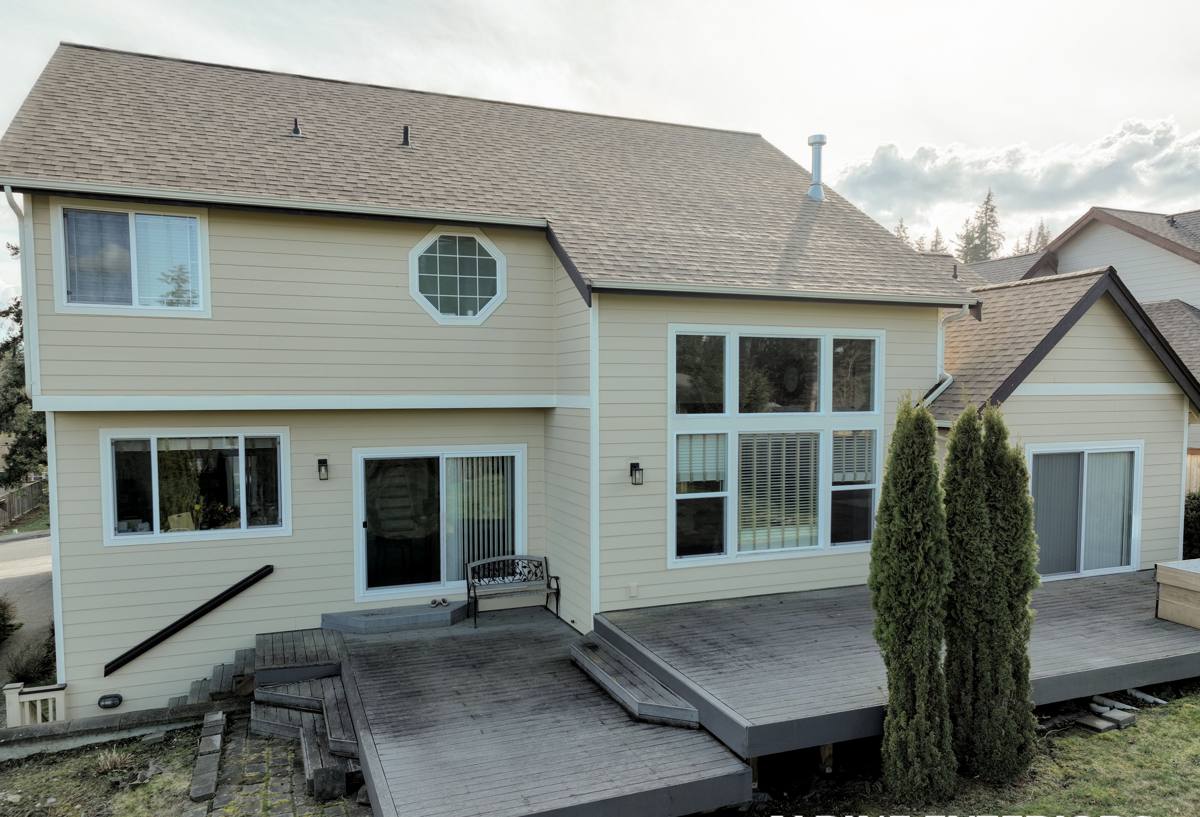
Signs a Lynden Deck Needs Replacement, Not Just Repair
Repair makes sense when the damage is isolated — a few soft boards, a loose railing, surface graying. Replacement becomes the honest recommendation when the problems are structural or systemic. Here's how we tell the difference on a typical inspection:
- Soft or spongy decking in multiple, unconnected areas — not just one board someone spilled water on
- Rust streaking or visibly corroded fasteners at the ledger, joist hangers, or railing posts
- A ledger board that's separating from the house, or flashing that's missing or improperly installed
- Persistent moss or black staining that returns within a season of cleaning, signaling the wood is staying wet longer than it should
- Posts or footings with visible movement, cracking, or rot at the base where they meet grade
- A deck older than 15–20 years built with untreated or undersized framing lumber
If what you're seeing is confined to the surface boards and the framing underneath is sound, a resurfacing or partial repair can be the right, more affordable call. We'll tell you honestly which situation you're in — we don't push a full replacement when a repair will genuinely hold.
What a Correct Deck Replacement Actually Involves
A deck that's going to hold up to Whatcom County weather isn't just new boards on old bones. A proper replacement addresses the whole system:
Ledger and Flashing
The ledger board — where the deck attaches to the house — is the single most common failure point we find on older decks. It needs correct flashing that directs water away from the house framing, not just caulk or paint covering a gap. This is also where a lot of hidden rot starts, because a bad ledger connection lets water into the house's rim joist, not just the deck.
Framing and Fasteners
Joists, beams, and posts should be sized for the actual span and load, spaced to avoid excess deflection, and installed with fasteners and hardware rated for the moisture exposure this area sees — not the cheapest galvanized option available. We use connectors and screws matched to whatever decking material goes on top, since mismatched metals can accelerate corrosion.
Footings
Footings need to sit below frost depth and bear on undisturbed or properly compacted soil. On older Lynden properties we sometimes find footings that were never poured to code, or posts sitting directly on grade — both of which lead to settling and the "bouncy" or uneven deck feel homeowners often notice first.
Drainage and Airflow
Water needs somewhere to go once it hits the deck surface, and air needs to move underneath it. Board spacing, joist tape, and grading beneath the deck all factor in. Skipping this is why so many decks in wetter climates develop rot from underneath before the surface ever shows damage.
Material Options for a Lynden Deck
There's no single "best" decking material — the right choice depends on your budget, how much upkeep you want to do, and how long you plan to stay in the house. Here's how the common options actually compare for this climate:
| Material | Upfront Cost | Maintenance | Moisture Performance Here |
|---|---|---|---|
| Pressure-treated wood | Lowest | Annual cleaning + periodic sealing/staining | Good if maintained; neglect leads to graying, splintering, and moss buildup |
| Cedar | Mid | Regular sealing to hold color and resist moisture | Naturally rot-resistant but still needs upkeep in a wet climate |
| Composite decking | Higher | Occasional washing, no staining/sealing | Very good — resists moisture and moss staining better than wood, though surface cleaning is still needed |
| PVC decking | Highest | Minimal — wash as needed | Excellent moisture resistance; best option for homeowners who want to skip yearly upkeep |
We're honest about trade-offs rather than pushing whatever has the best margin. Composite and PVC cost more upfront but save real time and money on maintenance over the years — that math works differently for a family planning to stay long-term versus someone getting a home ready to sell. Wood costs less to install but only performs well if someone actually keeps up with sealing and cleaning, which is a real commitment given how much moss pressure this region puts on exposed wood.
Our Deck Replacement Process
- On-site assessment — We inspect the existing deck's framing, ledger, footings, and any hidden moisture damage before quoting anything, not after demo has started.
- Honest scope and estimate — You get a clear written estimate that separates demolition, framing, decking material, railing, and any permit or inspection costs.
- Permitting — We handle the permit application and coordinate required inspections so you're not chasing paperwork.
- Demolition and disposal — Old decking, framing, and any rotted material are removed and hauled off the property.
- Rebuild — New footings (if needed), framing, ledger flashing, decking, and railing are installed to current code, with fasteners and hardware matched to your chosen material.
- Final walkthrough — We go over the finished deck with you, including basic care guidance for whatever material you chose.
Permits and Code in Whatcom County
Most deck replacements involving structural changes — new footings, altered framing, or a deck attached at a different height or footprint — require a permit and inspection under Whatcom County or City of Lynden building requirements, depending on your specific property location. Guardrail height, baluster spacing, and stair requirements are all governed by code, and these details matter for safety as well as for resale — an uninspected deck can become a problem when a home eventually goes on the market. We pull the required permits as part of the job rather than leaving that step to the homeowner.
Cost Factors to Understand Before You Get Quotes
Deck replacement costs vary widely based on size, material, and how much of the substructure needs rebuilding. Rather than quote a number that won't mean much without context, here's what actually drives the price:
| Factor | Why It Matters |
|---|---|
| Deck size and shape | Square footage and complexity (multiple levels, angles, built-in seating) directly affect labor and material |
| Decking material chosen | Composite and PVC cost more per square foot than pressure-treated wood but reduce long-term maintenance |
| Condition of the existing footings | Reusable footings save cost; footings that don't meet current code need to be replaced |
| Height and railing requirements | Taller decks need more substantial railings and may involve stairs, which add labor |
| Site access | Decks that are hard to reach with equipment take longer to demo and rebuild |
We'll walk your specific deck and give you a real number based on these factors rather than a generic per-square-foot rule of thumb that doesn't account for what's actually going on underneath your existing structure.
Why a Crew That Already Works in Lynden Matters
A contractor who regularly works in Lynden and the surrounding Whatcom County area already knows the local permitting process, has a working relationship with the inspectors, and understands how the local rain and moss patterns actually affect a deck over time — not just in theory. That familiarity shows up in small but important decisions: which flashing details hold up here, which fastener grades are worth the extra cost, and where drainage tends to be a problem based on typical lot grading in this area.
It also matters for follow-up. If a question comes up a year or two after the job — a squeak, a spot that's holding water, a railing that's loosened — a local crew is easy to reach and has a record of exactly what was built and how.
A Practical Checklist Before You Hire Anyone
- Get a written estimate that separates demolition, framing, decking, and railing costs
- Confirm the contractor is pulling the required permit, not leaving it to you
- Ask what fastener and hardware grade they use, and why
- Ask whether footings will be inspected or replaced if they don't meet current code
- Get proof of current licensing and insurance before any work begins
- Ask how they handle drainage and airflow underneath the new deck
If you're weighing repair versus replacement, or just want an honest read on what your current deck actually needs, we're happy to take a look. Fill out the form below for a free, no-pressure estimate.