 Bellingham Roofing
 Puget sits close enough to the water that its housing stock takes a steady, low-grade beating most inland Whatcom County neighborhoods don't deal with. Salt-tinged marine air moves through the neighborhood year-round, storms push rain sideways into wall and window assemblies rather than letting it fall straight down, and the tree cover and dampness common here support a moss and mildew season that can run most of the year on shaded elevations. Windows sit right at the center of all three of those pressures, and it shows up as failed seals, drafty frames, and heating bills that creep upward even though nothing looks obviously wrong from the curb.
Energy-efficient window replacement in Puget isn't just a matter of picking a higher-rated product off a spec sheet. The rating only holds up if the installation around it is built for this specific exposure. We treat this as a local job, not a generic one, because the climate here punishes shortcuts faster than it would somewhere drier and calmer.
What "Energy-Efficient" Actually Means for a Window
The term gets used loosely in sales conversations, but it refers to a specific, measurable set of properties. Understanding them helps you evaluate any window quote on its merits instead of taking a salesperson's word for it.
U-Factor
U-factor measures how much heat a window lets escape. Lower numbers mean better insulation. In a mild but consistently damp climate like Bellingham's, a low U-factor matters less for extreme cold than it does in a harsher inland climate, but it still affects how much your heating system has to work through the long, gray stretch of fall and winter.
Solar Heat Gain Coefficient (SHGC)
SHGC measures how much solar heat passes through the glass. On south- and west-facing walls that catch direct sun, a well-chosen SHGC helps balance natural warmth against summer overheating. On shaded or north-facing walls, common throughout Puget's tree-covered lots, SHGC matters less than air sealing and moisture management do.
Air Infiltration Rating
This measures how much air leaks through the window assembly itself, independent of the glass. A window with excellent glass performance but a poor air infiltration rating, or one installed with sloppy sealing, will still leak conditioned air and let moisture-laden outside air find its way in. In a neighborhood dealing with driving rain, this rating is arguably as important as the glass spec.
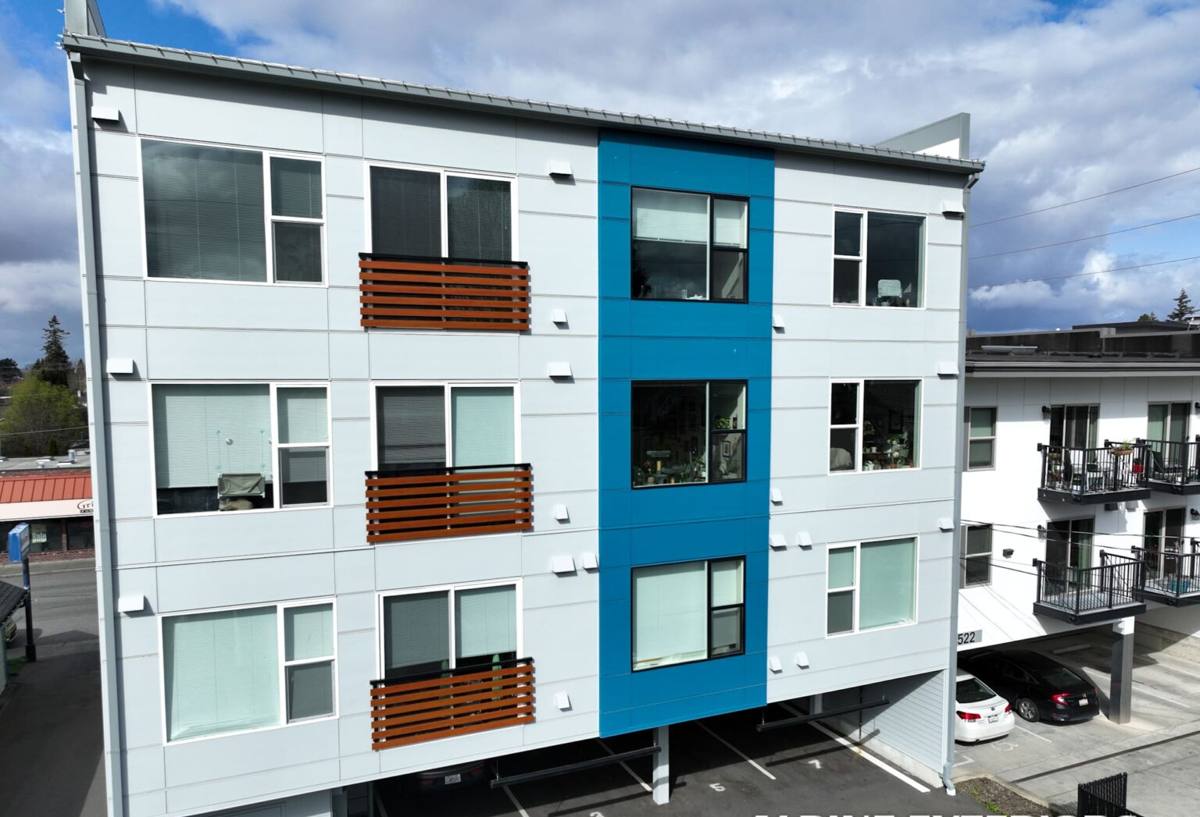
The Climate Factors Working Against Puget's Windows
Salt Air and Hardware Corrosion
Puget's proximity to the water means a steady flow of salt-laden air moving across the neighborhood, not just on days with an obvious storm. That kind of sustained exposure works on window hardware, screen frames, and lower-grade fasteners over years, corroding parts that a drier inland climate would leave alone. It's a slow, quiet failure mode that often isn't obvious until locks stick, cranks seize, or a frame starts to pit.
Driving Rain and Wind-Loaded Seams
Storms off the water push rain into this neighborhood at an angle instead of dropping it straight down, which means water gets forced into lap joints, sill seams, and flashing details that a purely vertical rainfall model wouldn't test. A window that would perform fine in a calmer climate can still let water in here specifically because the wind is driving it sideways into the assembly.
A Long Moss and Mildew Season
Mild temperatures combined with near-constant dampness give moss and mildew an extended growing season in Puget, and window sills, trim, and the framing around older units are common places it takes hold. Anywhere water sits instead of draining, or anywhere porous trim material stays damp, becomes a growth surface over time. Shaded elevations and windows tucked under eaves with poor drainage tend to show it first.
Frame Materials That Make Sense in This Climate
Frame material is one of the biggest factors in how well a window holds its energy performance over time, especially in a marine climate where moisture and salt exposure are constant rather than occasional.
| Frame Material | How It Performs Here | Trade-Offs |
|---|---|---|
| Vinyl | Doesn't corrode, low maintenance, competitively priced, solid energy performance in most configurations | Can flex in temperature swings if poorly reinforced; quality varies significantly between manufacturers |
| Fiberglass | Very stable dimensionally, holds paint and finish well, strong resistance to moisture and salt exposure | Higher upfront cost than vinyl |
| Wood, unclad | Traditional appearance, good insulating properties | Requires ongoing painting or sealing to keep moisture out; maintenance schedule is unforgiving in this climate |
| Wood-clad (exterior-clad in vinyl, aluminum, or fiberglass) | Interior wood look with a weather-resistant exterior shell | Performance depends heavily on how well the cladding is sealed at the joints; a good middle option when done right |
| Aluminum | Strong and slim-profile | Conducts heat and cold readily unless thermally broken; can promote condensation on interior surfaces in a damp climate |
We don't default to one frame material for every job. Vinyl and fiberglass tend to lead our recommendations for weather-facing openings in Puget because they don't corrode and hold their seal integrity longer under sustained moisture, but wood-clad options remain a legitimate choice when the interior look matters and the exterior cladding is detailed correctly. We'll walk through the honest trade-offs for your specific openings rather than pushing whatever's fastest to install.
Glass Packages Worth Paying For Here
Double-pane windows with a low-E coating and argon gas fill are the baseline for new construction and most replacements today, and they perform well in Bellingham's climate. Triple-pane glass adds another layer of insulation and sound dampening, which can be worth the added cost on a busy street or a wall facing prevailing weather, but it's rarely necessary on every opening in a home. Low-E coatings reflect infrared heat while still letting visible light through, which helps regulate interior temperature without darkening the room, and they're standard on any window worth installing today.
A Note on Gas Fill and Seal Life
Argon or krypton gas fill between panes improves insulating performance, but it depends entirely on the seal holding. Once a seal fails, the gas leaks out gradually and the insulating benefit drops even though the window may still look fine. This is one of the reasons seal and hardware warranties matter as much as the glass rating itself, especially in a climate that stresses seals harder than average.
What a Correct Installation Actually Involves
The energy rating printed on a window's label assumes a correctly installed unit. A poorly flashed or under-sealed installation can undercut even a high-performance window's real-world efficiency, and in a neighborhood dealing with wind-driven rain, a bad seal is also a moisture problem, not just an energy one.
Removal and Opening Assessment
We remove the old unit carefully and check the condition of the rough opening, sill, and surrounding framing before anything new goes in. This is often where hidden moisture damage from years of driving rain and a poorly sealed old window turns up, and it needs to be addressed before a new window can perform correctly.
Flashing and Weatherproofing Sequence
This is the step that matters most given Puget's exposure. Flashing has to be layered correctly, sill pans need to slope water outward instead of letting it pool, and house wrap needs to integrate with the window flange as one continuous water-management system rather than a series of separate steps. Skipping or rushing this sequence is the single most common reason a new window starts leaking within a few years of installation.
Air Sealing at the Frame
Proper low-expansion foam or backer rod and sealant around the frame perimeter closes the gap between the window unit and the rough opening. This is what actually delivers the air infiltration performance printed on the window's rating, and it's easy for a rushed crew to shortcut since it's invisible once trim goes back on.
Trim and Finish
Exterior trim gets integrated to shed water away from the window rather than channeling it toward seams, and interior trim is finished to match the rest of the room. On older Puget homes, this is also where trim or siding damaged by years of moisture around a failing old window often needs repair before the finish work can look right.
Signs Your Current Windows Are Losing Efficiency
- Visible condensation or fogging between panes, which usually means a failed seal and lost gas fill
- Noticeable drafts near the frame even with the window fully latched
- Sashes that are hard to open, close, or lock, often from hardware corrosion in this salt-exposed climate
- Soft or discolored trim and sill material, a sign moisture is getting behind the frame
- Moss or mildew building up on sills or trim faster than the rest of the house's exterior
- A noticeable temperature difference near the window compared to the rest of the room
- Rising heating costs without any other clear explanation
Our Process, Start to Finish
- On-site assessment — we evaluate each opening's condition, exposure, and existing performance issues before recommending anything
- Honest product recommendation — frame material, glass package, and pane configuration matched to each opening's exposure and your budget, explained plainly
- Ordering and scheduling — realistic lead times set upfront, since we'd rather tell you honestly than promise a date we can't hit
- Careful removal and opening prep — old units come out cleanly, and any hidden moisture or framing issues get addressed before the new window goes in
- Installation, flashing, and air sealing — built around a sequence suited to this specific climate, not a generic manufacturer template
- Trim and finish — exterior and interior trim completed to match the rest of the home
Cost Factors Worth Understanding Before You Get Quotes
| Factor | Why It Moves the Price |
|---|---|
| Frame material | Vinyl generally costs less than fiberglass or wood-clad options; each has different long-term maintenance implications |
| Glass package | Triple-pane and specialty low-E coatings add cost over a standard double-pane low-E unit |
| Number of openings | Ordering multiple windows together often improves per-unit pricing versus doing them one at a time |
| Opening condition | Hidden rot or framing damage found during removal adds repair cost that a quote can't predict in advance |
| Full-frame vs. insert replacement | Insert replacements are typically less expensive but only appropriate when the existing frame is sound |
| Custom sizing | Non-standard openings, common in older Puget homes, cost more than stock sizes due to manufacturing lead time and complexity |
We won't quote a number without seeing the openings in person, but we'll walk through which of these factors actually apply to your home before you commit to anything.
Why a Crew That Already Works Puget Matters
Manufacturer installation guidance is written for average conditions in a moderate climate, and Puget's exposure to salt air, driving rain, and a long moss season doesn't match that description particularly well. A crew that has actually flashed openings, sealed sills, and matched trim on homes in this specific neighborhood knows which parts of a standard installation guide are non-negotiable here and where extra time on flashing or sealant pays for itself even when it isn't strictly required elsewhere.
That experience shows up in decisions that rarely come up in a sales pitch: how much lap a flashing course needs given the wind exposure on a given elevation, when a sill needs a sloped composite cap instead of relying on caulk alone, and which frame materials hold up best against this particular combination of salt and sustained moisture. Those details decide whether new windows are still performing efficiently and drying correctly in fifteen years or showing drafts and soft trim in five.
Questions Worth Asking Before You Hire
- Ask how they sequence flashing and sill pan installation for this climate specifically
- Confirm current Washington contractor licensing and insurance
- Ask what's covered under warranty for the window unit versus the installation labor, since they're often separate
- Get a written scope of work before signing anything, including which openings are full-frame versus insert replacements
- Ask how they handle hidden moisture or framing damage found during removal, and how that affects the price
If your windows in Puget are drafty, fogging between the panes, or just costing more to heat around than they should, it's worth having someone look at the actual openings before you start comparing quotes. We offer free, no-pressure estimates for energy-efficient window replacement in Puget and the surrounding Bellingham area — use the form below to get a time on the schedule.