 Bellingham Roofing
 Barkley Sits Right in the Path of Whatcom County's Toughest Weather
Barkley homes take on a specific combination of exterior stress: salt-laden air drifting in off the water, rain that arrives sideways more often than straight down, and a moss season long enough that shaded walls rarely get a real chance to dry out. None of these three factors is unusual on its own for Whatcom County. What makes siding decisions in Barkley worth thinking through carefully is how long and how consistently a home's exterior has to withstand all three at once, year after year, without much of a break.
This page is specifically about James Hardie fiber cement siding on Barkley homes — the product itself, what a correct installation actually requires here, and how we run a project from first estimate to finished trim. We install James Hardie exclusively, and this page goes into why that holds up in this specific setting, not just as a general climate argument but down to fastener choice, flashing detail, and which Hardie product line fits which kind of Barkley home.
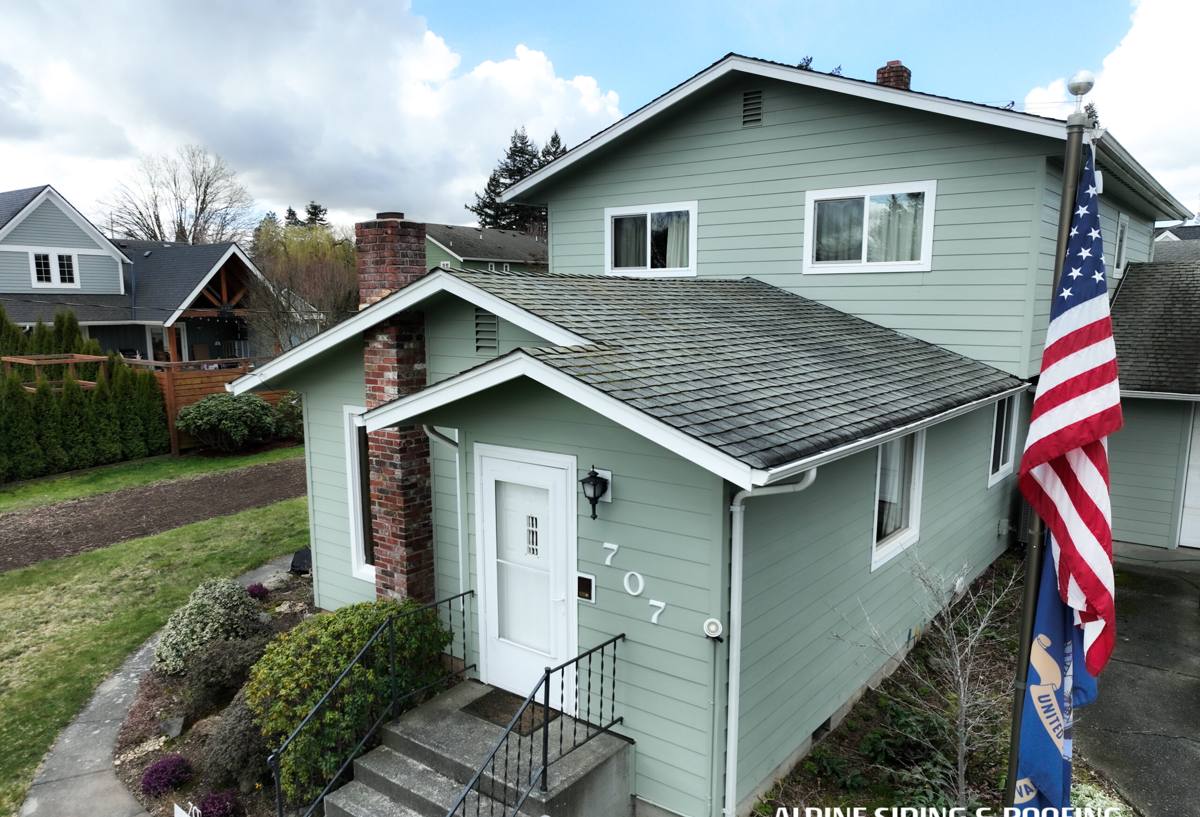
What Correct James Hardie Installation Requires in This Climate
James Hardie fiber cement is engineered to resist moisture, hold a factory finish, and stay dimensionally stable through temperature and humidity swings — but none of that performance is automatic. It depends entirely on installation details that are easy to shortcut and hard to notice from the ground once the siding is up. In a climate that tests every gap and seam as hard as Barkley's does, those details are the difference between siding that performs for decades and siding that looks fine for a season or two before problems start showing up at the edges.
Fastening
Hardie specifies particular fastener types, materials, and spacing for a reason: the wrong fastener corrodes faster in salt-laden air, and fasteners driven too tight or too loose both create long-term problems — either cracking the board around the fastener head or leaving room for the plank to work loose over years of wind exposure. We fasten to Hardie's published specifications for this exposure category, not a generic pattern.
Flashing and Water Management
Wind-driven rain doesn't behave like rain in a calmer climate. It gets pushed into laps, up under trim, and into any window or door opening that isn't flashed correctly, rather than simply running down the face of the wall. Every penetration — windows, doors, hose bibs, vents — needs flashing detailed so water is directed back out, not trapped behind the cladding where it can sit against the weather-resistive barrier indefinitely.
Clearance and Ventilation
Siding installed too close to grade, a roofline, or a deck surface stays wet longer than siding with proper clearance, and that matters more in a climate where the ground and lower courses rarely get a long dry stretch. We also pay attention to which walls on a given Barkley property are shaded or north-facing, since those are the walls that stay damp longest and are first to show moss.
Choosing the Right Hardie Product Line for Your Home
James Hardie makes more than one product, and picking the right one for a specific Barkley home depends on the home's style, exposure, and the look a homeowner actually wants — not just defaulting to whatever's most common.
| Product Line | Best Fit For | Notes |
|---|---|---|
| HardiePlank lap siding | Most traditional and craftsman-style Barkley homes | The most common choice; available in several exposure widths and textures |
| HardiePanel vertical siding | Modern builds, accent walls, gable ends | Often paired with lap siding for a mixed-material look |
| HardieShingle | Homes wanting a cedar-shake look without the maintenance | Mimics staggered or straight-edge shingle patterns |
| HardieTrim boards | Corners, fascia, window and door casing | Matches the siding's factory finish and moisture resistance at every edge |
We also specify Hardie's HZ5 formulation for this region rather than a generic national product. Hardie engineers its HZ product lines around regional climate zones, and HZ5 is built for the moisture exposure and freeze-thaw cycling that Pacific Northwest coastal properties, including Barkley, actually experience.
ColorPlus Factory Finish
ColorPlus is a factory-applied, baked-on finish, as opposed to a coat of paint applied on-site after installation. That distinction matters more here than in a drier climate: field-applied paint has to be reapplied on a cycle, and every repaint is another chance for moisture to get behind the finish during the process. A factory finish cured under controlled conditions holds its color and resists the fading and chalking that constant dampness and UV cycling cause, and it comes with its own warranty coverage separate from the substrate.
Our Process for a Barkley James Hardie Project
We run every project through the same sequence, adjusted for the specifics of the property, so nothing gets skipped between the first walkthrough and the final punch list.
- Initial assessment: We walk the property, look at current siding condition, check for existing moisture damage at trim, corners, and penetrations, and talk through what the homeowner wants out of the project.
- Product and color selection: We help narrow down the right HardiePlank, HardiePanel, or HardieShingle configuration and ColorPlus color for the home's style and exposure.
- Tear-off and substrate check: Old siding comes off and we inspect the sheathing and weather-resistive barrier underneath before anything new goes up — this is often where hidden moisture damage from a prior installation shows up.
- Weather-resistive barrier and flashing: House wrap is lapped and sealed correctly, and flashing is installed at every window, door, and penetration before siding starts.
- Installation: Siding, trim, and any transitions between products are installed to Hardie's fastening, clearance, and joint specifications for this climate zone.
- Final walkthrough: We inspect the finished work with the homeowner, address any punch-list items, and go over care and maintenance specific to the product installed.
What Drives Cost on a Barkley Hardie Project
Every property is different, so we don't quote a number without seeing the home, but the same handful of factors move the price on most Barkley projects.
| Cost Factor | Why It Matters |
|---|---|
| Substrate condition | Hidden rot or water damage found at tear-off adds repair work before new siding can go on |
| Home size and complexity | More corners, gables, and window openings mean more trim, flashing, and cut waste |
| Product mix | Combining lap siding with panel or shingle accents costs more than a single product throughout |
| Color and texture selection | Standard ColorPlus colors are typically less costly than premium or custom-matched finishes |
| Access and site conditions | Steep lots, limited driveway access, or tall walls affect staging and labor time |
What to Confirm Before Hiring Anyone for a Hardie Installation
Not every contractor who says they install James Hardie installs it to the same standard. Before hiring, it's worth confirming a few specifics:
- Current Washington state contractor license and active insurance
- Familiarity with Hardie's published fastening and clearance specifications, not just general siding experience
- A clear answer on which HZ product formulation they'd specify for a Barkley property
- How they handle flashing at windows, doors, and penetrations specifically
- Whether they inspect and repair substrate issues before installing new siding, rather than covering them up
- A written estimate that separates material, labor, and any substrate repair contingency
Why a Crew That Already Works Barkley Matters
A lot of what separates a siding job that lasts from one that doesn't comes down to judgment calls made on-site, not anything written in a spec sheet. Knowing which walls on a typical Barkley lot take the most wind-driven rain, where moss tends to establish first based on shade and tree cover, and how much clearance a given foundation and grade actually needs isn't something a crew picks up from a single job. It comes from doing this work in this specific area repeatedly and paying attention to how earlier installations held up.
That familiarity shows up in details homeowners rarely notice directly — where flashing gets an extra lap, where a fastener pattern gets tightened up for a more exposed wall — but it's exactly what determines whether the siding still looks and performs the way it should ten or twenty years out.
Warranty and Long-Term Performance
James Hardie backs its fiber cement substrate and its ColorPlus factory finish with separate manufacturer warranties, and that coverage is transferable if the home sells within the warranty period — a detail that matters to buyers and appraisers alike. Warranty coverage assumes installation to Hardie's specifications, which is part of why we treat those specifications as non-negotiable rather than a flexible guideline. Correct installation is what keeps both the product warranty valid and the siding performing the way it's engineered to through a full range of Barkley weather, not just on install day.
If you're planning a siding project on a Barkley home, we're glad to take a look and give you a straightforward, no-pressure estimate — reach out using the form below.