 Bellingham Roofing
 Siding Replacement Built for Birchwood's Climate
Siding in Birchwood doesn't fail because a homeowner did anything wrong. It fails because the material or the installation underneath it was never really built for what this part of Whatcom County throws at a wall year after year. Salt-tinged air drifting in off the water works on fasteners, trim, and factory finishes long before anyone notices a problem from the ground. Rain here rarely falls straight down for long stretches of the year — it gets driven sideways and forced into seams, laps, and trim joints that a drier climate's siding was never designed to handle. And on shaded, tree-lined lots, which describes a lot of Birchwood properties, moss and mildew settle in for a long season and don't let go until well into the warmer months. None of that means siding is a losing battle here. It means the replacement has to be planned and installed by people who are actually accounting for those three conditions, not treating the job like it's going on a house in a different climate.
This page is about what a correct siding replacement looks like specifically for a home in Birchwood — what local conditions demand from the material and the install, how our process runs from the first walk-through to the final cleanup, and why we've standardized on one product rather than offering a menu of options.
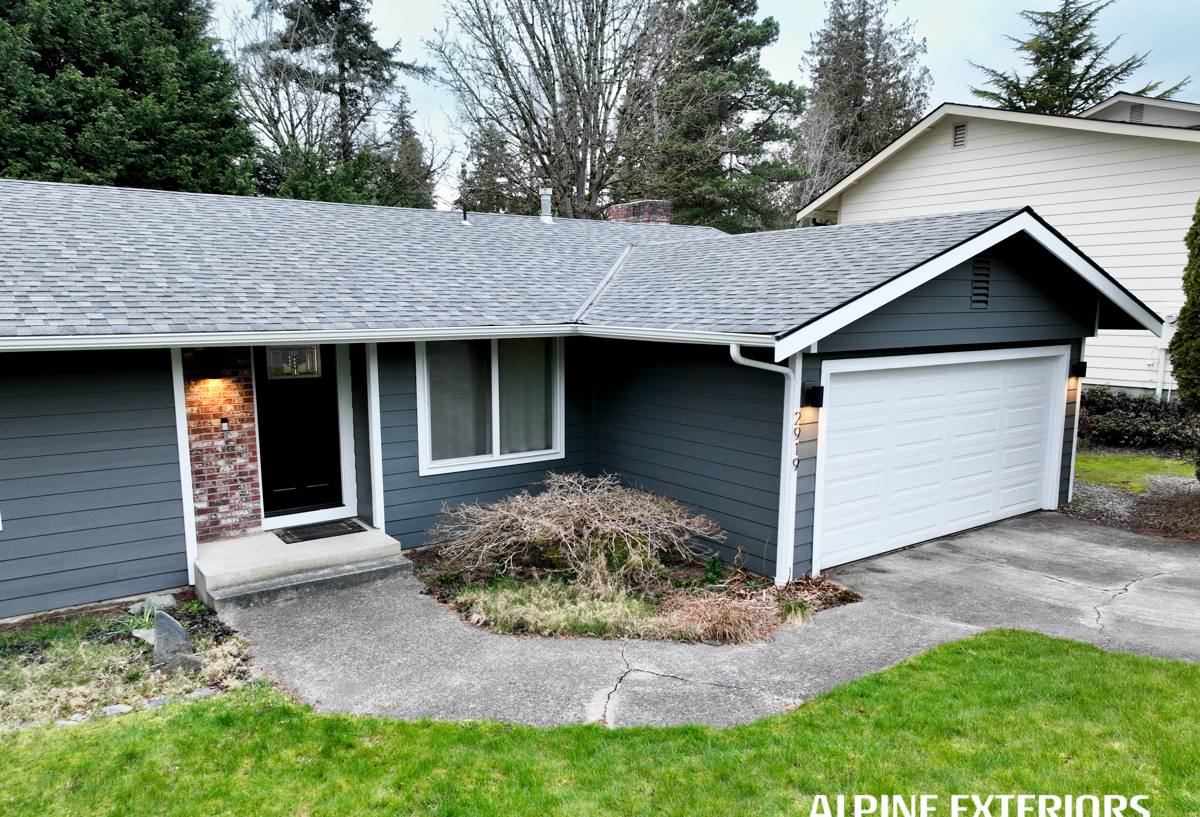
Why We Install Only James Hardie Fiber Cement
We used to install a wider range of siding products. Years of tear-offs and service calls in this specific stretch of Whatcom County changed that. Wood-based and engineered-wood siding depends on an intact factory coating to keep moisture out, and once that coating is compromised at a cut edge, a fastener hole, or a joint that wasn't sealed quite right, water gets in and the substrate underneath starts to break down — slowly, in a way that isn't obvious until the damage is already advanced. Vinyl siding is low-maintenance in the sense that it doesn't rot, but it's a thin, flexible material that can warp, crack in cold snaps, and fade unevenly over time, and it doesn't offer the same fire performance or resale expectations that many Birchwood homeowners are looking for.
James Hardie fiber cement is a cement-and-cellulose composite that doesn't share those failure modes. It's non-combustible, it doesn't swell or rot when it takes on moisture at a cut edge the way wood-based products can, and Hardie's ColorPlus factory finish is baked on rather than field-sprayed, which matters directly in a climate where UV exposure and salt air are both working against a painted surface. Hardie also engineers its HZ5 product line specifically for climates like the Pacific Northwest's — cooler, wetter conditions with real freeze-thaw cycling — rather than shipping one formulation everywhere. That climate-specific engineering, backed by a real transferable warranty, is the reason we stopped installing anything else. We're not going to claim other products are worthless; plenty of homes around the region have vinyl or engineered wood on them and get by fine. We just decided we could only fully stand behind one system, and this is the one we chose.
What That Means in Practice
It means every estimate we write for a Birchwood home names a specific Hardie product and profile, not a vague line item that just says "siding." It also means we turn down jobs where a homeowner wants a product outside that lineup — not because we can't physically install it, but because we're not willing to put our name behind an installation we don't believe will hold up to this climate for the long haul.
What a Correct Siding Replacement Actually Involves
Siding replacement isn't just stripping the old material off and nailing up new panels. Done correctly, it's a layered system, and each layer is doing a specific job that matters more here than it would in a milder, drier market.
Tear-Off and Sheathing Inspection
A full tear-off down to the sheathing is the only way to actually find rot, soft spots, or hidden moisture damage that's been developing quietly behind the old siding, sometimes for years. Installing new siding directly over an existing layer skips this step entirely and just seals whatever problems already exist underneath a fresh surface — which, on a home that's absorbed a decade or more of driving rain, is a real risk rather than a theoretical one.
Weather-Resistive Barrier and Flashing
A properly lapped weather-resistive barrier behind the siding, integrated with flashing at every window, door, and wall penetration, is what actually keeps wind-driven rain from reaching the sheathing even when water does get past the siding's outer surface. Most siding failures we've seen don't start in the open field of the wall — they start at a window flashing detail or a trim intersection that wasn't built as part of the water management system, just caulked over after the fact.
Fastening, Gaps, and Caulking Discipline
Hardie siding has to be fastened per manufacturer specification, with the correct nail type, spacing, and clearance from butt joints, and it needs proper gapping at trim and penetrations to allow for the material's normal expansion and contraction. Caulking has its place at specific joints, but it's not a substitute for correct flashing and gapping — a bead of sealant covering a detail that wasn't built right the first time is exactly the kind of shortcut that fails quietly over a few winters.
Comparing James Hardie Product Lines for Birchwood Homes
Hardie's lineup covers a range of looks and applications, and the right choice usually comes down to the home's existing style, how much of the exterior sits in shade, and how much trim and accent work is involved.
| Product Line | Best For | Why It Fits Birchwood |
|---|---|---|
| HardiePlank Lap Siding | Traditional horizontal lap look, the most common choice on Whatcom County homes | HZ5 formulation is engineered for cooler, wetter Pacific Northwest conditions and freeze-thaw cycling |
| HardiePanel Vertical Siding | Board-and-batten or modern vertical styling, gable ends and accent walls | Handles driving rain well on exposed elevations when flashed and gapped correctly |
| HardieShingle | A traditional shingle look without cedar's ongoing upkeep | Popular where homeowners want a Pacific Northwest aesthetic with less long-term maintenance against moss |
| HardieTrim | Corner boards, fascia, window and door trim | Non-combustible trim that won't absorb water or rot at the most exposed edges of the home |
Color is worth planning for as well. Hardie's ColorPlus finishes are factory-applied and come pre-matched across siding, trim, and soffit material, which keeps the whole exterior looking uniform and holds up better against salt air and UV exposure than a field-applied paint job typically does.
Cost Factors Worth Understanding
Two bids for the same Birchwood home can land thousands of dollars apart, and the gap is almost always real differences in scope rather than one contractor simply padding the number. Knowing what drives cost makes it much easier to compare estimates that look nothing alike on paper.
| Factor | What It Affects |
|---|---|
| Home size and number of stories | Total material quantity and labor hours, plus staging needs on taller walls |
| Existing siding removal | Whether hidden sheathing damage gets found and repaired before new siding goes up |
| Sheathing and rot repair scope | Can vary significantly once old siding comes off and the wall is actually exposed |
| Trim, corner, and soffit work | How much of the surrounding trim system gets replaced alongside the field siding |
| Product line and profile | Lap width, panel style, and factory finish selection |
| Site access and lot conditions | Tree cover, tight setbacks, and multi-story walls affect staging and labor time |
A written estimate that breaks these items out line by line tells you far more than a single lump-sum number. It's worth asking any contractor to walk you through exactly what's included before comparing two prices side by side.
Signs Your Birchwood Home May Need Siding Replacement Now
Siding rarely fails all at once. It gives warning signs first, often well before water damage shows up inside the house, and catching those signs early is frequently the difference between a repair and a full replacement.
- Soft or spongy spots when you press on the siding, which usually points to moisture that's already reached the substrate underneath
- Paint that won't hold anymore, peeling or bubbling repeatedly even after being redone
- Visible warping, buckling, or separation at panel edges and seams
- Moss or algae staining that keeps coming back within a season or two of being cleaned
- Gaps at trim or seams where daylight or drafts are noticeable from inside
- A noticeable rise in heating costs that isn't explained by anything else, which can point to compromised insulation behind failing siding
If any of this sounds familiar, it's worth having the exterior looked at before the next stretch of wet weather rather than waiting for interior damage to force the decision.
Our Siding Replacement Process, Start to Finish
We keep the process straightforward because a project this size on your home deserves clear communication at every stage, not surprises partway through.
- In-person assessment: We walk the exterior with you and look at the current siding, trim, and any visible problem areas ourselves, rather than estimating from photos.
- Written estimate and product selection: You get an itemized bid naming the specific Hardie product, profile, and color, along with tear-off, sheathing repair allowance, and trim scope.
- Scheduling around weather: We build reasonable flexibility into the timeline, since wet-season delays are a normal part of working in this region rather than an excuse we reach for later.
- Full tear-off and sheathing repair: Old siding comes off completely, and any rot or moisture damage we find gets repaired before anything new goes up.
- Weather-resistive barrier and flashing: Housewrap and flashing go in at every window, door, and penetration as an integrated system, not an afterthought.
- Hardie siding and trim installation: Panels and trim go on to manufacturer specification for fastening, gapping, and clearance.
- Final walkthrough and cleanup: We review the finished exterior with you in person and do a full site cleanup before we consider the job done.
Why Hiring a Crew That Already Works in Birchwood Matters
A crew that regularly works siding jobs in and around Birchwood has already seen how salt-laden air corrodes underspecified fasteners, how wind-driven rain finds its way through a poorly lapped weather barrier, and which elevations and lots hold moss longest through the wet months. That's practical, earned knowledge that shows up in dozens of small decisions over the course of a job — decisions a crew unfamiliar with this specific stretch of coastline might not think to make at all.
It also matters after the job wraps up. A workmanship warranty is only as good as the company standing behind it years later, and a contractor with an established, ongoing presence in Bellingham and the surrounding area is one you can actually reach if a question comes up down the road, not a name that's moved on somewhere else.
A Practical Checklist Before You Choose a Siding Contractor
- Do they perform a full tear-off with sheathing inspection, not an install-over-existing shortcut?
- Does the estimate name a specific Hardie product line and profile, not just "fiber cement siding"?
- Is weather-resistive barrier and flashing work explicitly written into the bid?
- Do they carry current WA contractor licensing, liability insurance, and workers' compensation?
- Can they point to recent, real siding work in or near Birchwood?
- Does the bid clearly separate Hardie's manufacturer material warranty from the contractor's own workmanship warranty?
Caring for Hardie Siding Through Moss Season
One advantage of switching to fiber cement is how little ongoing maintenance it actually needs compared to wood-based siding, but "low-maintenance" isn't "no-maintenance," especially through a Birchwood moss season that runs long. Keeping gutters and downspouts clear keeps water from sheeting down the wall face and feeding moss growth at the top courses of siding. Trimming back branches and vegetation that shade the exterior helps siding dry out between rain events instead of staying damp for weeks at a stretch. A gentle annual rinse with a garden hose or low-pressure setting keeps organic buildup from taking hold, while a full-pressure power washer aimed directly at siding seams can force water behind the panels and undo what the installation was built to prevent. None of this is a heavy lift, but a few minutes a couple of times a year goes a long way toward getting the full lifespan out of a Hardie installation in this climate.
If you'd like an honest, no-pressure look at your Birchwood home's siding and a written estimate you can compare against anything else you've received, we're glad to come take a look. Use the form below to request a free estimate.