 Bellingham Roofing
 Building New in Blaine? Get the Windows Right the First Time
New construction is the one point in a home's life when window installation can be done exactly right, with no shortcuts forced by an existing wall. In Blaine, that matters more than in most towns. Sitting on Semiahmoo Bay near the Canadian border, Blaine homes take a steady diet of salt-laden air, wind-driven rain off the Strait of Georgia, and long stretches of gray, damp weather that keep siding and trim wet for days at a time. Windows installed correctly during framing will handle all of that for decades. Windows installed with rushed flashing or the wrong hardware will show problems within a few winters — usually as staining, soft trim, or a draft that never quite goes away.
This page is about one job done one way, correctly: new-construction window installation for homes being built or substantially reframed in Blaine. Not replacement windows dropped into an old opening, not a repair — the real thing, tied into the wall assembly the way it's supposed to be from the start.
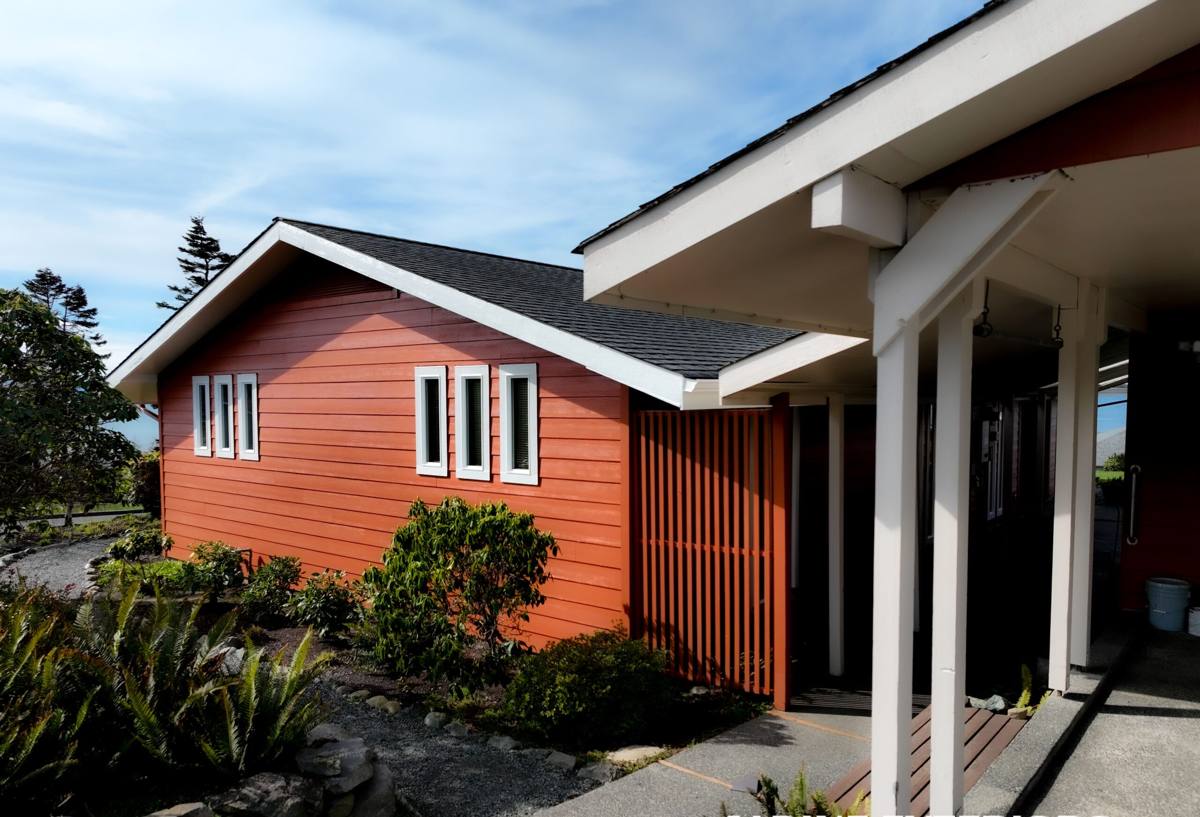
What Blaine's Climate Actually Does to Windows
Whatcom County's marine climate is mild compared to inland Washington, but "mild" doesn't mean easy on building materials. Three conditions specific to Blaine's location shape how we spec and install windows here.
Salt Air and Coastal Corrosion
Blaine's proximity to Drayton Harbor and the Strait means airborne salt reaches building exteriors even a mile or more inland, especially during winter storms. Salt accelerates corrosion on unprotected fasteners, aluminum cladding without a marine-grade finish, and cheaper window hardware. It also degrades some sealants faster than manufacturers' inland test data suggests. We factor this into fastener selection and hardware choice on every coastal-facing job, not just the ones with a water view.
Driving Rain and Water Management
Rain in Blaine rarely falls straight down. Wind off the water pushes it sideways into wall assemblies, which is exactly the condition window flashing is designed to defeat — if it's installed correctly. A window that's caulked instead of properly flashed will pass a garden-hose test and still leak during an actual winter storm, because the failure mode is different: water gets behind the cladding and works its way down, not through the window itself.
Moss, Shade, and Prolonged Moisture
Whatcom County's tree cover and cloud cover mean many building sites stay shaded and damp for months at a stretch. That's the same condition that grows moss on roofs and north-facing siding — it also keeps window sills and lower trim wet longer than in sunnier climates, which is why sill pan flashing and end-dam details aren't optional extras here; they're what keeps trapped moisture from ever becoming a problem in the first place.
New-Construction Installation vs. Retrofit — Why the Method Matters
"New-construction" isn't just a window style, it's an installation method. These windows have a nailing flange around the perimeter that gets integrated directly into the wall's weather-resistive barrier before siding goes on. That's fundamentally different from a retrofit or pocket window, which is installed into an existing frame after the fact and relies more heavily on sealant and trim to manage water. On a new build or a full reframe, there's no reason to use the retrofit approach — it exists for renovations where the wall can't be opened up, not for a project where you get to build the water management system from scratch.
| Factor | New-Construction (Flange) Installation | Retrofit/Pocket Installation |
|---|---|---|
| Water management | Flashed into the WRB and sheathing before siding — layered, redundant protection | Relies on sealant and trim over the existing frame |
| Best used for | New builds, additions, full wall reframes | Renovations where the wall can't be opened |
| Long-term coastal performance | Strong, when flashed correctly to sequence with siding | More maintenance-dependent over time |
| Trim and sightlines | Clean, built-in reveal matches new siding | Visible frame-within-a-frame in most cases |
What a Correct Installation Actually Involves
The window itself is often the easy part. The sequencing around it is where jobs succeed or fail. On every new-construction install we follow the same order of operations, because skipping a step or doing them out of order is how water gets trapped instead of shed.
- Rough opening is checked for square, level, and correct dimension before the window ever shows up on site.
- Sill pan flashing is installed first, sloped to drain outward, with back and end dams so any water that reaches the sill has nowhere to go but out.
- Window is set, shimmed for a true, square fit, and fastened through the flange per the manufacturer's schedule — not "a few screws in the corners."
- Jamb and head flashing are integrated with the weather-resistive barrier in the correct shingle-lap order — head flashing last, so water sheds over every layer beneath it, never behind it.
- Interior air sealing is done separately from exterior water sealing — they're two different jobs with two different materials, and conflating them is a common source of both drafts and trapped moisture.
- Operation is checked — smooth open/close, tight latch, no binding — before trim and siding go on and make adjustment harder.
Choosing Frame Materials and Glass for a Coastal Whatcom County Site
Every major frame material can work in Blaine's climate, but they don't all age the same way under salt air and constant moisture. We walk homeowners through the real trade-offs rather than pushing one product line.
| Frame Material | Coastal Performance | Maintenance |
|---|---|---|
| Vinyl | Good resistance to salt corrosion since there's no exposed metal to pit; performance depends on weld and reinforcement quality | Low — no painting, occasional cleaning |
| Fiberglass | Excellent dimensional stability in temperature and moisture swings; holds up well long-term near the water | Low |
| Wood / Wood-Clad | Warmer appearance, but exterior wood or clad joints need consistent upkeep in a damp, shaded climate | Higher — finish and joint maintenance |
| Aluminum | Strong but conductive and more prone to condensation and corrosion issues near salt air unless it's a marine-rated finish | Moderate, finish-dependent |
For glass, we typically recommend dual-pane, low-E units as the baseline in this climate — they cut heat loss during Blaine's long cool season and reduce interior condensation, which matters when a house sits in shade and fog for weeks at a time. Argon-filled units add a modest efficiency bump for a small cost difference. Where a home faces open water or a lot of afternoon glare, we'll talk through tinted or higher-performance low-E options, but we'd rather size the recommendation to the actual exposure of your lot than sell an upgrade nobody needs.
Hardware and Fastener Details That Matter More Here Than Inland
On coastal-exposed elevations, we default to corrosion-resistant fastener and hardware specs rather than whatever ships standard with a given window line. It's a small line-item difference on a new build and a real difference in how the hardware looks and operates ten winters from now.
Code, Energy, and Egress Requirements in Whatcom County
New-construction windows have to satisfy more than water management — they're also part of the building's energy code compliance and life-safety plan. Bedrooms need an egress-rated window sized and positioned correctly for emergency escape. Overall glazing has to meet the U-factor and performance targets under the energy code Whatcom County enforces for new residential construction. And on a full build, window placement interacts with the home's overall energy modeling, so swapping a window size or type mid-project can have downstream effects on the permit. We coordinate window selection with your builder or general contractor early, before framing locks in openings that don't match the final window schedule.
Our Process on a Blaine New-Construction Job
We work as a subcontractor to builders and general contractors as often as we work directly with homeowners managing their own build, so our process is built to slot into either.
- Plan review: We check window schedules against rough openings, egress requirements, and the wall assembly before ordering anything.
- Material selection: We walk through frame material, glass package, and hardware options based on the lot's actual sun, wind, and water exposure.
- Coordinated timing: Installation is scheduled to land at the right point in the framing sequence — after sheathing and WRB are in place, ahead of siding.
- Installation: Sill pan, flashing, fastening, and air sealing done in the correct order, on every opening, not just the visible ones.
- Final check: Every window is operated, inspected, and documented before we consider the job complete.
A Checklist Before You Hire Anyone for New-Construction Windows
Window installation is one of those trades where the difference between a good job and a bad one is invisible until a storm finds it. A few questions up front tell you a lot about who you're hiring.
- Do they install sill pan flashing with end dams, or rely mainly on caulk?
- Can they explain their flashing sequence relative to the weather-resistive barrier, in order?
- Do they adjust fastener and hardware specs for coastal exposure, or use one standard spec everywhere?
- Are they used to coordinating with a general contractor's framing schedule, not just working solo?
- Do they carry manufacturer training or certification for the window lines they install, protecting your warranty?
- Will they document the installation for warranty and inspection purposes?
Why a Crew That Already Works in Blaine Is Worth Choosing
Window installation technique doesn't change from town to town, but judgment does. A crew that works Blaine regularly has already seen which elevations catch the worst of the winter wind off the water, which lots stay shaded and slow to dry, and which details actually earn their keep in this specific stretch of Whatcom County versus a drier inland town. That's the kind of calibration that comes from doing the work here repeatedly, not from a manufacturer's install manual alone. It also means a shorter drive for warranty follow-up, which matters if you ever need us back for an adjustment.
If you're planning a new build or a major addition in Blaine and want windows installed right the first time, we're glad to walk your plans with you. Reach out for a free, no-pressure estimate — we'll look at your window schedule, talk through material options for your specific lot, and give you a straight answer on what the job involves.