 Bellingham Roofing
 Repairing Siding on a Blaine Home Is Different From Repairing One Inland
Blaine sits closer to open saltwater than almost anywhere else in Whatcom County, and that changes what siding damage actually looks like by the time a homeowner notices it. A cracked panel, a soft spot low on a wall, or a patch of moss that keeps coming back isn't just cosmetic here — it's usually a sign that salt air, wind-driven rain, or trapped moisture has already been working on that wall for a while. Repair work on a Blaine home has to account for that history, not just patch the visible damage and move on.
This page is specifically about siding repair — fixing damage to an otherwise sound siding system, as opposed to a full re-side. We install and repair James Hardie fiber cement exclusively, and everything below reflects that. If a repair assessment turns up damage extensive enough that a full re-side makes more sense, we'll say so plainly rather than patching a wall that's better off replaced.
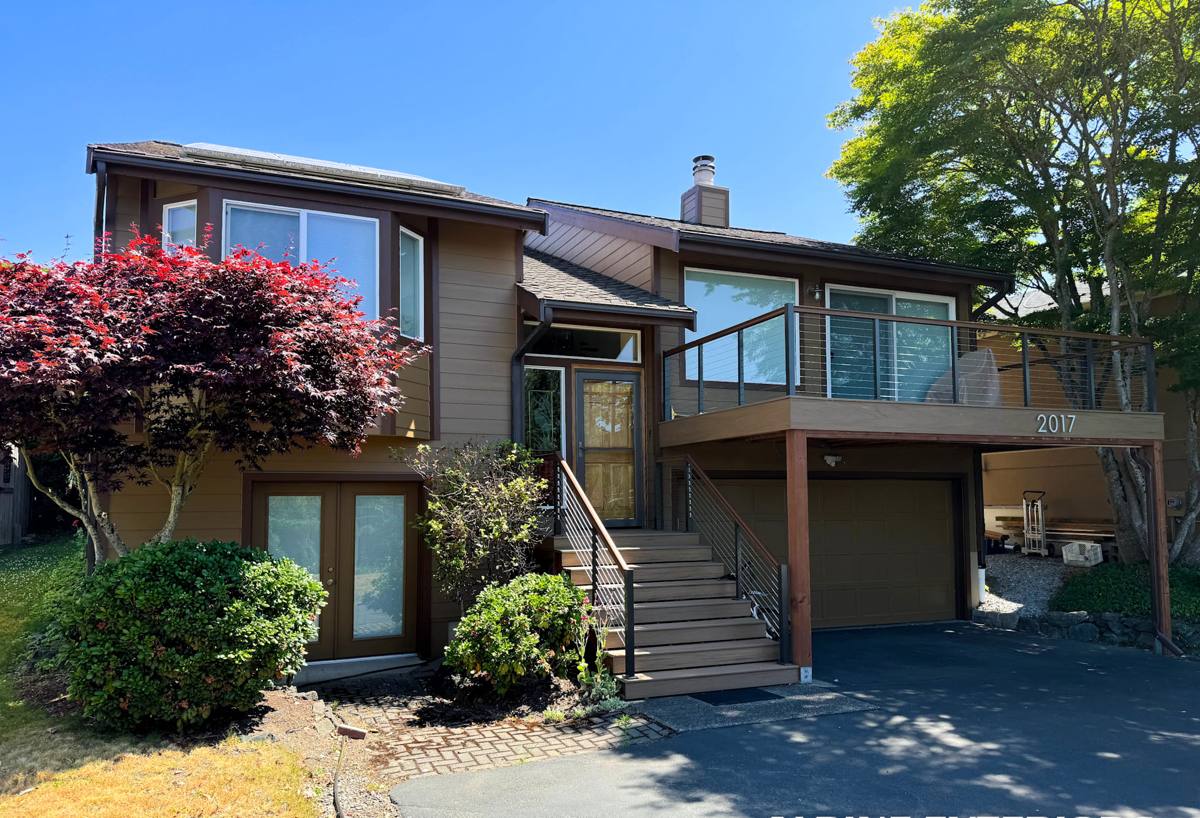
What Blaine's Climate Does to Siding Over Time
Salt Air, Close to the Water
Homes near Semiahmoo Bay and Drayton Harbor take on salt-laden air as a daily condition rather than an occasional one. That accelerates corrosion on fasteners, flashing, and trim hardware, and it's often the hardware — not the siding panel itself — that fails first and lets a repair problem start. A repair that only addresses the visible panel damage without checking the fasteners and flashing around it tends to need a second repair sooner than it should.
Driving Rain Off the Strait
Winter storms moving in off the water rarely drop rain straight down on a Blaine home. Wind pushes it sideways into panel joints, trim seams, and anywhere flashing has started to fail, which is why damage often shows up at corners, around windows, and at the bottom courses of a wall before it shows up in the open field of the siding. That pattern is a useful diagnostic — where the damage clusters usually points to where water is actually getting in.
A Moss Season That Runs Most of the Year
Mild temperatures and near-constant moisture keep moss and mildew pressure high on shaded and north-facing walls for much of the year, and tree-covered lots around Blaine see this especially. Moss that keeps returning after cleaning is often a sign a wall isn't drying out between wet spells, which can mean a drainage or clearance problem behind the siding rather than just a surface cleaning issue.
Common Siding Repair Issues We See on Blaine Homes
| Issue | Typical cause in this climate | Left unaddressed |
|---|---|---|
| Cracked or chipped panels | Impact damage, or fiber cement stressed by moisture cycling at an unsealed cut edge | Water intrusion at the crack, worsening with each wet season |
| Soft or spongy siding low on a wall | Inadequate clearance above grade, deck, or roofline allowing splash-back or standing water | Rot spreading into the sheathing behind the siding |
| Rust streaking from fasteners or trim | Standard-grade hardware corroding faster under salt air exposure | Loosened panels and trim, and staining that keeps recurring after cleaning |
| Recurring moss or dark staining | Poor drainage, tight-fitted panels, or heavy shade limiting airflow | Chronic moisture against the substrate, accelerating other damage |
| Gaps or separation at trim and corners | Failed sealant or flashing that's shifted or degraded over time | A direct path for wind-driven rain to get behind the cladding |
How We Approach a Siding Repair
Inspection Beyond the Obvious Damage
We start by looking at the specific area a homeowner is concerned about, but we also check the surrounding wall, fasteners, flashing, and clearances. Coastal damage rarely stays isolated to one spot, and a repair that ignores the cause behind it — a flashing gap, a clearance issue, a hardware problem — tends to resurface within a season or two.
Checking What's Behind the Panel
Where damage suggests moisture has been present for a while, we check the sheathing underneath before closing anything back up. Patching over damaged sheathing hides a problem that keeps getting worse behind the wall, which is a bad trade for a homeowner even when it looks fine from the outside on repair day.
Matching Material and Finish
James Hardie's ColorPlus finish is factory-applied, which means a repair needs the right product line and color match to blend with existing siding rather than leaving an obvious patch. We account for that during the estimate, including cases where an older color has weathered enough that an exact match isn't realistic.
Repairing to Manufacturer Spec
Replacement panels go in following the same fastening, clearance, and sealing requirements as a new installation. A repair that skips those details to save time on a small job creates the same failure points a shortcut installation would, just on a smaller scale.
Addressing the Underlying Cause
If the damage traces back to a flashing gap, a clearance problem, or corroded hardware, we fix that root cause as part of the repair, not just the panel that failed because of it. A new panel over an unresolved flashing issue is a repair that's scheduled to fail again.
Repair vs. Full Re-Side: How We Help a Homeowner Decide
Not every siding problem calls for a full re-side, and not every problem is a simple patch either. A few honest guidelines we use when advising a Blaine homeowner:
- Isolated damage — a handful of cracked panels, one section of rust staining, a corner with a flashing gap — is usually a straightforward repair
- Widespread soft spots or rot across multiple walls often point to a systemic moisture problem that repair alone won't solve
- Siding older than 20-25 years with recurring issues may be nearing the point where repair costs start rivaling replacement value
- Damage concentrated on one water-facing or shaded wall, with the rest of the house sound, is often repairable without touching unaffected walls
- If sheathing damage turns up during a repair and extends beyond the immediate area, that's a signal worth a broader conversation before closing the wall back up
We'll always give a straight answer on which category a given job falls into, including when the honest answer is that a repair now is the right call and a fuller conversation about re-siding can wait.
Why We Only Repair With James Hardie Fiber Cement
We install and repair James Hardie exclusively, which matters for repair work specifically because a mismatched product mixed onto an existing Hardie wall creates its own long-term problems — different expansion behavior, a finish that won't age the same way, and a warranty picture that gets muddier rather than clearer. Hardie's non-combustible core, factory-applied ColorPlus finish, and HZ5 formulation for moisture and freeze-thaw exposure are a strong match for Blaine's coastal conditions, and repairing with the same system keeps a wall behaving consistently rather than creating a patchwork of materials aging at different rates.
We don't repair or install LP SmartSide, vinyl siding, Cemplank, Allura, primed spruce, or cedar. That's a professional standard specific to the kind of sustained salt and moisture exposure this area sees, not a judgment on homeowners who have those products elsewhere. When a repair call comes in for a home with one of those materials, we'll still take an honest look and explain the options, including when patching the existing material is the more practical near-term answer than switching systems mid-wall.
Where a Mismatched Repair Material Creates Problems
| Approach | Trade-off on an existing coastal home |
|---|---|
| Patching with a different fiber cement brand | May not match ColorPlus finish or HZ-style formulation, and can weather at a different rate than the original panels |
| Patching with vinyl over a fiber cement wall | Different expansion and fastening behavior creates a visibly and functionally inconsistent wall section |
| Leaving damaged sections unrepaired | Small, isolated damage becomes a moisture entry point that widens with each storm season |
| Repairing without addressing the underlying flashing or clearance issue | New material fails again on the same timeline as the original damage |
Signs a Blaine Home Needs a Siding Repair Assessment
- Moss or dark staining that returns quickly after cleaning, especially on shaded or north-facing walls
- Soft or spongy panels, particularly low on a wall or near window and door trim
- Cracked, chipped, or missing panels, especially after a windstorm off the water
- Rust streaking running down from fasteners, trim, or flashing
- Gaps or separation at corners, trim, or window and door surrounds
- Musty odors or staining on interior walls that back up to exterior siding
- Peeling paint or visible warping on any older wood-based sections mixed into the siding
What Affects Siding Repair Cost on a Blaine Property
Repair pricing depends on the specifics of each job, but a few factors consistently drive the number: how much of the wall is affected and whether damage is isolated or spread across multiple sections, whether sheathing underneath turns out to be sound or needs repair of its own, how close the existing color and product line are to what's currently available for a clean match, and how much of the underlying cause — flashing, clearance, hardware — needs correcting alongside the visible panel repair. We walk through those factors during the estimate so a homeowner understands what's driving the price, not just what the final number is.
Why a Crew That Already Works Blaine Matters for Repair Work
Repair work rewards local experience even more than new installation does, because diagnosing why a wall failed requires knowing what this specific coastline does to a house over time. A crew that regularly works Blaine's waterfront and near-waterfront properties recognizes the difference between damage caused by a one-time storm event and damage that signals a chronic flashing or drainage problem, and that distinction changes what the right repair actually is. It also means that when a repair is finished, it's backed by a crew still working in the same area season after season, not one that diagnosed the problem once and moved on to a different part of the county.
If your Blaine home has siding damage you'd like looked at, we're glad to come take an honest look and explain exactly what we find. Reach out using the form below for a free, no-pressure estimate.