 Bellingham Roofing
 Building Decks That Actually Hold Up in Puget's Marine Climate
Puget-area homes sit close enough to the water and the tree line that a deck here works harder than a deck almost anywhere else in the country. Salt-laden air corrodes hardware faster than it does inland, driving rain drives moisture sideways into places a dry-climate deck design never has to account for, and the long, wet moss season coats every horizontal surface in a film that turns slick and starts breaking down wood and composite finishes alike. A deck built to a generic national spec will show its age here in three or four years instead of fifteen or twenty. A deck built for this specific climate, with the right materials, fasteners, and drainage details, will still be solid and safe decades later.
This page is about one thing: custom deck construction for homes in and around the Puget area near Bellingham. Not a general overview of decking — the specific decisions that matter when the site is exposed to Pacific storm systems, salt air off the Sound, and a rainy season that can run from October through May.
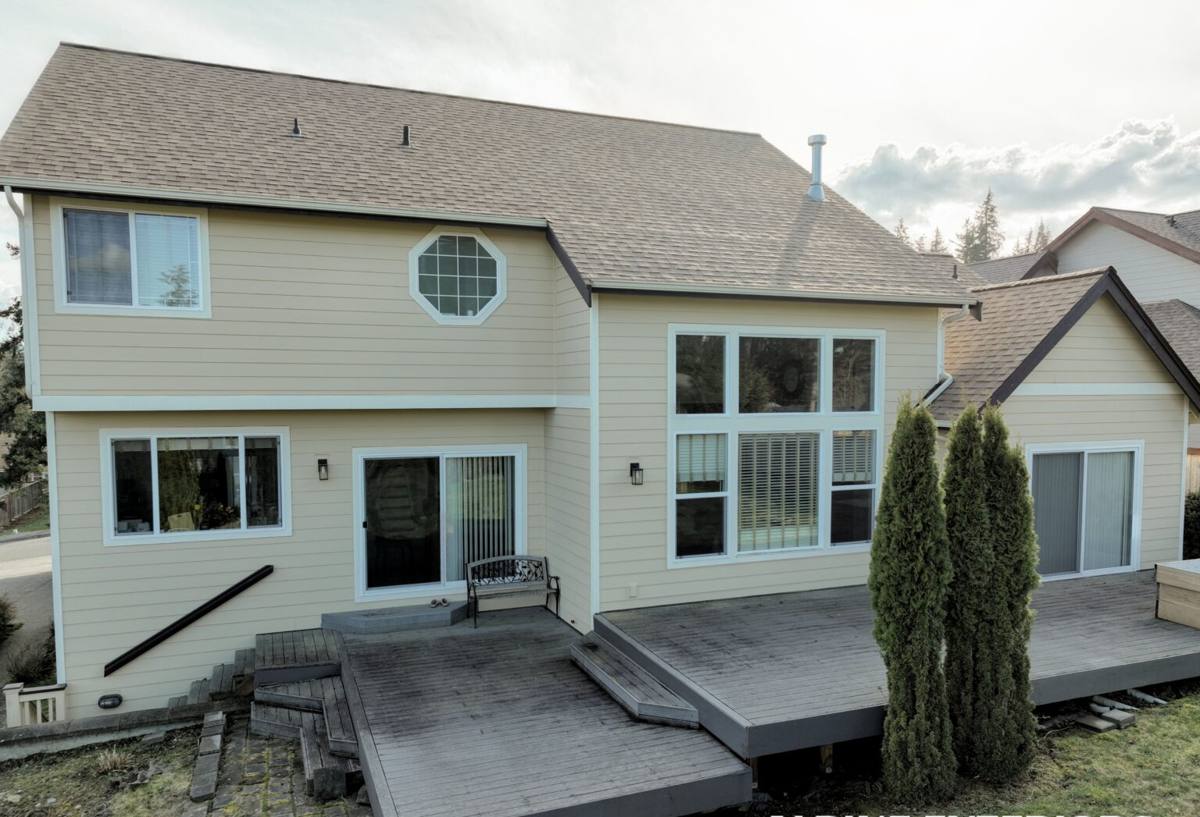
What the Local Climate Demands From a Deck
Whatcom County's marine climate is mild compared to most of the country, which is exactly why people underestimate it. There's no hard freeze-thaw cycle destroying concrete footings the way you'd see in the Midwest, but there's something arguably tougher to design around: near-constant moisture exposure for months at a time, combined with airborne salt that accelerates corrosion on fasteners, flashing, and connectors.
Driving Rain and Wind-Driven Moisture
Storms coming off the water don't just fall straight down — wind pushes rain sideways into ledger connections, under railing posts, and into any gap where end grain is exposed. A deck design that doesn't account for wind-driven rain will trap water in the one place you can't see it: behind the ledger board, where it rots the rim joist and the house's framing before anyone notices.
Salt Air and Corrosion
Even homes set back from the water get salt exposure carried on the wind. Standard zinc-coated fasteners and hardware corrode faster in this environment, and corroded fasteners are one of the leading causes of deck hardware failure. This is a materials decision, not an afterthought — it has to be specified before the first post hole is dug.
Moss, Algae, and Surface Degradation
Shaded lots, tree cover, and long stretches of damp weather mean moss and algae growth on deck surfaces is close to guaranteed if the deck isn't designed to shed water and dry out between rain events. Moss holds moisture against the decking surface, and on wood that means accelerated rot; on composite it means a slick, unsafe walking surface and a maintenance chore that never really ends if drainage and airflow weren't planned for from the start.
Choosing the Right Decking Material for This Environment
There's no single "best" decking material — there's a best material for a given budget, sun exposure, and how much upkeep a homeowner actually wants to do. In a climate this wet, the tradeoffs shift compared to a drier region.
| Material | How It Handles Puget's Climate | Maintenance Reality |
|---|---|---|
| Pressure-treated wood | Affordable, strong, but end grain and fastener holes need real attention to sealing or rot starts within a few seasons | Annual cleaning and re-sealing to keep water out |
| Cedar | Naturally resists some rot and looks right on Pacific Northwest homes, but softer surface takes moss and mildew staining | Regular cleaning, periodic oil or stain |
| Composite decking | Handles constant moisture well and won't rot, but needs grooved or capped boards with real airflow underneath or algae will still grow on the surface | Occasional washing, no sealing or staining |
| PVC decking | Fully moisture-proof surface, best resistance to mold and moss buildup of any common option | Lowest maintenance, higher upfront cost |
We'll walk through these tradeoffs honestly during an estimate rather than pushing whatever has the best margin. A shaded, damp lot near tree cover is a very different recommendation than an open, sun-exposed yard, even a few hundred feet apart.
What a Correctly Built Deck Actually Involves
A deck is a structure, not a surface — the decking boards are the least important part of whether it lasts. Here's what separates a deck that holds up in this climate from one that doesn't.
Footings and Framing
Footings need to be sized and set below frost depth per local code and bear on undisturbed soil — on the sloped, sometimes soggy lots common around Puget, that often means deeper or wider footings than a flat, well-drained lot would need. Joists and beams should be sized for the actual span and load, not the minimum the lumber will technically hold.
Ledger Attachment and Flashing
The ledger board — where the deck attaches to the house — is the single most common failure point on any deck, and it's the point wind-driven rain attacks hardest. Proper flashing that directs water out and away from the house band joist, combined with a gap or waterproof membrane behind the ledger, is not optional in this climate. This is where a lot of failures we get called out to inspect actually originate.
Fasteners and Hardware
Given the salt air exposure, we specify stainless steel or high-grade corrosion-resistant coated fasteners and structural connectors rather than standard zinc hardware. It costs more up front and saves the deck from hardware failure a decade earlier than it should happen.
Drainage and Airflow Underneath
Water needs somewhere to go. That means proper board spacing, a slight slope away from the house, and enough clearance underneath the deck for air to circulate and surfaces to actually dry between storms — not just after the rain stops, but during the long stretches of damp weather that define the season here.
Cost Factors for a Custom Deck in This Area
Every deck is priced on its own site conditions, size, and material choice, but the variables that move the number the most in this region are consistent enough to explain up front.
| Factor | Why It Affects Cost Here |
|---|---|
| Site slope and soil | Sloped or wet lots common near the water often need deeper footings, additional bracing, or a taller substructure |
| Decking material | Wood, composite, and PVC span a wide price range, and the gap widens further once you factor long-term maintenance |
| Ledger and house condition | Older homes sometimes need rim joist repair or upgraded flashing before a deck can be safely attached |
| Railing and hardware spec | Corrosion-resistant hardware and quality railing systems cost more but are not optional this close to the water |
| Size and complexity | Multi-level decks, built-in seating, or stairs on a slope add labor beyond simple square footage |
We give straightforward, itemized estimates so homeowners can see exactly where the money is going rather than a single lump number.
Railings, Fasteners, and Hardware Built for Salt Air
Railings take a beating from wind and rain on exposed decks, and they're a safety component, not a decoration. We spec posts anchored with corrosion-resistant hardware and, where wood railings are used, make sure end grain and post bases are sealed and detailed to shed water rather than trap it. For homes with a clear view or exposure toward the water, we also account for wind load on the railing system itself — a real consideration on open decks in this area, not a formality.
Our Process, Start to Finish
- On-site assessment: we walk the lot, check drainage, sun exposure, existing structure if there's a deck to replace, and talk through how the space will actually be used.
- Design and material selection: we lay out size, layout, and material options with honest cost and maintenance tradeoffs for this specific site.
- Permitting: we handle the permit application and inspections required by the local building department so the homeowner doesn't have to navigate that alone.
- Footings and framing: the structural work — footings, posts, beams, joists, ledger, and flashing — all built to hold up to this climate specifically, not just to pass inspection.
- Decking, railing, and finish work: boards, railings, stairs, and any built-ins installed with attention to drainage and airflow underneath.
- Final walkthrough: we go over care and maintenance specific to the material chosen before we consider the job done.
Maintenance That Actually Matters Here
Every deck material needs some upkeep in this climate — the difference between a wood deck and a composite deck is how much and how often, not whether. Skipping the basics is what turns moss season from an annoyance into a structural problem.
- Sweep leaves and debris off the deck surface regularly through fall and winter — trapped organic matter is what moss and algae feed on
- Rinse or wash the deck surface at least once or twice a year to break up early moss growth before it takes hold
- Check under the deck periodically for standing water or blocked drainage paths
- Inspect ledger flashing and railing post bases yearly for signs of water intrusion or rust staining
- Reseal or re-stain wood decking on the schedule the product actually requires, not just when it looks bad
- Tighten or replace any corroding fasteners as soon as they're spotted, rather than waiting for a failure
Permits and Local Building Requirements
Most custom decks in Whatcom County require a building permit, particularly anything attached to the house, elevated, or supporting a roof or railing system. Requirements vary by jurisdiction and by the specifics of the site — setbacks, height, and structural review can all come into play. We handle the permit process as part of the job so the deck is built to code and won't create problems at resale or insurance time.
Why a Crew That Already Works in Puget Makes a Difference
A contractor who only occasionally works this close to the water tends to default to generic specs — standard fasteners, standard flashing details, standard footing depth — because that's what works most places. A crew that regularly builds decks in this specific area already knows which details actually matter here: where wind-driven rain hits hardest, which lots need extra drainage attention, and which fastener and flashing choices actually hold up through a full wet season instead of just looking fine at handoff. That local repetition is what prevents callbacks two or three years down the road.
If you're considering a custom deck for your Puget-area home, we're happy to walk the site and put together a straightforward, no-pressure estimate — just fill out the form below.