 Bellingham Roofing
 Edgemoor's Setting Puts Extra Demands on a Wall
Edgemoor sits among the wooded, bluff-top neighborhoods along Bellingham's shoreline, where mature tree canopy, close proximity to saltwater, and a mix of older custom homes and newer construction all combine into a specific set of siding conditions. It's not the same job as siding a house on an open, sun-exposed lot further inland. Shade from tall conifers keeps walls damp longer after a storm, saltwater proximity adds a steady dose of airborne salt to every exposed surface, and the terrain itself channels wind and rain against exterior walls in ways that vary from one side of a house to the other. Any siding installer working in this neighborhood needs to plan around all of that before the first board goes up.
We install James Hardie fiber cement siding exclusively, and on a neighborhood like Edgemoor, where trees, elevation, and saltwater exposure interact in ways a standard install spec doesn't fully anticipate, that product choice and the installation details around it matter as much as the labor itself.
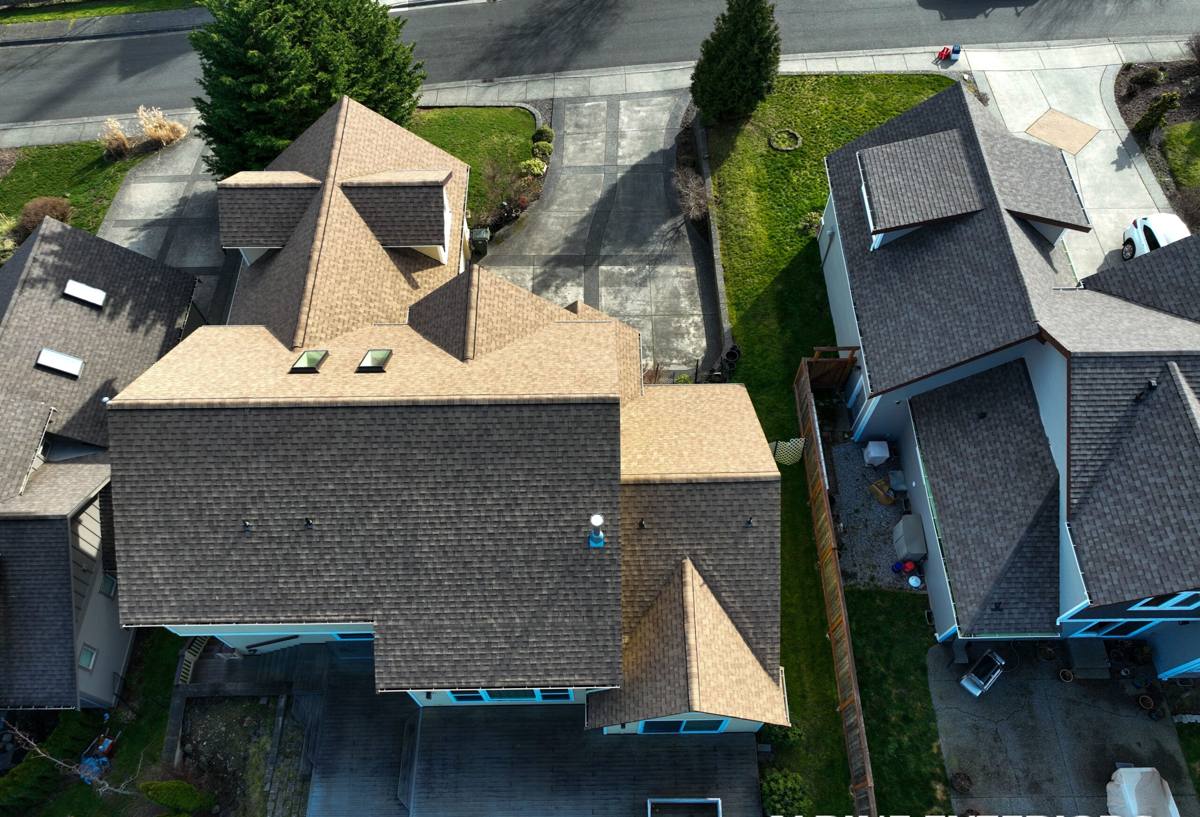
What Salt Air, Driving Rain, and Moss Season Do to Edgemoor Siding
Salt Air and Slow Corrosion
Homes close to Bellingham Bay and the Salish Sea take on a steady, low-level dose of salt-laden air even when there's no storm in sight. Over years, that salt exposure works on anything metal — fasteners, flashing, trim connectors — faster than it would further inland. Siding that depends on caulk or paint alone to protect its seams and fastener heads tends to show that wear first at those connection points, long before the field of the siding itself looks tired.
Wind-Driven Rain Off the Water
Rain in this part of Whatcom County rarely falls straight down, and a bluff-top or shoreline-adjacent lot like the ones common in Edgemoor gets more of that sideways push than a sheltered inland site does. Wind-driven rain finds every gap in a wall system it can reach — around window and door trim, at corners, at the bottom of the wall — which is why flashing and lap details carry more weight here than the siding material's face does.
A Long Moss Season Under Tree Cover
Edgemoor's tree canopy is part of what makes the neighborhood distinctive, but shade also means walls dry out slower after every rain, and Bellingham's moss season runs long. North-facing and heavily shaded walls in particular can stay damp for days at a stretch during the wetter months. Siding that holds moisture at the surface or swells slightly when wet gives moss and mildew exactly the foothold they need, and once established, that growth holds even more moisture against the wall behind it.
Why We Standardized on James Hardie for Homes Like These
We install only James Hardie fiber cement siding. We don't offer LP SmartSide, vinyl, Cemplank, Allura, primed spruce, or cedar. Those are all legitimate products, and other contractors install them well, but on a neighborhood like Edgemoor — shaded, salt-exposed, wind-loaded — the trade-offs of wood-based and vinyl products stack up faster than they would on a more sheltered, sun-exposed lot.
| Material | Response to Sustained Dampness | Maintenance Under Tree Cover | Realistic Lifespan Here |
|---|---|---|---|
| James Hardie fiber cement | Doesn't swell, rot, or absorb moisture into the core | Low; factory ColorPlus finish resists moss staining | 30+ years with correct install |
| Cedar | Absorbs moisture readily; prone to cupping and checking | High; recurring sealing or repainting needed | 15-25 years with consistent upkeep |
| LP SmartSide (engineered wood) | Sensitive at cut edges and fastener holes if not sealed | Moderate; edge maintenance is ongoing | 15-25 years, climate-dependent |
| Vinyl | Doesn't rot, but can gap, warp, or trap moisture behind it | Low visible upkeep, but hidden issues are hard to catch | 20-30 years, variable |
Fiber cement's dimensional stability is the property that matters most under Edgemoor's tree cover — it doesn't expand, contract, or cup the way wood-based sidings can when they stay damp for extended stretches. James Hardie's factory-applied ColorPlus finish is baked on under controlled conditions, which gives it a more consistent, longer-lasting resistance to moss staining and fading than a field-applied paint job can match, and it comes with a strong transferable warranty that reflects the manufacturer's confidence in that finish holding up.
What a Correct Siding Installation Involves
The finished look of a siding job is the easy part to evaluate. What actually determines whether that wall performs for thirty years happens underneath it, and it's the same on every wall of the house regardless of which side faces the water or the trees:
- A continuous, correctly lapped weather-resistive barrier installed before any siding goes up
- A drainage gap or rainscreen behind the siding so moisture that does get past the surface can dry out instead of sitting against the sheathing
- Corrosion-resistant fasteners, sized and spaced to James Hardie's installation spec, not just enough to hold the boards up
- Proper clearance between siding and grade, decks, and roof lines so water sheds away from the wall instead of wicking up into it
- Correctly flashed and lapped transitions at every window, door, corner, and penetration
- Factory-cut edges kept intact wherever possible, with any field-cut edges primed before installation to protect the exposed core
Skip any one of these and the wall can still look right on the day it's finished. The failures that follow — staining at seams, soft trim, paint or caulk failure at corners — usually take a wet season or two to show up, which is exactly why they're easy for a rushed or corner-cutting install to get away with until the homeowner is the one living with the consequences.
How We Approach an Edgemoor Siding Project
Every siding project starts with a walk-around of the house, not a generic estimate. On a shaded or bluff-adjacent lot, that means looking at which walls get the most wind-driven rain, which ones stay damp longest under tree cover, and where the existing siding or trim is already showing early wear. That assessment shapes the flashing plan and fastener spec before a single board is ordered.
From there, the process follows a consistent sequence: removing old siding and inspecting the sheathing underneath for hidden moisture damage, correcting any water-resistive barrier or flashing issues found at that stage, installing the drainage plane and James Hardie siding to manufacturer spec, and finishing with the trim, caulking, and touch-up painting that protect the cut edges. We walk the finished job with the homeowner before calling it done, because problems are far cheaper to fix at that stage than after the first winter storm season.
Signs Existing Siding in Edgemoor Is Already Failing
Because moisture problems on shaded, salt-exposed walls tend to develop slowly, a lot of homeowners don't realize how far along the damage is until it's visible from the street. Worth checking for:
- Persistent moss or dark staining that returns quickly after cleaning, especially on north-facing or tree-shaded walls
- Soft or spongy spots when pressed near the base of the wall or below window sills
- Paint that's peeling, bubbling, or failing faster on one side of the house than the others
- Visible gaps, cupping, or warping at siding seams and corners
- Rusting or discolored fastener heads showing through the siding face
Any one of these on its own might just mean a cleaning or touch-up is due. Two or three together, especially on the walls that face the water or sit under the heaviest tree cover, usually mean it's worth having someone look at what's happening behind the siding, not just on top of it.
Why Hiring a Crew That Already Works This Neighborhood Matters
Edgemoor's mix of mature trees, sloped and bluff-adjacent lots, and proximity to saltwater isn't the same set of conditions as a flat, open lot elsewhere in Bellingham or further inland in Whatcom County. A crew that's already done siding work in neighborhoods like this one has a feel for which walls tend to need extra attention to flashing and drainage, how far to plan around root systems and drop zones when staging material near mature trees, and what access is typically like on lots with grade changes or limited driveway space. That familiarity doesn't replace a careful site-specific assessment, but it does mean fewer surprises once the job starts.
It also means a crew that's seen how James Hardie siding performs on similar homes over years, not just on installation day — which walls tend to need extra attention to fastener spec, where flashing tends to need the most care, and how the ColorPlus finish holds up under this specific combination of shade, salt, and rain.
Cost Factors for Siding Installation in Edgemoor
Siding costs vary by house size, existing condition, and site access, and we don't publish blanket per-square-foot pricing because it rarely reflects what a specific home actually needs. The factors below are the ones that most often move the number up or down on a project in this neighborhood:
| Factor | Why It Matters Here |
|---|---|
| Existing sheathing condition | Hidden moisture damage under old siding, more common on shaded walls, adds repair scope before new siding goes on |
| Site access and staging | Sloped, wooded, or bluff-adjacent lots can limit where material and equipment stage, affecting labor time |
| Wall complexity | Additional windows, dormers, and trim details each add flashing and cut-edge work |
| Siding profile chosen | Lap, shingle, and board and batten profiles differ in fastener count and installation time |
| Removal and disposal | Tear-off and haul-away of old siding material adds to project scope and timeline |
The only way to get a number that actually means something is a site walk-through, which is why every estimate starts there rather than with a phone quote.
Get an Estimate for Your Edgemoor Home
If you're planning a siding project in Edgemoor, or you're not sure whether what you're seeing on your walls is normal wear or something that needs attention, we're glad to take a look. The estimate is free, there's no pressure attached to it, and you'll get a straight answer about what your home actually needs. Use the form below to get started.