 Bellingham Roofing
 Fiber Cement Siding for Puget Homes
Puget is one of those in-between areas around Bellingham — close enough to the water and the marine weather patterns that come with it, but made up of the same mix of older homes and newer construction you'll find across Whatcom County. What ties these properties together isn't their age or their style, it's what the climate does to whatever material is on the walls. Salt-tinged air off the Sound, rain that rarely falls straight down, and a moss season that runs most of the year on shaded or north-facing walls all put steady, cumulative stress on siding. A product that looks fine on installation day can start showing real problems within a handful of wet seasons if it wasn't built, or installed, for this specific mix of conditions.
We install James Hardie fiber cement siding exclusively for homes in Puget and the surrounding Bellingham area. That's not a default or a convenience — it's a standard we settled on after weighing what actually holds up here against what tends to need attention sooner than homeowners expect.
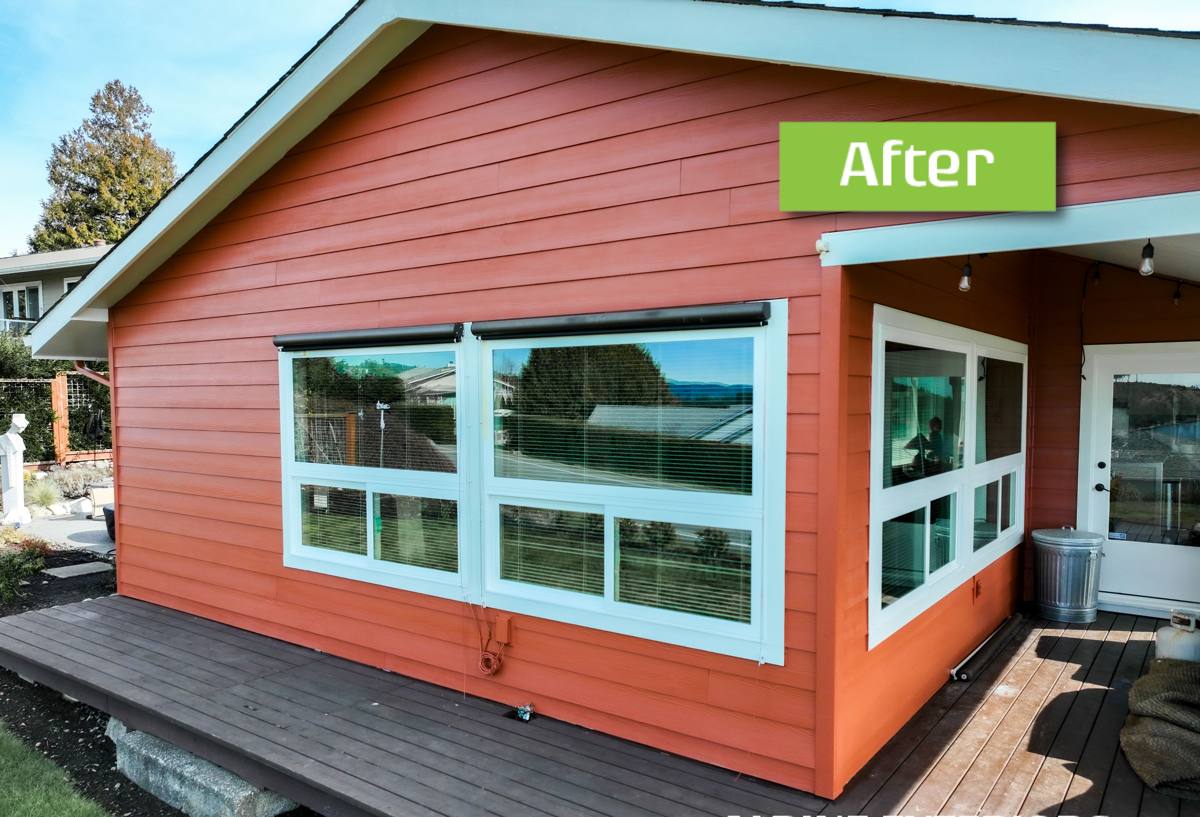
What This Climate Does to Siding in Puget
Salt Air and Slow Corrosion
Homes in and around Puget sit close enough to the water that the air carries a mild but steady salt content, and that exposure doesn't stay near the shoreline — it spreads across the whole area on prevailing winds. Salt-tinged moisture is hard on exposed fasteners, trim metal, and any siding finish that isn't built to resist it. Over years, that shows up as premature corrosion at nail heads, a chalky or faded finish, or paint that fails well ahead of schedule on materials that depend on field-applied coatings.
Driving Rain, Not Straight-Down Rain
Wind coming off open water pushes rain sideways into walls rather than letting it fall straight down and run off. That matters more than most homeowners assume, because a lot of siding installation guidance is written around the assumption that water mostly needs to be shed downward. In Bellingham's climate, laps, seams, and flashing details need to hold up against wind-driven rain hitting them at an angle, which is a tougher test than the same material would face somewhere drier and more sheltered.
A Moss Season That Doesn't Really End
Whatcom County's mix of marine humidity and tree cover means moss and mildew have a long growing window on shaded or north-facing exterior walls — often close to year-round on the walls that get the least direct sun. Moss holds moisture against a surface far longer than open air would, and a siding material or finish that's not built to resist that kind of sustained dampness will show it eventually: staining, softening at the substrate, or a finish that dulls and discolors faster than the same product would somewhere drier.
Why We Install Only James Hardie in This Area
Fiber cement itself isn't unique to one manufacturer — Allura and Cemplank both make fiber cement siding, and LP SmartSide (engineered wood), vinyl, primed spruce, and cedar are all legitimate, commonly installed alternatives. We don't install any of those. That's a professional standard, not a claim that those products can't perform reasonably well in the right circumstances. What we found, weighing long-term behavior against the specific demands of this climate, is that James Hardie's fiber cement system — engineered HZ product lines built for regional moisture and temperature conditions, a factory-applied ColorPlus finish, and a well-documented installation spec — gives us the most consistent, defensible answer for what a Puget-area wall needs to hold up for decades rather than years.
| Material | Behavior in Salt Air & Driving Rain | Moss-Season Maintenance | Realistic Lifespan Here |
|---|---|---|---|
| James Hardie fiber cement | Dimensionally stable; factory finish resists moisture and salt exposure | Low; ColorPlus finish resists moss staining and fading | 30+ years with correct install |
| LP SmartSide (engineered wood) | Wood-based core more sensitive to moisture at cuts and fastener holes | Moderate; edge sealing and paint upkeep needed | 15-25 years, climate-dependent |
| Vinyl | Can warp in heat and become brittle in cold; seams less rigid over time | Low visible upkeep, but moisture behind panels is hard to catch | 20-30 years, variable |
| Cedar | Absorbs moisture readily without a consistent sealing schedule | High; regular repainting or resealing required | 15-25 years with consistent upkeep |
The factory-applied finish is a meaningful part of that difference. Field-painted materials depend entirely on paint quality and application holding up against years of salt air and rain — Hardie's ColorPlus finish is baked on at the factory under controlled conditions, so the only field painting we do is priming the occasional cut edge. That's a smaller point of failure than a siding system where the entire wall's finish is applied on-site.
What a Correct Fiber Cement Install Actually Involves
Fiber cement siding performs the way it's supposed to only when it's installed to spec — the material itself doesn't do the work if the details behind it are skipped. A correct install in this climate includes:
- A house wrap or weather-resistive barrier installed and properly lapped before any siding goes up
- A drainage gap or rainscreen behind the siding so moisture that does get past the surface can dry out instead of sitting against the sheathing
- Corrosion-resistant fasteners, correctly sized and spaced to the manufacturer's specification, not just "enough to hold the board"
- Proper lap clearance so panels can shed wind-driven rain instead of trapping it at the joint
- Correctly flashed and lapped transitions at windows, doors, corners, and the base of the wall
- Cut edges primed before installation so the factory finish's protection isn't compromised at the one place it's interrupted
Skip any one of these and the wall can still look right for a season or two. The consequences — moisture intrusion behind the cladding, soft spots at the base of the wall, premature finish failure at unprimed cuts — take a few wet seasons to surface, which is exactly why they're easy for a rushed install to get away with until the homeowner is the one dealing with the repair.
Our Process for a Puget Fiber Cement Project
Walkthrough and Assessment
We start by looking at your specific walls — which face the prevailing wind and rain directly, which are shaded and slow to dry, and whether the existing wall assembly has any moisture issues that need addressing before new siding goes up. New siding over an already-damp wall just buries the problem instead of solving it.
Planning the Details Before Install Day
We work out panel layout, corner details, and how the siding will meet trim, windows, and rooflines before any material gets cut. Sorting that out on paper first avoids field improvisation, which is usually where corners get cut on a rushed job.
Installation to Manufacturer Spec
Every fastener, gap, and flashing lap follows James Hardie's published installation requirements for this region, not a generic national baseline. That's what keeps the manufacturer's warranty valid and what determines whether the wall performs for decades rather than years.
Final Walkthrough
We walk the finished job with you, cover what little ongoing maintenance fiber cement actually needs, and make sure you know what a healthy wall looks like if you ever want to check it yourself down the road.
Cost Factors for Fiber Cement Siding in Puget
Fiber cement siding costs vary by home, and a rough per-square-foot number rarely tells the whole story. A few things move the price on any given Puget-area project:
| Factor | Why It Matters |
|---|---|
| Wall condition underneath the old siding | Rot or moisture damage found during tear-off needs repair before new siding goes on |
| Wall height and complexity | More corners, dormers, and transitions mean more cuts and flashing details |
| Siding profile and reveal | Lap width and style affect material quantity and installation labor |
| Number of window and door openings | Each opening needs its own flashing and trim detail |
| Site access | Tight lots, slopes, or limited staging area can add labor time |
We'll walk your specific property and give you real numbers rather than a generic estimate based on square footage alone — two homes of similar size in Puget can land at very different totals depending on how many of these factors come into play.
Maintenance Through the Moss Season
One of the practical advantages of James Hardie's factory finish in an area like this is how little ongoing maintenance it asks for. Where a field-painted or wood-based product needs periodic resealing, recaulking, or repainting to keep moss and mildew from taking hold, a correctly installed Hardie wall mainly needs an occasional rinse to keep organic growth from building up on the surface, plus normal attention to gutters and grading so water is directed away from the base of the wall. That's a meaningfully lighter maintenance load than what cedar or primed wood siding demands in a climate where shaded walls stay damp for much of the year.
Why Hire a Crew That Already Works Puget
The failure points in a poorly installed fiber cement wall are subtle and slow to show up, which is exactly why installation experience in this specific area matters. A crew that's worked Puget and the surrounding Bellingham area through multiple wet seasons already knows which wall orientations need extra attention because of shade and tree cover, how much lap clearance actually earns its keep in a climate this damp, and where a drainage gap makes the difference between a wall that looks the same in fifteen years and one that's showing staining and softening by year five. That judgment doesn't show up on a spec sheet — it's the difference between a fiber cement wall that performs as designed and one that quietly fails behind a finish that still looks fine from the curb.
If you're weighing fiber cement siding for a home in Puget, we're happy to walk the property, talk through what your specific walls need given their exposure and orientation, and put together a straightforward, no-pressure estimate. There's a form below — reach out and we'll set up a time to take a look.