 Bellingham Roofing
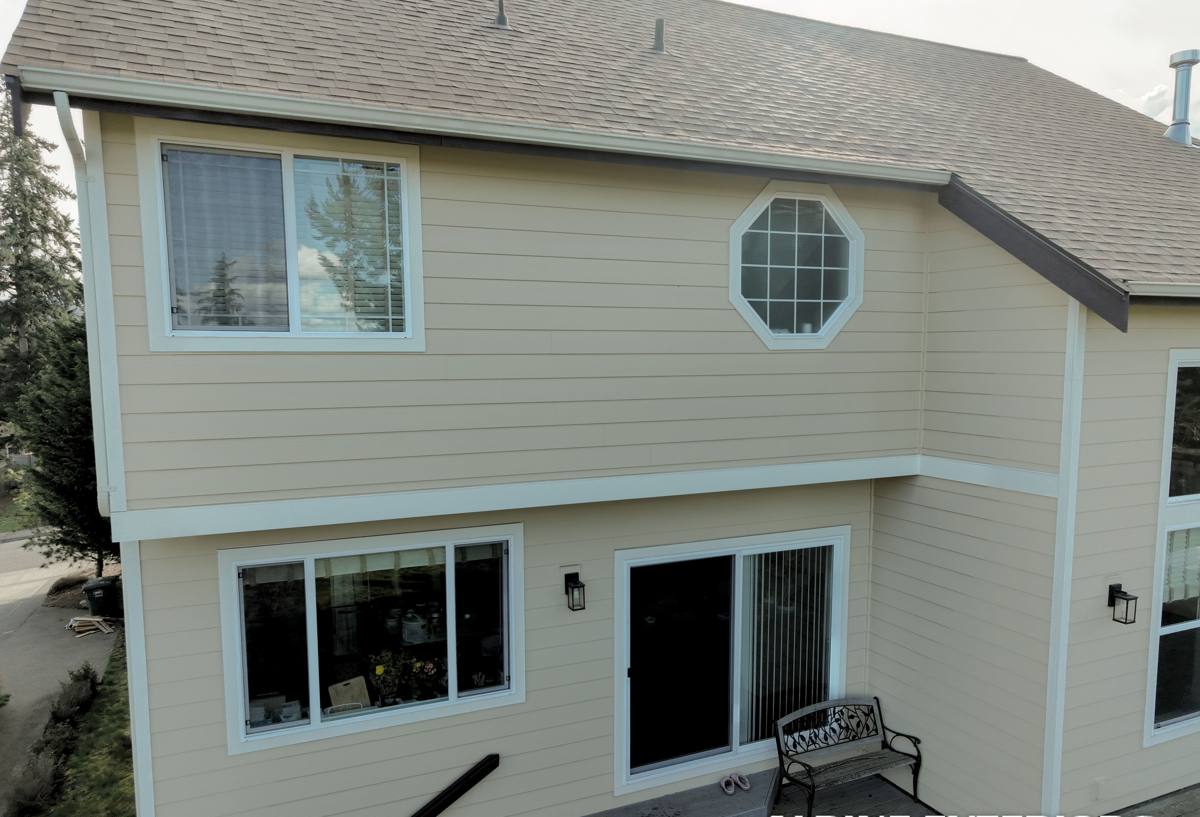
 James Hardie Siding, Built for Happy Valley
Happy Valley sits close enough to the water and the surrounding tree cover that its homes take on a specific set of weather challenges — salt-tinged air drifting in off the bay, rain that rarely falls straight down, and shaded lots where moss has the run of the place for most of the year. Siding on a Happy Valley home isn't decoration. It's the one layer standing between a wood-framed structure and a climate that spends roughly nine months of the year finding new ways to get moisture into a wall.
We install James Hardie fiber cement siding exclusively — not because it's the only decent product on the market, but because after years of working walls across Bellingham and Whatcom County, it's the one system we're willing to put our name behind for the long haul. This page is specifically about what James Hardie siding installation looks like for a Happy Valley home: what the local climate demands, what a correct job actually involves, and why the crew doing the work matters as much as the material itself.
What Happy Valley's Climate Asks of a Siding System
Salt Air and Slow Corrosion
Homes in and around Happy Valley live with a steady dose of salt-laden marine air common to this part of Whatcom County. Salt exposure doesn't damage siding material the way it damages metal, but it does accelerate corrosion in anything exposed — fasteners, flashing, trim screws. Siding that looks fine from the ground can still be failing at the fastener line if the hardware underneath wasn't spec'd for this exposure. This is one of those problems that's invisible until it isn't, which is exactly why fastener choice gets more attention on our jobs than most homeowners expect it to.
Wind-Driven Rain
Bellingham's rain has a habit of coming in sideways rather than straight down, driven by wind off the bay and the Salish Sea. That matters for siding because a lap profile designed to shed water falling vertically doesn't automatically shed water being pushed sideways and upward under wind pressure. The overlap at every course, the seal behind every joint, and the flashing at every window and door opening all have to account for wind-driven rain specifically, not just gravity.
Year-Round Moss Pressure
Shaded and tree-covered lots — common throughout Happy Valley — stay damp longer than open, sun-exposed ones, and that dampness is exactly what moss needs to take hold. On siding, moss growth usually isn't a cosmetic problem by itself; it's a sign that a wall surface is staying wet longer than it should. Left alone, that sustained moisture is what eventually leads to staining, coating breakdown, and in the worst cases, softening of whatever's behind the siding. A siding material and installation detail that manages moisture well keeps that whole chain from starting.
Why We Standardized on One Product
We don't install LP SmartSide, vinyl, Cemplank, Allura, primed spruce, or cedar siding. That's a deliberate professional decision, not a lack of options. Each of those products has real strengths and other contractors install them competently. But every one of them asks something of the homeowner — more frequent recoating, more sensitivity to moisture at cut edges, more maintenance to keep the finish intact — that we don't think makes sense for a climate that gives siding this little room to dry out.
| Material | Moisture Behavior | Maintenance in This Climate | Realistic Lifespan |
|---|---|---|---|
| James Hardie fiber cement | Dimensionally stable; doesn't swell, cup, or rot from moisture exposure | Low; factory finish resists moss growth and fading | 30+ years with correct installation |
| LP SmartSide (engineered wood) | Wood-based core is more sensitive at cut edges and fastener penetrations | Moderate; edge sealing and touch-up needed over time | 15-25 years, climate-dependent |
| Vinyl | Doesn't absorb water, but can trap moisture behind it if installed loosely | Low surface upkeep, but hidden issues are hard to catch | 20-30 years, variable |
| Cedar | Absorbs and releases moisture constantly without regular sealing | High; recurring staining or sealing schedule required | 15-25 years with consistent upkeep |
James Hardie's fiber cement core is non-combustible and doesn't expand and contract with moisture the way wood-based siding does. That stability is what lets it hold a factory-applied finish for decades instead of a few years, and it's the property we've come to rely on most in a climate where a wall might not fully dry out between one rain event and the next.
The James Hardie Lines That Make Sense for This Climate
James Hardie makes several distinct siding profiles, and picking the right one for a Happy Valley home is part of doing the job correctly:
- HardiePlank lap siding — the most common profile, available in several width and texture options, built to shed water in overlapping horizontal courses
- HardiePanel vertical siding — a clean, modern vertical look often paired with board and batten trim
- HardieShingle siding — a shaped-shingle profile for homes where that architectural detail matters
- HardieTrim boards — used around windows, corners, and fascia to complete the system with matching material and finish
James Hardie also engineers its products by climate zone — the HZ5 formulation used in this region is built for freeze-thaw cycling and sustained moisture exposure, as opposed to the HZ10 formulation sold in hot, dry climates. Installing the correct zone-matched product is a detail that's easy to overlook if a contractor isn't paying attention to sourcing, and it's one we check on every order.
Color is handled through Hardie's ColorPlus technology — a factory-applied, baked-on finish rather than a coat of paint rolled on after installation. That matters in a marine, moss-prone climate because the finish is cured and consistent before the material ever reaches a wall, instead of depending on field conditions and applicator skill the day it's painted on site.
What a Correct James Hardie Installation Actually Involves
The material is only half of what determines how a wall performs over time. The installation details matter just as much, and they're the part a homeowner usually can't evaluate just by looking at the finished wall:
- House wrap or weather-resistive barrier installed and properly lapped, shingle-style, before any siding goes up
- A drainage plane or rainscreen gap behind the siding so incidental moisture can drain and dry instead of sitting against the sheathing
- Corrosion-resistant fasteners, sized and spaced to James Hardie's published specification for this climate zone
- Minimum clearance maintained between siding and grade, decks, patios, and roof lines so water doesn't wick upward into the material
- Properly flashed and lapped transitions at every window, door, corner, and penetration
- Factory-cut boards kept face-down when cut on site, with any field-cut edges primed before installation to protect the exposed substrate
Skip any one of these steps and the wall can still look right for a year or two. The consequences — moisture staining, soft trim, premature coating failure — tend to surface only after a few wet seasons have passed, which is exactly why they're easy for a rushed or inexperienced install to get away with until the homeowner is the one dealing with the repair bill.
Our Process for a Happy Valley Siding Project
On-Site Assessment
We start by walking the property and looking at each elevation individually — which walls take direct weather, which stay shaded and slow to dry, and whether the existing wall assembly shows signs of moisture damage that needs to be addressed before new siding goes on. Installing new siding over a compromised substrate just hides the problem instead of fixing it.
Product and Detail Planning
Before any material is ordered, we work out profile choice, trim details, and how the siding will meet windows, rooflines, and existing features on the home. Planning these details on paper first keeps the crew from improvising in the field, which is where corners tend to get cut on rushed jobs.
Installation to Manufacturer Specification
Every fastener, gap, and flashing detail follows James Hardie's published installation requirements for this climate zone — not a generic, one-size-fits-all standard. Following spec is also what keeps the manufacturer's warranty valid, which matters more over a 30-year lifespan than it does on install day.
Final Walkthrough
Once the job is done, we walk the property with you, explain what little maintenance James Hardie siding actually needs, and make sure you know what a healthy wall looks like versus something worth a call if you ever see it down the road.
Why a Crew That Already Works Happy Valley Matters
A lot of what separates a siding job that performs for thirty years from one that starts showing problems in five isn't visible in a brochure — it's judgment built from doing the work in this specific place, repeatedly, through multiple wet seasons. A crew that's already worked Happy Valley and the surrounding Bellingham neighborhoods has seen which orientations need extra drainage detail because of shade and tree cover, how fastener corrosion actually shows up in this salt exposure versus what a generic spec sheet assumes, and where a rainscreen gap is worth the extra step versus where it's optional. That local pattern recognition is hard to fake, and it's usually the difference between a wall that ages the way it's supposed to and one that needs attention well ahead of schedule.
Cost Factors for a Happy Valley Siding Project
James Hardie siding costs more up front than vinyl and is comparable to or less than well-installed cedar over the life of the product, once you factor in maintenance. Beyond base material and square footage, a few things move the price on a specific home:
| Factor | Why It Matters |
|---|---|
| Existing wall condition | Hidden moisture damage found during tear-off needs repair before new siding goes up |
| Home height and complexity | More stories, dormers, and rooflines mean more cuts, staging, and flashing details |
| Siding profile chosen | Lap, panel, shingle, and board and batten differ in material and labor requirements |
| Trim and window detailing | More openings and corners mean more finish work and flashing per square foot |
| Site access | Tree cover, slope, and limited access can add setup and labor time |
We'll walk your specific home and give you real, itemized numbers rather than a rough square-footage estimate — two Happy Valley homes with similar footprints can land in very different price ranges depending on how many of these factors come into play.
Getting It Right the First Time
Siding is not a product you want to redo. Correcting a poorly installed wall usually means pulling siding, trim, and sometimes the weather barrier underneath it, rather than a simple patch — which is a far bigger job than doing it right from the start. That's part of why we treat the planning and detailing phase of every project with the same seriousness as the installation itself: the cost of getting a wall right the first time is a fraction of the cost of tearing one out because a shortcut was taken somewhere along the way.
James Hardie also backs its products with a strong, transferable limited warranty when installation follows its specification — one more reason the installation details matter as much as the material choice, since a warranty is only as good as the install work behind it.
If you're weighing new siding for a home in Happy Valley, we're happy to take a look at your specific walls, talk through what your exposure and orientation actually need, and put together a straightforward, no-pressure estimate. There's a form below — reach out and we'll set up a time to come by.