 Bellingham Roofing
 Why Lynden Siding Has to Work Harder Than People Expect
Lynden sits inland from the Salish Sea but still gets plenty of the Pacific Northwest's signature weather punishment: long stretches of driving rain off and on for months, damp air that never fully dries out between storms, and a moss and algae season that can run from fall clear through spring on north-facing walls and anything shaded by trees or a neighboring structure. Add in the salt-tinged air that reaches inland across Whatcom County on a west wind, and you've got a climate that's constantly testing whatever material is on the outside of a house. Siding here isn't just cosmetic. It's the first and most important line of defense against moisture finding its way into wall framing, sheathing, and insulation.
Homes in and around Lynden run the gamut from older farmhouses to newer builds on larger lots, and a lot of them carry wood siding, vinyl, or aging fiber cement that was never detailed correctly to begin with. When we get called out to look at siding problems here, the pattern is almost always the same: moisture got behind the cladding at a seam, a butt joint, or a poorly flashed window, and it sat there because the assembly behind it couldn't dry out fast enough between rain events. That's the specific problem a correctly installed James Hardie system is built to solve.
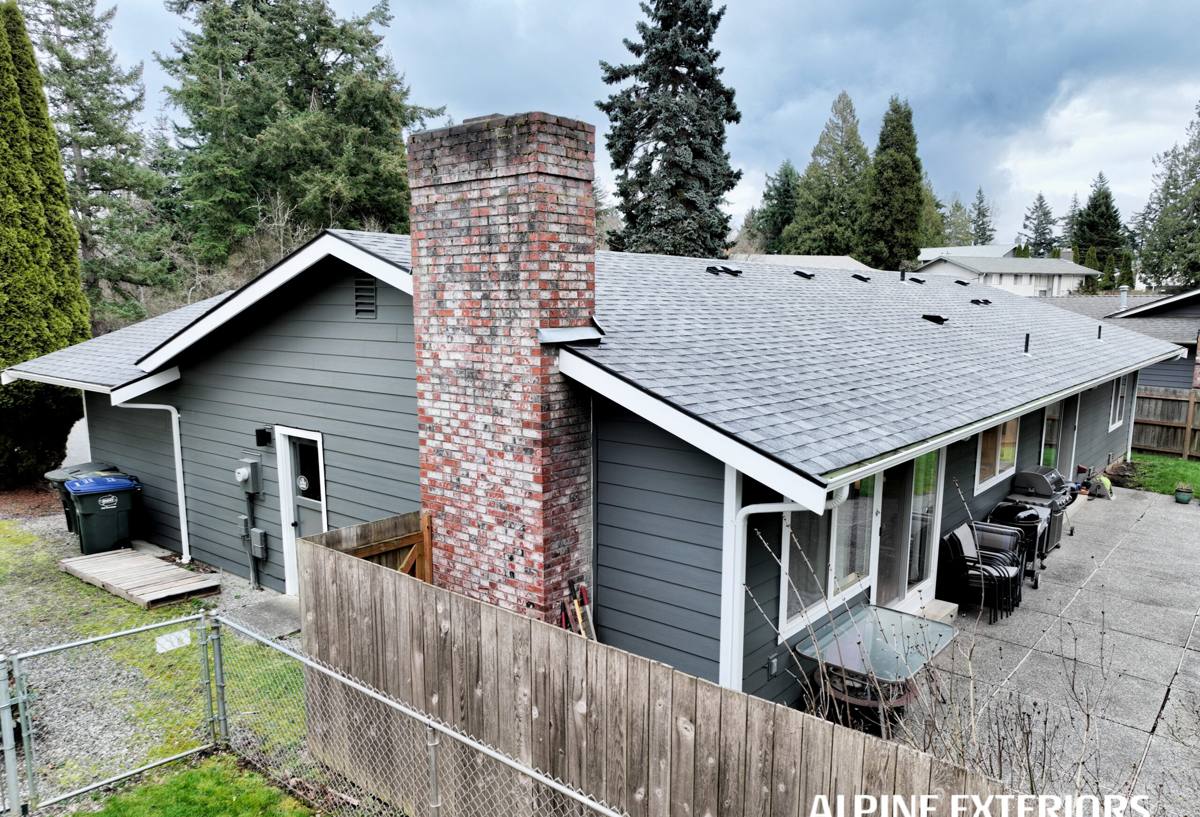
What James Hardie Actually Brings to a Lynden Home
We install James Hardie fiber cement siding exclusively. That's not a marketing preference — it's a standard we set because of what this climate does to lesser materials over time. James Hardie panels and lap siding are made from cement, sand, and cellulose fiber, engineered to hold paint, resist moisture absorption, and stay dimensionally stable through the wet-dry cycling that's constant here nine months out of the year.
Built for This Specific Climate
James Hardie makes climate-specific formulations under its HZ5 engineering for the Pacific Northwest and similar wet regions. The product is formulated to perform in high-moisture, high-humidity conditions rather than a generic one-size-fits-all mix. That matters in Whatcom County, where a siding product has to shrug off months of saturation, not just an occasional storm.
A Factory Finish That Doesn't Rely on a Painter's Timing
Most of what we install carries James Hardie's ColorPlus finish — a factory-applied, baked-on finish that's more consistent and better bonded than field-applied paint. On a home exposed to salt air and constant damp, a factory finish that resists fading and doesn't depend on perfect painting weather during a narrow installation window is a real advantage, not a luxury upsell.
What a Correct Installation Actually Involves
Fiber cement siding is only as good as the installation behind it. A huge share of the "Hardie siding problems" we get asked about on other homes trace back to shortcuts during install, not the material itself. Here's what we hold to on every Lynden job:
- Proper clearance between the bottom edge of the siding and grade, decks, patios, and roof lines, so water can't wick up into the panel edges
- A correctly lapped and sealed weather-resistive barrier behind the siding, with all penetrations flashed before a single panel goes up
- Butt joints staggered, backed with flashing, and never left to rely on caulk alone as the only moisture barrier
- Fasteners placed and driven to James Hardie's specification — not overdriven, not underdriven, and in the right pattern for the panel type and wind exposure
- Correct window and door flashing integration so the siding sheds water past openings instead of into them
- Factory-cut and field-cut edges sealed per manufacturer spec before installation, especially on any cut panel ends
None of this is exotic. It's disciplined, sequenced work that takes longer than a rushed install, and it's exactly the kind of detail that separates siding that lasts thirty-plus years from siding that starts failing at the seams inside a decade.
Where Moisture Actually Gets In
On the failure inspections we've done around the county, the entry points are consistent. Understanding them is useful for any homeowner, whether you hire us or someone else.
| Failure Point | What Goes Wrong | How a Correct Install Prevents It |
|---|---|---|
| Bottom edge near grade or decks | Splashback and standing water wick into the panel over years | Manufacturer-specified clearance gaps, plus proper flashing at deck ledgers |
| Butt joints between panels | Caulk-only joints crack and open a direct path for water | Metal or plastic flashing behind every joint, caulk as a second layer, not the only one |
| Window and door trim | Missing or reversed flashing sends water behind the opening | Proper flashing sequence integrated with the weather barrier before trim goes on |
| Fastener holes | Overdriven nails crack the panel edge and create a wick point | Pneumatic tools set and tested for correct depth per panel thickness |
| Roof-to-wall transitions | Step flashing skipped or undersized | Step and kick-out flashing installed to code before siding terminates at the roofline |
Our Process, Start to Finish
We walk every Lynden estimate the same way, because skipping steps is how problems get built into a wall for the next twenty years.
Assessment and Tear-Off
We inspect the existing wall assembly before quoting anything. If there's rot, compromised sheathing, or old moisture damage under the current siding, that gets addressed and documented — you'll know about it before we start, not after we've already closed the wall back up.
Weather Barrier and Flashing First
Before any Hardie panel is hung, we get the weather-resistive barrier and all flashing details right. This is the step that determines whether the siding actually protects the house or just looks like it does.
Installation to Manufacturer Spec
Panels go up following James Hardie's fastening, clearance, and joint requirements — not shortcuts, not "close enough." This is also where correct installation protects your ability to use the manufacturer's warranty coverage down the road, since improper installation is a common reason claims get denied.
Final Detailing and Walkthrough
Trim, caulking at appropriate joints, and a final walkthrough where we point out what we did and why, so you understand your own siding system instead of just trusting it blindly.
Choosing the Right Look for a Lynden Property
James Hardie's product lines give real flexibility without sacrificing the performance side. Lap siding in various exposures suits traditional farmhouse-style homes common around Whatcom County, while panel and board-and-batten combinations work well on newer builds looking for a more modern exterior. ColorPlus comes in a range of factory finishes, and trim, soffit, and fascia products are available to match so the whole exterior reads as one coordinated system rather than mismatched materials patched together over time.
We'll walk you through which profile and finish combination fits your home's style and orientation — a north-facing wall that stays shaded and damp longer benefits from the same rigorous detailing regardless of color choice, but darker ColorPlus finishes and their heat behavior are worth discussing if you're deciding between options.
What Drives Cost on a Lynden Siding Job
| Factor | Why It Matters |
|---|---|
| Existing wall condition | Rot or sheathing repair found at tear-off adds material and labor before new siding goes on |
| Home size and wall complexity | More corners, dormers, and roof intersections mean more flashing detail and cut work |
| Siding profile and finish | Lap siding, panel systems, and premium ColorPlus finishes carry different material costs |
| Trim and accessory scope | Matching Hardie trim, soffit, and fascia adds cost but keeps the whole system consistent |
| Access and site conditions | Steep grades, tight lot lines, or landscaping near the walls affect labor time |
We give a real, itemized estimate after walking your specific property — not a generic square-footage number pulled from a phone call. Given the range of home ages and styles around Lynden, every job's condition and scope is different enough that a fair number requires an actual site visit.
Living With Hardie Siding Through Moss Season
One advantage of fiber cement over wood is that it doesn't feed moss and algae growth the way organic material does, but nothing in this climate stays completely clean on its own. A little seasonal attention keeps a correctly installed system looking and performing its best for decades.
- Rinse siding with a garden hose and soft brush once or twice a year, focusing on shaded, north-facing walls where moss and algae take hold first
- Keep gutters clear so overflow doesn't run down the siding face during heavy rain events
- Trim back landscaping and tree branches that keep a wall section shaded and damp longer than the rest of the house
- Check caulking at trim and joints every couple of years and have any cracked or missing sections resealed
- Walk the exterior after major windstorms to check for any dislodged trim or panel damage before small issues become bigger ones
Why It Matters That We Already Work in Lynden
A crew that already works around Lynden and greater Whatcom County has seen how this specific stretch of weather treats a house over years, not just during a single installation season. That means we're not guessing at flashing details or clearance requirements — we're applying what we already know holds up against salt-laden wind off the water and a moss season that doesn't really end. It also means shorter travel for warranty follow-up, project walkthroughs, and any future service, rather than waiting on a contractor based an hour or more away.
If you're weighing a siding replacement or new construction project in Lynden, we're glad to walk your property, look at what's there now, and give you a straight assessment of what correct James Hardie installation would involve for your specific home. Reach out for a free, no-pressure estimate using the form below.