 Bellingham Roofing
 Puget's Climate Is Hard on Siding — Here's Why
Homes in the Puget area of Bellingham sit close enough to the water and the weather patterns that roll in off it that siding takes a different kind of beating than it would ten or twenty miles inland. Salt-laden air, wind-driven rain that hits walls sideways instead of falling straight down, and a moss and mildew season that can stretch for most of the year all work against whatever material is on the outside of your house. Siding here isn't just a cosmetic layer — it's the first and most exposed line of defense against a genuinely tough coastal climate.
That combination is why we treat siding installation in Puget differently than we would in a drier, more sheltered part of Whatcom County. The product has to be right, and the installation details have to be right, or the siding starts failing years before it should.
Salt Air and Coastal Exposure
Airborne salt accelerates corrosion on fasteners, flashing, and any exposed metal trim, and it slowly breaks down finishes that weren't engineered to handle it. Paint film on untreated wood siding chalks and fades faster near the water. Vinyl can become brittle sooner. The practical result is that siding choices which perform fine in inland neighborhoods can underperform in Puget simply because of proximity to salt spray and marine humidity.
Driving Rain and Wind-Driven Moisture
Bellingham gets a lot of rain, but the more damaging factor for siding is wind-driven rain — moisture pushed sideways and upward under laps, around trim, and into any gap that wasn't sealed or flashed correctly. A siding system can look watertight and still let moisture in through the details nobody notices from the ground: butt joints, inside corners, and the transitions around windows and doors.
A Long Moss and Mildew Season
Shade, moisture, and moderate temperatures are exactly what moss and mildew need, and Puget's tree cover and marine humidity give both plenty of runway. Siding that stays damp too long because it can't dry out properly between rain events becomes a host for growth, staining, and — over time — the kind of moisture intrusion that damages sheathing behind the siding, not just the surface you can see.
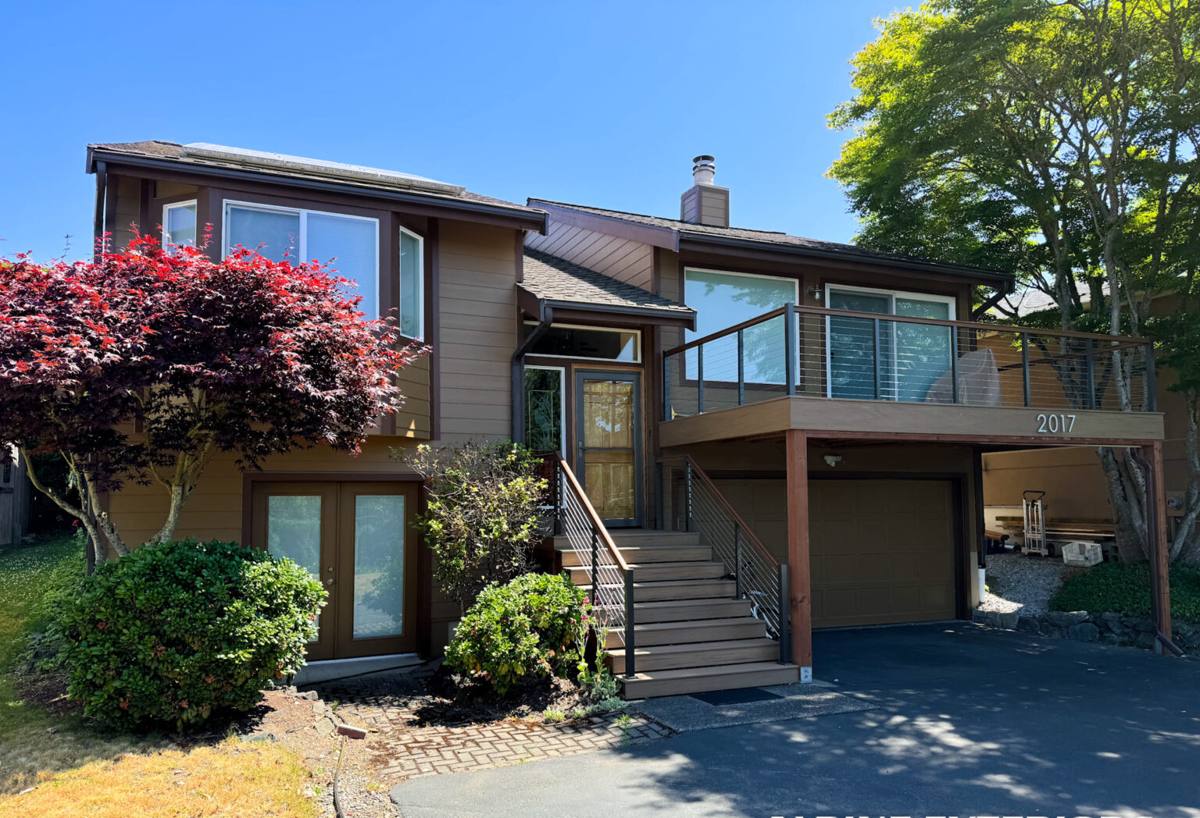
Why We Only Install James Hardie Fiber Cement in Puget
We install James Hardie fiber cement siding exclusively. We don't install vinyl, LP SmartSide, Cemplank, Allura, or primed spruce or cedar siding, and in a climate like Puget's, that's a deliberate standard rather than a preference.
Fiber cement is non-combustible and dimensionally stable, meaning it doesn't expand, contract, warp, or cup the way wood-based products can when they cycle through wet and dry seasons. James Hardie's ColorPlus factory-applied finish is baked on under controlled conditions and is formulated to resist the fading and chalking that salt air and UV exposure cause faster near open water. And Hardie's HZ5 product line is specifically engineered for climates with more moisture exposure and freeze-thaw cycling, which fits the Puget area better than general-purpose siding products designed for drier regions.
We're not going to tell you every other siding product is worthless — each has situations where it performs reasonably well. But for a coastal Whatcom County climate with salt air, driving rain, and a long moss season, we've made the call that Hardie fiber cement is the product we're willing to put our name behind and back with installation workmanship we stand by.
What a Correct Siding Installation Actually Involves
The siding material is only part of the equation. Most siding failures we get called out to inspect in coastal neighborhoods trace back to installation shortcuts, not the product itself. A correct job addresses what's happening behind the siding just as much as what you see on the surface.
Water Management Behind the Siding
Every wall needs a drainage plane — a water-resistive barrier and, ideally, a rainscreen gap that lets any moisture that does get past the siding drain out and lets the wall assembly dry. This matters more in Puget than in drier climates because wind-driven rain increases the odds that some moisture reaches the barrier, and a wall that can't dry out stays wet longer, which feeds the moss and mildew problem described above.
Fastening and Clearances
James Hardie publishes specific fastener types, spacing, and embedment requirements, and following them isn't optional if you want the warranty to mean anything. Just as important are the clearances the manufacturer requires between siding and grade, roof lines, decks, and other surfaces — gaps that are easy to shortcut but that exist specifically to keep splashback and standing water away from the bottom edge of the siding.
Trim, Flashing, and Joints
Butt joints, inside and outside corners, and the trim around windows and doors are where most water intrusion actually starts. Correctly flashed and caulked joints, with the right sealant used in the right places (and not relied on as the only line of defense), are what keep wind-driven rain from working its way behind the siding over a Puget winter.
Our Siding Installation Process for Puget Homes
- On-site assessment. We look at your home's current siding, sheathing condition, exposure to prevailing wind and rain, and any existing moisture or moss issues before recommending a scope of work.
- Tear-off and sheathing check. Old siding comes off and we inspect the sheathing underneath for rot or water damage — issues that are far cheaper to address now than after new siding is installed over them.
- Water-resistive barrier and drainage plane. We install a proper weather barrier and drainage detail suited to the wall assembly, prioritizing the ability of the wall to dry.
- Hardie installation to manufacturer spec. Fastening, clearances, and layout follow James Hardie's published installation requirements, not shortcuts.
- Flashing and joint detailing. Every penetration, corner, and joint is flashed and sealed with attention to how wind-driven rain actually moves across a wall in this area.
- Final walkthrough. We review the finished work with you, including care and maintenance specific to a coastal Whatcom County climate.
James Hardie Product Lines That Fit Puget
James Hardie makes several siding profiles, and the right one depends on your home's style and exposure. The table below is a general comparison, not a substitute for an on-site recommendation.
| Product | Look | Best Fit For |
|---|---|---|
| HardiePlank lap siding | Traditional horizontal lap | Most single-family homes; the most common choice in this region |
| HardiePanel vertical siding | Vertical board look | Modern styling, accent walls, gable ends |
| HardieShingle siding | Staggered or straight-edge shingle | Craftsman and cottage-style homes wanting texture |
| HardieTrim boards | Smooth or woodgrain trim | Window, door, and corner detailing on any of the above |
For a marine-influenced climate like Puget's, we typically steer homeowners toward the HZ5 engineered formulation and a ColorPlus factory finish, which reduces on-site painting seams and gives better long-term color performance in salt air than field-applied paint.
What Affects the Cost of Siding Installation
Every home is different, but the factors below are the main drivers of cost on a Puget siding project. We'll give you a firm, itemized number after an on-site look — not a rough guess over the phone.
| Factor | Why It Matters |
|---|---|
| Tear-off scope | Removing old siding down to sheathing takes more labor than installing over a prepped surface |
| Sheathing repair | Rot or water damage found during tear-off adds material and labor before new siding goes on |
| Home size and wall complexity | Corners, dormers, and multiple stories increase both material waste and labor time |
| Product line and profile | Plank, panel, and shingle profiles have different material and labor costs |
| Trim and detail work | Window and door trim, corner boards, and fascia detailing add finish-carpentry time |
| Access and staging | Tight lots, slopes, or limited equipment access can add setup time |
Signs Your Puget Home May Need New Siding
- Visible cracking, warping, or soft spots when you press on the siding
- Persistent moss, algae, or dark staining that returns shortly after cleaning
- Paint that's peeling or bubbling rather than just fading
- Soft or discolored sheathing visible at seams, corners, or penetrations
- Rising energy bills that point to a wall assembly no longer sealing properly
- Siding that's original to a home built more than 20-25 years ago, especially wood-based products
Why It Matters That We Already Work in Puget
A crew that installs siding across a range of climates without adjusting for local conditions will often install a technically fine product the wrong way for this area — skipping a rainscreen detail, under-flashing a joint, or ignoring clearance requirements that matter more here than they would somewhere drier. Working regularly in the Puget area and the broader Bellingham market means we've seen how salt air, driving rain, and moss actually affect siding installations over years, not just on install day, and we build our process around that.
We also know this climate doesn't forgive shortcuts. A siding job that looks complete at handoff can fail behind the surface within a few wet seasons if the water management details weren't right. That's the part of the job that matters most, and it's the part a homeowner can't easily inspect after the fact — which is why it has to be done correctly the first time.
If you're considering new siding for a home in the Puget area, we're happy to take a look and give you a straightforward, no-pressure estimate — including an honest read on your current siding's condition and what it would take to get it right with James Hardie fiber cement.