 Bellingham Roofing
 Silver Beach's Siding Problem Isn't Quite What People Expect
Ask most Bellingham homeowners what wears out siding and they'll say the rain, or the salt air off Bellingham Bay. Both are real factors across Whatcom County, and they matter for plenty of homes in town. But Silver Beach sits up against Lake Whatcom, tucked into wooded, sloped lots with heavy tree cover — and that setting creates its own version of the problem, one that's arguably harder on siding than salt spray ever is here.
Shade and standing moisture are the story in this neighborhood. Mature conifers and deciduous trees block sun for long stretches of the day, especially on north-facing walls and anything tucked close to the tree line. Add Bellingham's typically long, wet fall-through-spring stretch, and you get siding that simply doesn't get a chance to dry out between storms. That's the exact condition wood-based and moisture-sensitive siding products struggle with, and it's why what looks fine from the street can be quietly failing at the butt joints and bottom courses.
Humidity Trapped by the Lake and the Trees
Being close to open water adds its own humidity load even without salt exposure — evaporation off Lake Whatcom keeps ambient moisture higher than it would be a few miles inland, and the surrounding tree canopy slows air movement across exterior walls. Less airflow means slower drying, which means more cumulative moisture exposure over a siding product's lifespan, even in a single wet season.
Leaf and Needle Litter Is a Siding Issue, Not Just a Gutter Issue
Homes shaded by big trees deal with organic debris collecting against siding at grade, in valleys, and behind shrubs, holding moisture directly against the material. Over years, that's a steady contributor to rot in wood-based products and to the moss and algae staining that shows up on almost anything left untreated in this kind of microclimate.
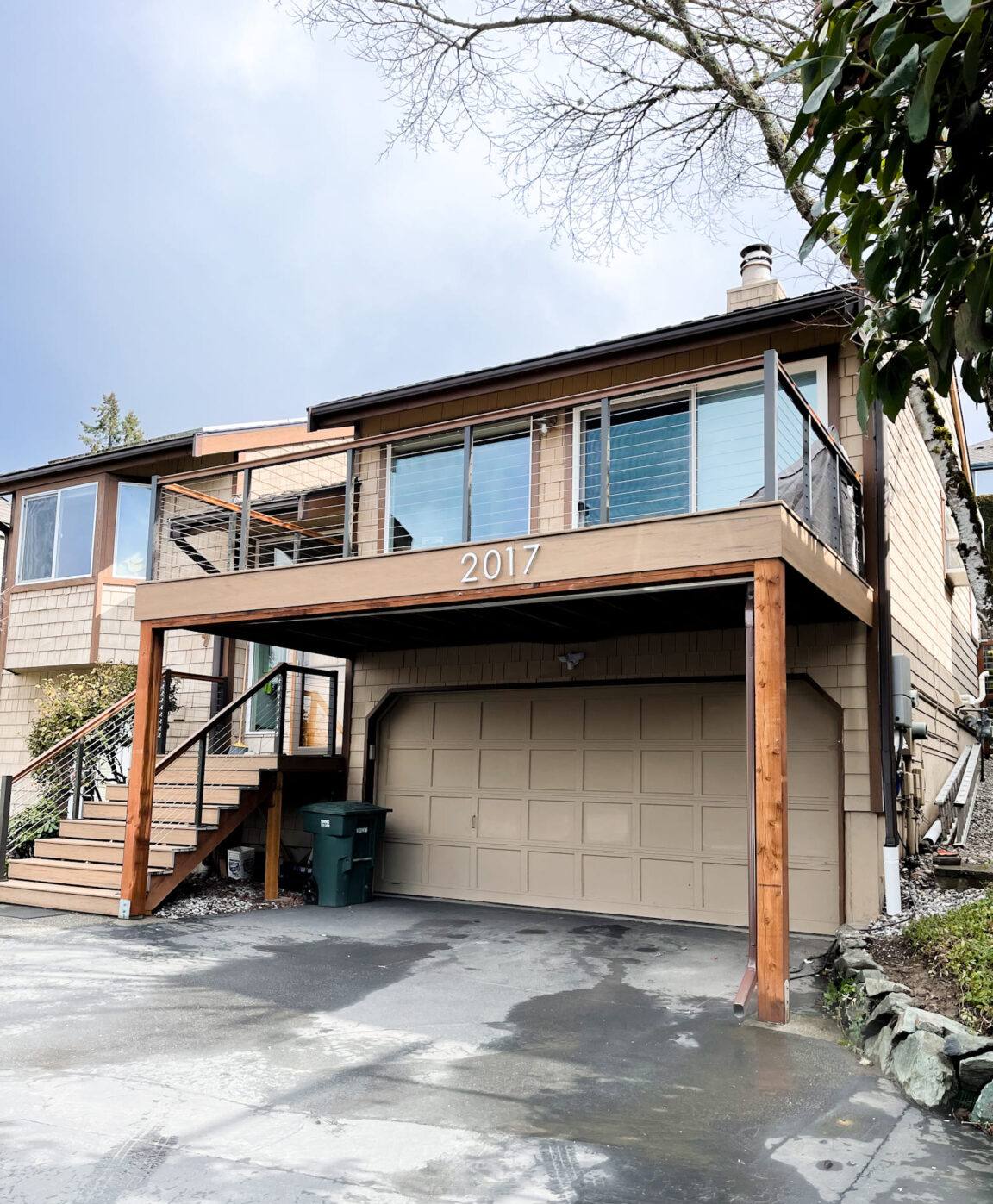
How This Shows Up as Siding Damage
On a lake-adjacent, tree-shaded lot, the failure pattern tends to look different from a wind-exposed hillside home. What we typically find during an inspection includes:
- Soft or delaminating siding at the lowest courses and around foundation splash zones
- Persistent moss and algae growth on shaded walls, especially north- and east-facing elevations
- Swollen or bubbled paint film where moisture has been trapped under old coatings
- Failed caulk joints and gapping at butt seams, letting water track behind the siding
- Warping or cupping on horizontal lap siding that's been shaded and damp for years
- Trim and corner boards rotting from the inside out, often worse than the field siding itself
None of this is unique to Silver Beach, but the combination — shade, standing humidity, slower drying, organic debris — tends to accelerate it compared to a more open, sun-exposed lot elsewhere in Bellingham.
Why We Only Install James Hardie Fiber Cement
Given that pattern, the material choice matters more here than the color or profile does. We install James Hardie fiber cement exclusively — not vinyl, not LP SmartSide, not primed spruce or cedar, not other fiber cement brands. That's a deliberate standard, not a sales preference, and it's worth being upfront about why.
Wood-based siding, even engineered products with resin-treated strand faces, is still an organic material at its core. In a shaded, slow-drying environment like Silver Beach, any breach in the factory coating or field-applied caulk gives moisture a path in, and once it's in, wood-based substrates swell and soften. Vinyl sidesteps the rot question but has its own trade-offs in this setting: it doesn't hold paint if a homeowner ever wants to change the color, it can warp under direct heat reflection from windows, and its seams and channels give algae and moss a place to take hold without the surface flexibility to be scrubbed hard.
Fiber cement is different because it's not wood and it's not plastic — it's cement, sand, and cellulose fiber, which means it doesn't rot, doesn't support fungal growth the way wood does, and holds its shape and paint film in humid, shaded conditions. James Hardie backs its product with a factory-applied ColorPlus finish that's baked on and warranted separately from the substrate, so the finish is engineered for exactly the kind of long, damp exposure this neighborhood produces.
HardieZone Matters for a Coastal Climate
James Hardie engineers its lap and panel products in two formulations — HZ5 for harsher freeze-prone climates and HZ10 for temperate, moisture-heavy coastal regions. Whatcom County, including Silver Beach, falls into the HZ10 category, and using the correctly zoned product is part of what separates a spec-correct Hardie install from one that just looks the same off the truck.
What a Correct Siding Replacement Actually Involves
Replacing siding on a shaded, moisture-prone lot is not a cosmetic swap. Done right, it's a full envelope job, and skipping steps here is exactly how a ten-year-old "new" siding job ends up with the same rot problem it replaced.
Tear-Off and What's Underneath
Full removal of the old siding lets us see the sheathing, framing, and any existing water-resistive barrier before anything new goes up. On homes that have sat shaded and damp for years, this is often where hidden rot at sill plates, window openings, and corner framing turns up — problems that get sealed over, not fixed, if a job just goes over the old material.
Water-Resistive Barrier and Flashing
A correctly lapped weather-resistive barrier, properly integrated window and door flashing, and rainscreen or drainage detailing behind the siding give bulk water a way out instead of a place to collect. This is the step that matters most in a slow-drying microclimate — the siding itself is only half the system.
Installation to Manufacturer Spec
Correct fastening patterns, proper clearance from grade, hardie-specified joint treatment, and factory-caulked or properly sealed butt joints all affect how the finished wall performs over the next 20-plus years. This is also where installer experience shows: fastener spacing and nail-set depth that look fine on day one can lead to cracking or water intrusion at year five if they're off spec.
Our Process for a Silver Beach Home
- On-site inspection of existing siding, trim, and sheathing condition, with particular attention to shaded elevations and grade-level moisture
- Written scope covering tear-off, sheathing repair allowance, water-resistive barrier, flashing, and Hardie product selection
- Material order in the correct HZ10 formulation, profile, and ColorPlus finish
- Tear-off, sheathing inspection and repair, and barrier/flashing installation
- Hardie siding, trim, and accessory installation to manufacturer specification
- Final walk-through and documentation for the transferable warranty
Cost Factors on a Neighborhood Like This
Every siding job is priced on its own specifics, but a few factors show up consistently on Silver Beach lots and are worth planning for before you get quotes.
| Factor | Why It Affects Cost |
|---|---|
| Site access | Sloped, tree-lined lots common near the lake can limit staging area and require more hand-carrying of material |
| Hidden sheathing damage | Shaded, slow-drying walls have a higher chance of rot found at tear-off, which adds repair scope |
| Home size and wall complexity | More corners, dormers, and trim detail mean more cutting, flashing, and labor time |
| Siding profile and accessories | Lap width, trim style, and factory-finish color all shift material cost within the Hardie line |
| Existing paint or coating removal | Old coatings on previous siding can affect disposal and prep requirements |
Ask any contractor for a broad range and what drives it up or down for your specific lot before you commit — a fair, itemized quote should walk you through each of these.
Why Local Experience in This Specific Neighborhood Matters
Silver Beach's lots aren't uniform. Some are tight and sloped down toward the water, some sit up higher with more open sun, and access for material delivery and staging varies house to house in a way it doesn't on a flat subdivision block. A crew that has already worked this neighborhood knows where trailers can and can't stage, which streets have tighter turning for delivery trucks, and what tree-cover and drainage patterns tend to mean for a given lot before they even get on a ladder.
That local familiarity also extends to knowing what to expect once the old siding comes off. A crew that's done several tear-offs in this specific microclimate has a realistic sense of how much hidden sheathing repair to plan for on a shaded, lake-adjacent home, rather than guessing from experience on drier, more exposed sites elsewhere in Bellingham.
After the Install: Keeping Moss and Algae From Coming Back
Fiber cement doesn't rot, but any exterior surface in a shaded Whatcom County lot can still collect surface moss and algae over time if it never sees direct sun. A soft wash on a normal schedule keeps the ColorPlus finish clean without damaging it, and trimming back branches that shade or brush against the wall goes a long way toward slowing regrowth. None of this is structural — it's cosmetic upkeep — but it's the difference between a Hardie install that still looks sharp at year fifteen and one that just looks old.
If your Silver Beach home is dealing with soft trim, persistent moss staining, or siding that's simply reached the end of its life in this shaded, damp setting, we're happy to take a look. A free, no-pressure estimate gets you a straight answer on condition, scope, and what correct James Hardie installation would look like on your specific lot — no obligation, just the form below.