 Bellingham Roofing
 Why Decks in Sudden Valley Wear Differently Than Decks Elsewhere
Sudden Valley sits in the trees along Lake Whatcom, southeast of Bellingham, and that setting changes what a deck has to deal with every year. Most lots carry heavy tree canopy and partial shade for a good part of the day, which means decking surfaces dry slower after rain than they would on an open, sun-exposed lot closer to town. Add in the broader Whatcom County climate — a marine-influenced pattern with salt-tinged air moving in off Bellingham Bay and a long, wet stretch from October through May — and you get a combination that's hard on any exterior surface, decking included.
The practical result is moss. Whatcom County's moss season isn't a two-week nuisance; on shaded, lake-adjacent lots it can run most of the year, and it doesn't just grow on roofs. It colonizes deck boards, gaps between boards, the tops of joists, and anywhere organic debris and moisture sit undisturbed. A deck built without that in mind — wrong board spacing, wrong ventilation underneath, wrong fastener choice — will show algae staining, soft spots, and hardware corrosion years before it should.
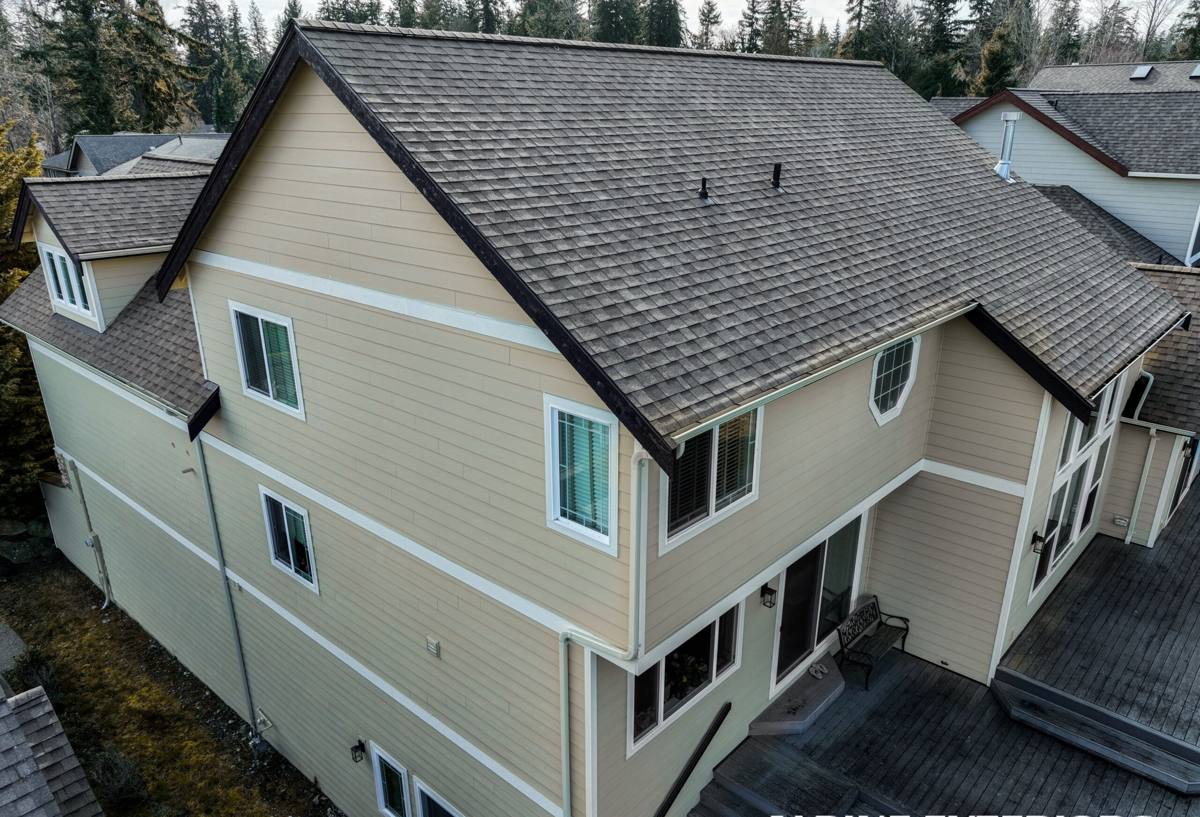
What "Composite Decking" Actually Covers
Composite decking isn't one product — it's a category, and the differences between tiers matter more in a wet, shaded climate than they do somewhere dry. Broadly:
Capped composite
Boards with a wood-plastic composite core wrapped in a polymer cap on all sides. The cap is what actually resists moisture absorption, staining, and mold growth — it's the reason capped composite has become the standard choice for our climate. Uncapped or partially capped boards let the core absorb moisture at cut ends and exposed faces, which is where problems start.
Composite vs. PVC vs. pressure-treated wood
PVC decking is fully synthetic — no wood fiber at all — and handles moisture the best of the three, but it looks and feels the most obviously synthetic and costs more. Pressure-treated wood costs the least up front but needs annual cleaning, periodic sealing, and will show cupping, splintering, and rot over time in a climate this wet — especially under tree cover where it never fully dries out. Capped composite sits in the middle: better moisture performance than wood, more natural wood-grain appearance than PVC, and a manufacturer warranty structure that typically covers staining and structural integrity for decades.
| Material | Moisture Resistance | Maintenance | Typical Lifespan |
|---|---|---|---|
| Pressure-treated wood | Low — absorbs water, needs sealing | Annual cleaning/sealing | 10–15 years in this climate |
| Uncapped composite | Moderate — core can still absorb moisture at edges | Periodic cleaning | 15–20 years |
| Capped composite | High — sealed cap on all sides | Occasional wash-down | 25–30+ years (mfr. warranty dependent) |
| PVC | Highest — no wood fiber to absorb moisture | Minimal | 25–30+ years |
What a Correct Installation Looks Like Under These Conditions
Substructure and drainage first
The decking material is only half the job. On a shaded Sudden Valley lot, what happens underneath the boards matters just as much as what's on top. Joists need to slope slightly for drainage, ledger connections need proper flashing so water can't work its way into the house rim joist, and there needs to be enough clearance under the frame for air to actually move. A deck built tight to grade in a shaded, damp yard will hold moisture against the framing indefinitely, and that's true no matter how good the decking boards themselves are.
Fastener and hardware choice
Salt-tinged marine air corrodes standard hardware faster than most homeowners expect, and it's a slow, invisible failure — you don't see it until a fastener lets go. Correct practice is stainless steel or coated hardware rated for the exposure, hidden fastener clips where the board profile supports them, and structural connectors sized to code rather than whatever's on the shelf.
Board spacing and airflow
Gapping between boards needs to account for composite's expansion and contraction with temperature and moisture, but it also needs to be wide enough to let debris and moisture pass through rather than pack in and feed moss growth. On shaded lots we typically run slightly more generous gapping and make sure the substructure has real airflow — a deck built too tight, too low, and too close to the trees will grow moss in the seams within a season or two regardless of what the boards are made of.
Moss, Mildew, and Long-Term Care on a Wooded Lakeside Lot
Even a correctly built capped composite deck in Sudden Valley needs some seasonal attention — it just needs far less than wood does. The main jobs are keeping leaf litter and needle drop out of the board gaps, rinsing pollen and organic buildup off the surface a couple of times a year, and giving shaded sections an occasional scrub with a soft brush and mild cleaner if algae film starts to show. What you want to avoid is pressure-washing composite at close range or high PSI — it can etch the cap surface and actually make the boards more prone to staining afterward, which defeats the purpose of choosing capped composite in the first place.
Gutters and any nearby roof runoff also deserve a look. A deck positioned under a roof valley or downspout with no diverter will take far more water than the rest of the surface and show it first — usually as a streak of algae or a spot where boards stay damp longest after everyone else has dried.
Permits, HOA Review, and Local Logistics
Sudden Valley is an association-governed community, and most exterior projects — deck construction and replacement included — go through an architectural or design review process before work starts, on top of whatever permit the county requires for the scope of work. Attached decks above a certain height, or anything involving structural changes to the ledger connection, typically need a building permit through Whatcom County. A crew that's worked in the neighborhood before knows to build that review time into the schedule rather than surprising the homeowner with it midway through the project.
There's also a simple logistics side to it. Sudden Valley's roads and lot access aren't identical to a flat in-town lot — material staging, dumpster placement, and delivery timing all go smoother when the crew has already worked the area and knows what to expect getting equipment and boards to the build site.
Our Process
- On-site walkthrough. We look at sun/shade exposure, existing structure (if replacing a deck), drainage, and access before quoting anything.
- Honest material recommendation. Based on your budget, how much shade the deck sits in, and how it'll be used, we'll tell you where capped composite makes sense and where it doesn't.
- Written estimate. Materials, labor, permit/HOA handling, and timeline spelled out — no vague allowances.
- Permit and review handling. We prepare what's needed for county permitting and HOA design review so you're not chasing paperwork.
- Build. Substructure, flashing, and drainage done right before a single deck board goes down.
- Final walkthrough. We go over care basics for your specific setup — shade level, tree cover, and drainage — so the deck actually reaches its warranty life.
What Drives Cost on a Sudden Valley Deck
| Factor | Why It Matters |
|---|---|
| Board tier (uncapped vs. capped composite vs. PVC) | Material cost per square foot varies significantly; higher tiers cost more but last longer and need less upkeep |
| Substructure condition | Replacing rotted or undersized framing adds cost but is not optional if the old structure is compromised |
| Height and railing requirements | Elevated decks need code-compliant railing and stairs, which adds material and labor |
| Site access | Sloped, wooded, or tight-access lots take longer to stage material and set up equipment |
| Permit/HOA scope | Larger or structurally different projects require more review and documentation time |
Why It Matters to Hire a Crew That Already Works This Neighborhood
None of the above is complicated on its own, but it adds up. A contractor who hasn't built in Sudden Valley before is learning the HOA review process, the access realities, and the shaded-lot moisture behavior on your project instead of coming in already knowing it. That shows up as delays, change orders, or — worse — a deck that looks right the day it's finished but starts showing moss and hardware corrosion two winters in because the substructure wasn't detailed for this specific climate and setting.
Before you sign a contract with anyone, it's worth checking a few basics:
- Are they licensed, bonded, and insured in Washington State — and will they show you proof without being asked twice?
- Do they have recent decking work you can see in this climate, not just photos from a dry-climate portfolio?
- Will they put the board tier, fastener type, and warranty terms in writing, not just "composite decking" as a line item?
- Do they understand Sudden Valley's HOA/design review process, or will you be figuring that out on your own?
- Do they account for drainage and ventilation in the substructure, or is the quote just about the visible boards?
- Is the timeline realistic given permit and review turnaround, or does it ignore that step entirely?
If you're weighing a new deck or a replacement in Sudden Valley, we're glad to walk the site, look at your sun and shade exposure, and give you a straight answer on what material and build approach actually fits your lot. The estimate is free, there's no pressure attached to it, and you can use the form below to get started.