 Bellingham Roofing
 York is one of Bellingham's older, established neighborhoods, which means a lot of its homes are carrying original or aging siding that was never engineered for the Pacific Northwest's specific brand of punishment. Between the salt-laden air drifting in off Bellingham Bay, driving rain that comes in sideways more often than straight down, and a moss and algae season that can stretch nine months of the year, exterior cladding in this part of Whatcom County gets tested constantly. We install James Hardie fiber cement siding in York because it's the one product system we've found that holds up to all three of those stresses at once without turning into a maintenance project for the homeowner.
What York's Climate Actually Does to Siding
Every siding material fails in its own way, and the failure mode is almost always tied to moisture and organic growth in this region. Salt air accelerates corrosion on exposed fasteners and metal trim, which is why fastener selection and flashing details matter more here than in drier inland climates. Driving rain — the kind that hits a wall at an angle instead of falling straight — finds every gap in a poorly lapped or under-caulked siding system and pushes water behind it, where it can sit against sheathing for months without drying out. And the long moss season means anything with even moderate porosity becomes a growth surface for algae and moss within a few years, not a few decades.
Older York homes often show all three problems layered on top of each other: rust streaking below nail heads, soft or delaminating panels at the bottom courses where rain splashes back off the ground, and dark green-black staining on north- and west-facing walls that never get direct sun to dry them out. None of that is a character flaw in the house — it's what happens to siding that wasn't built with this specific climate in mind.
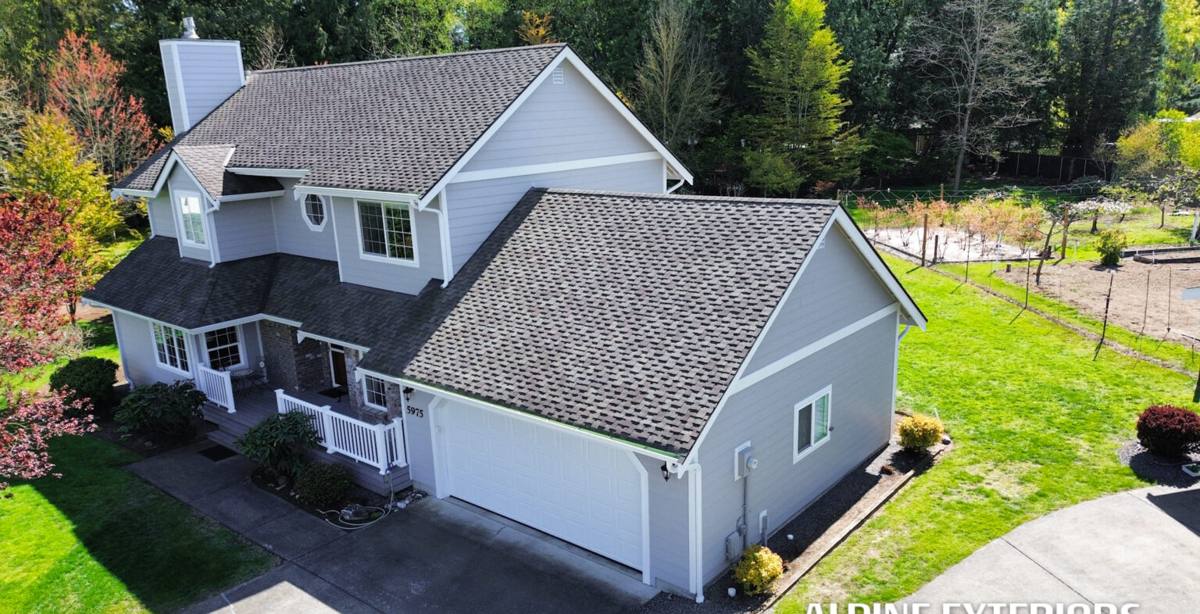
Why We Install James Hardie and Nothing Else
We made a deliberate decision years ago to standardize on James Hardie fiber cement and stop installing everything else — vinyl, LP SmartSide, primed wood, and other fiber cement brands included. That's not a marketing position, it's an installation standard. Fiber cement itself is non-combustible and dimensionally stable in a way wood-based products aren't, but the specific reasons we settled on Hardie come down to three things: the HZ5 product line is engineered for Pacific Northwest moisture exposure, the ColorPlus factory finish holds up to UV and salt air far better than field-applied paint, and the warranty is transferable if the home sells, which matters to homeowners who don't plan to be in York forever.
We're not going to tell you other products are junk — vinyl has its place on a budget, and engineered wood siding has genuinely improved over the last decade. But we've seen enough call-backs and premature failures in this specific climate that we stopped installing anything other than Hardie. If you want the honest trade-offs on any of those alternatives, we're glad to walk through them during an estimate.
What Correct Installation Actually Involves
Fiber cement siding is only as good as the installation underneath it. A rushed or by-the-book-ignored install will fail in this climate faster than most people expect, regardless of how good the panels themselves are. Here's what we consider non-negotiable on every York project.
Clearance and Drainage
Hardie's own installation instructions call for a minimum clearance between the bottom edge of the siding and grade, decks, and roof lines — and in a wet climate like this, we don't cut that close. We also install a proper drainage plane (weather-resistive barrier plus a rainscreen gap where the wall assembly calls for it) so that any water that does get past the siding has somewhere to go besides straight into the sheathing.
Fastening and Flashing
Given the salt air exposure this close to the water, we use corrosion-resistant fasteners and flash every window, door, and horizontal transition with materials rated for long-term wet exposure. Skipping or shortcutting flashing is the single most common cause of hidden water damage behind siding — it's invisible until the rot shows up years later.
Caulking and Finish
ColorPlus prefinished panels reduce how much field caulking and touch-up painting is needed, but joints, butt seams, and trim transitions still need to be sealed correctly with the right sealant for a fiber cement substrate. We follow Hardie's fastening and joint-treatment specs exactly — not because we have to, but because it's the difference between a 30-year siding job and a 10-year one.
James Hardie Compared to Other Common Options
| Factor | James Hardie Fiber Cement | Vinyl | Engineered Wood (LP-Type) |
|---|---|---|---|
| Moisture resistance in driving rain | Strong when installed to spec | Moderate — seams and gaps are vulnerable | Good, but core material is wood-based |
| Moss/algae resistance | ColorPlus finish resists staining better than raw surfaces | Prone to algae film in shaded, damp areas | Prone to surface growth without regular cleaning |
| Salt air / corrosion exposure | Panel itself doesn't corrode; fastener choice matters | Panel stable, but can become brittle over time in coastal wind | Wood fiber core sensitive to prolonged moisture |
| Fire resistance | Non-combustible | Combustible, can melt/warp near heat sources | Combustible |
| Warranty | Long-term, transferable to new owner | Varies widely by manufacturer and product tier | Typically shorter, installation-sensitive |
Our Process for a York Siding Project
We keep this straightforward because most homeowners just want to know what's going to happen to their house and for how long.
- On-site assessment — we walk the exterior, check for existing moisture damage behind current siding, and note any problem areas (grade clearance, missing flashing, rot at trim).
- Written estimate — a clear scope covering tear-off (if applicable), housewrap or rainscreen work, Hardie product line and color, trim, and timeline.
- Tear-off and inspection — once old siding comes off, we inspect the sheathing underneath before anything new goes up. Hidden rot gets addressed before we close the wall back up, not after.
- Weather barrier and drainage plane — installed correctly the first time, since this is the layer that actually keeps water out long-term.
- Hardie panel installation — fastened, flashed, and joined to manufacturer spec for this climate zone.
- Final walkthrough — we go over the finished work with you before we consider the job done.
Signs Your York Home's Siding Needs Attention
A lot of siding problems in this neighborhood get ignored because they start small and slow. Worth checking for:
- Soft or spongy spots when you press on the siding near the bottom courses or under windows
- Persistent dark green or black staining that comes back within weeks of cleaning
- Rust streaks running down from nail heads or metal trim
- Paint that's bubbling, peeling, or chalking heavily on one or two walls but not others
- Visible gaps or separation at seams, corners, or where siding meets window and door trim
- A musty smell in an adjacent interior room, which can indicate moisture behind the wall
What Affects Cost on a Project Like This
| Factor | Why It Matters |
|---|---|
| Tear-off vs. new construction | Removing and disposing of old siding, and repairing any sheathing damage found underneath, adds labor |
| Home size and wall complexity | Dormers, gables, and multiple stories increase both material cuts and labor time |
| Hardie product line selected | Lap siding, shingle-style panels, and board-and-batten carry different material and labor costs |
| Trim and accessory work | Corner boards, window trim, and fascia work are often bundled with siding for a consistent finish |
| Access and site conditions | Tight lots, mature landscaping, or steep grades common in older York properties can affect staging and labor |
We don't quote broad numbers without seeing the house, because the range on a real project depends entirely on the factors above. What we can tell you is that we price the job in writing, up front, with no surprise add-ons once we've started.
Why a Crew That Already Works York Matters
York's housing stock skews older than a lot of Bellingham's newer developments, and older homes tend to hide their own surprises — undersized original sheathing, old repairs done without flashing, or additions where the siding transitions were never detailed correctly. A crew that's worked on homes like this before knows to check for those issues before they become a change order mid-project. We're also close enough to be responsive if something comes up after the job is done — a warranty question, a piece of trim that needs a second look, whatever it is — without the delay of a contractor working out of a different part of the county.
After Installation: What Upkeep Looks Like
One of the real advantages of ColorPlus-finished Hardie siding in this climate is how little it asks of you afterward. It doesn't need repainting on the schedule that field-painted wood or fiber cement does, and it holds up to periodic gentle washing without the finish degrading the way some other materials do. Given Bellingham's moss season, an occasional rinse-down of north- and west-facing walls keeps organic growth from taking hold, but that's a homeowner task, not a contractor callback. Beyond that, the biggest thing we ask is that homeowners let us know if they notice any of the warning signs listed above — catching a flashing or caulking issue early is a five-minute fix, not a wall-opening repair.
If your York home's siding is showing its age, or you're planning ahead for a replacement before a small problem becomes a big one, we're happy to come take a look. The estimate is free, there's no pressure, and you'll walk away with a straight answer about what your house actually needs.