 Bellingham Roofing
 Why Blaine's Coastal Climate Is Hard on Siding
Blaine sits about as close to the water and the weather as a Whatcom County home can get. That waterfront position on the Salish Sea means siding here deals with a combination most inland Bellingham homes don't face at the same intensity: salt-laden air moving off the water, wind-driven rain that hits walls sideways instead of falling straight down, and a long, damp shoulder season where moss and algae get a real foothold on anything that stays wet. Any one of those factors will shorten the life of the wrong siding material. Together, they punish it.
Salt air is corrosive to exposed metal fasteners and trim, and it accelerates the breakdown of coatings that aren't formulated to resist it. Driving rain doesn't just wet the surface of a wall — it tests every seam, joint, and penetration, pushing water sideways and upward behind laps and around windows in a way that vertical rain never does. And the moss season that stretches through much of the fall, winter, and spring in this part of Washington means siding stays damp for extended stretches, which is exactly the condition that lets moss, mildew, and rot organisms establish themselves on porous or poorly finished surfaces.
None of this means siding can't hold up in Blaine. It means the material and the installation both have to be chosen for this specific environment, not for a generic Pacific Northwest climate zone. That's the standard we hold every job to.
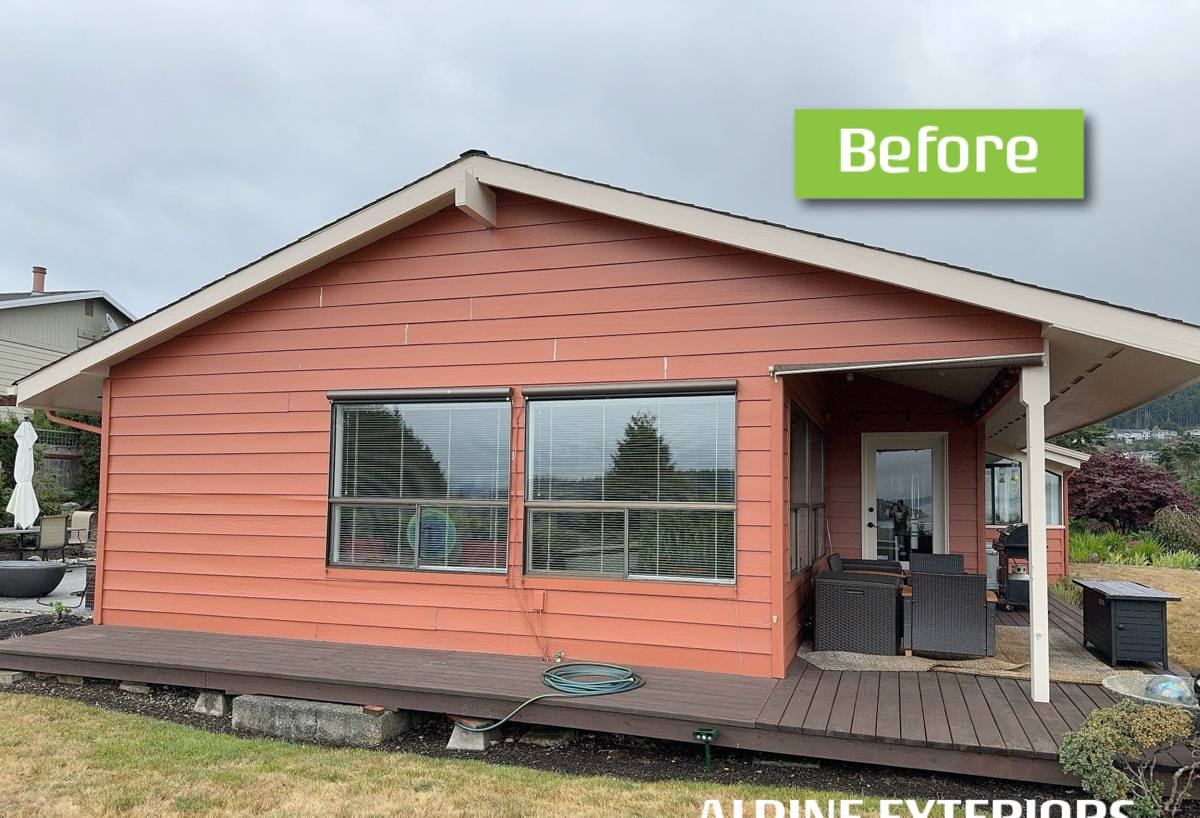
What "Correct" Siding Installation Actually Involves
Siding failures in coastal Whatcom County almost never start with the siding panel itself. They start behind it — with a weather-resistive barrier that was cut short, a flashing detail that was skipped, or fasteners that were driven wrong. A wall assembly is a system, and every layer has a job.
The Weather Barrier and Drainage Plane
Behind every siding installation we do is a continuous weather-resistive barrier, lapped correctly from bottom to top so water is always shed downward and outward, never trapped. In a climate with as much driving rain as Blaine sees, we also build in a drainage gap where the wall assembly calls for it, so any moisture that does get past the siding has somewhere to go besides sitting against the sheathing.
Flashing at Every Penetration
Windows, doors, hose bibs, light fixtures, vents — every penetration through the wall plane is a place water can get in if it's not flashed correctly. This is the detail work that separates a durable installation from one that looks fine for a year or two and then starts showing stains and soft spots. We flash to shed water past the opening, not into it.
Fastening and Clearances
James Hardie siding has specific fastening requirements — fastener type, spacing, and depth all matter, and getting them wrong voids the manufacturer's warranty and creates cracking or fastener-pop over time. We also hold proper clearances at grade, roofing, decks, and other siding-to-hard-surface transitions, since a board that sits too close to the ground or a patio is a board that stays wet and starts absorbing moisture at the bottom edge.
Why We Install Only James Hardie Fiber Cement
We don't install vinyl, LP SmartSide, primed spruce, cedar, or other fiber cement brands. That's a deliberate standard, not a limitation on what we're capable of installing. Each of those alternatives comes with a real trade-off — vinyl can warp and become brittle in temperature swings and doesn't stand up well to impact; engineered wood products rely on factory sealing that has to stay intact at every cut edge or moisture gets in; cedar and primed wood need ongoing maintenance and are more vulnerable to the rot and moss growth that Blaine's damp season encourages.
James Hardie fiber cement is non-combustible, dimensionally stable across our temperature range, and its ColorPlus factory finish is baked on and warrantied against fading and chipping in a way field-applied paint isn't. It holds up to the kind of sustained damp, salt-touched exposure that this stretch of coastline delivers year after year — not just in a brochure, but in how the material physically resists moisture absorption and coating breakdown. For homes exposed to driving rain and salt air, that durability difference compounds over decades.
Climate-Engineered Product Lines
James Hardie doesn't make one siding product — it engineers different HZ (HardieZone) formulations for different climate demands, and that matters in a marine environment like Blaine's. The formulation used in wetter, more humid coastal zones is built with moisture and freeze-thaw performance in mind, which is the right match for a location where the walls are rarely fully dry for long stretches at a time.
We spec the product line and profile to the specific home and exposure — a wall that takes the brunt of the prevailing wind and rain off the water may call for different detailing attention than a more sheltered elevation of the same house, even though both get the same Hardie material.
Common Hardie Siding Profiles
- HardiePlank lap siding — the most common profile, available in multiple widths and textures, the classic horizontal look
- HardieShingle — for homes wanting a shingle or shake appearance without the maintenance of real wood shakes
- HardiePanel — vertical panel siding, often used for accent sections or board-and-batten style
- HardieTrim — matching trim boards for corners, fascia, and window/door surrounds, finished to hold up alongside the siding itself
Our Installation Process
Every job follows the same disciplined sequence, whether it's a full re-side or a targeted section replacement:
- On-site assessment — we look at the existing wall assembly, check for hidden moisture damage or rot in the sheathing, and evaluate exposure on each elevation of the home.
- Tear-off and sheathing repair — old siding comes off, and any compromised sheathing or framing found underneath is repaired before anything new goes on. Covering up a wet or rotten wall with new siding just hides the problem.
- Weather barrier installation — a new, continuous weather-resistive barrier goes on, lapped and taped to manufacturer specification.
- Flashing — every window, door, and penetration is flashed before siding starts.
- Hardie installation — siding is installed to James Hardie's fastening and clearance specifications, which is what keeps the manufacturer's warranty intact.
- Trim and detail work — corners, trim, and caulking joints are finished last, with attention to the same water-shedding logic used throughout.
- Final walkthrough — we walk the finished job with the homeowner before calling it done.
Material Comparison for a Coastal Whatcom County Home
| Material | Salt Air / Coastal Exposure | Driving Rain Resistance | Moss/Algae Resistance | Long-Term Maintenance |
|---|---|---|---|---|
| James Hardie Fiber Cement | Strong — non-combustible, dimensionally stable | Strong when properly flashed | Good — factory finish resists organic growth | Low — occasional wash, no repainting cycle |
| Vinyl | Can become brittle with temperature swings | Seams are a common leak point | Moderate — can trap moisture behind panels | Low upfront, but limited repair options if damaged |
| LP SmartSide / Engineered Wood | Vulnerable at exposed or cut edges | Moderate — edge sealing is critical | Moderate, depends on coating integrity | Moderate — edge maintenance is ongoing |
| Cedar / Primed Wood | Absorbs moisture, salt accelerates weathering | Weak without diligent upkeep | Weak — prone to moss and mildew in damp seasons | High — regular refinishing required |
What Drives the Cost of a Blaine Siding Project
| Factor | Why It Matters |
|---|---|
| Home size and wall complexity | More corners, gables, and dormers mean more cutting, flashing, and labor time |
| Existing wall condition | Hidden rot or moisture damage found during tear-off adds repair scope |
| Siding profile and finish | Lap width, shingle-style profiles, and trim detailing affect material and labor cost |
| Exposure and elevation detailing | Sides facing prevailing wind and rain often need more careful flashing work |
| Access | Site access, scaffolding needs, and landscaping around the home affect labor time |
We give exact numbers only after walking the property — anyone quoting a firm price sight unseen for a coastal Whatcom County home is guessing.
What to Ask Any Siding Contractor Before Hiring
- Are you a certified or factory-trained installer for the specific siding brand you're proposing?
- What weather-resistive barrier and flashing details do you use, and can you explain how they handle wind-driven rain?
- How do you fasten the siding, and does that match the manufacturer's warranty requirements?
- What happens if you find rot or moisture damage once tear-off starts?
- Do you carry liability insurance and workers' compensation coverage?
- Can I see the manufacturer warranty terms in writing before work begins?
Why It Matters That We Already Work in Blaine
A crew that regularly works this stretch of Whatcom County isn't guessing at how to handle salt exposure, driving rain, or a wet moss season — they've seen how those conditions actually play out on real walls over real winters. That shows up in small decisions: which elevations get extra flashing attention, how clearances are held near grade in a climate where things rarely dry out fast, and which product line and profile make sense for a specific home's exposure. Those are judgment calls that come from experience with this specific coastline, not from a generic installation manual.
Maintaining Your Siding After Installation
James Hardie siding is low-maintenance, not no-maintenance. A little attention keeps it performing the way it's designed to in this climate:
- Rinse the exterior periodically to clear salt residue and organic buildup, especially on shaded or north-facing walls that stay damp longest
- Keep gutters clear so water isn't overflowing and running down the wall face
- Trim back vegetation and landscaping that holds moisture against the siding
- Check caulking at trim joints and penetrations periodically and have any gaps resealed
- Address any impact damage or cracked boards promptly rather than letting moisture get behind them
If your Blaine home's siding is aging, showing moss staining, or you're planning ahead for a re-side, we're happy to walk the property, look at what your walls are actually dealing with, and put together a straightforward, no-pressure estimate. There's a form right below to get that conversation started.