 Bellingham Roofing
 "Energy-efficient windows" gets used as a catch-all marketing phrase, but for a homeowner in Sunnyland it should mean something specific: windows that keep conditioned air where it belongs, keep Whatcom County's weather out, and hold their performance for decades rather than just for the first winter. Sunnyland is one of Bellingham's older, established residential neighborhoods, with a mix of homes that range from early- to mid-century construction to more recent remodels and infill. That mix matters, because the window problems we find in a 1940s single-pane wood sash are different from the problems we find in a 1990s aluminum-frame slider, even though both end up costing the homeowner money on the heating bill.
Why Older Sunnyland Homes Lose So Much Energy Through Their Windows
Windows are almost always the weakest point in a home's building envelope, and older homes make that worse in a few predictable ways. Original single-pane wood windows have no insulating gas layer and often no low-emissivity coating at all, so heat moves through the glass itself with very little resistance. Decades of settling and seasonal wood movement open up gaps around the sash and frame that no amount of weatherstripping fully solves. And storm windows or early-generation double-pane retrofits, common in homes that got a partial upgrade at some point, frequently have failed seals that nobody notices until the glass fogs.
Newer aluminum-frame windows from a later remodel era bring a different problem: aluminum conducts heat efficiently, which is exactly what you don't want in a frame material. Even a double-pane aluminum window can perform poorly if the frame itself is acting as a bridge straight from the cold outside air to the warm interior trim. None of this is unique to Sunnyland, but it shows up here often enough that we treat window condition as a standard thing to evaluate on almost any exterior project in the neighborhood, not an afterthought.
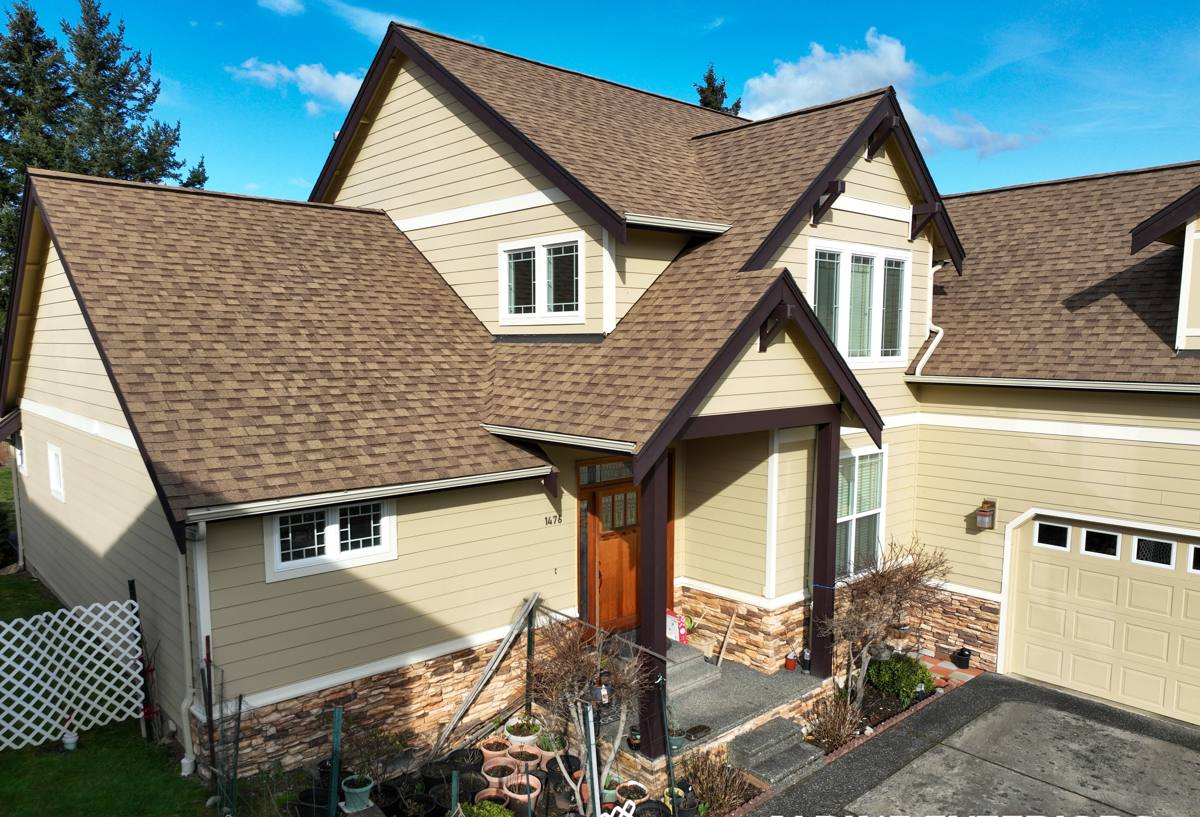
The Climate Factor: What Bellingham's Weather Does to Windows Over Time
Whatcom County's marine climate is mild compared to a lot of the country, but mild doesn't mean easy on a building. Salt-laden air moving in off Bellingham Bay accelerates corrosion on window hardware, fasteners, and lower-grade frame components over the years, especially on the sides of a house that catch the prevailing wind. Storms coming off the water drive rain sideways into wall assemblies rather than letting it run straight down, which tests flashing and sealant details that a calmer climate would never stress. And the long, damp moss season here keeps shaded or north-facing exterior surfaces wet for extended stretches, which is exactly the condition that lets wood rot take hold around sills and trim if water is finding its way in anywhere.
For windows specifically, that combination means two separate things have to be right: the unit itself has to actually insulate well, and the installation around it has to keep water out for good. A high-performance window installed with a sloppy flashing job will still let moisture into the wall cavity, and a beautifully flashed opening with a cheap, leaky window still won't cut the heating bill. We treat both halves as part of the same job.
Where Failure Actually Starts
It's rarely the center of the glass that fails first. It's the corners of the frame, the bottom of the sill, and the perimeter where the window meets the wall — the spots where wind-driven rain gets pushed hardest and where a rushed installation is most likely to skip a step. On an older Sunnyland home, that's also often where decades of prior repairs, caulk-over-caulk, or minor rot are already hiding, which is why a real inspection matters more than a quick measurement.
What "Energy-Efficient" Actually Means on a Spec Sheet
Every window sold today gets an NFRC (National Fenestration Rating Council) label, and that label is the honest way to compare products instead of relying on the word "efficient" printed on a brochure. The two numbers that matter most for a Whatcom County home are U-factor, which measures how much heat escapes through the whole window assembly (lower is better), and Solar Heat Gain Coefficient (SHGC), which measures how much solar heat passes through the glass. In our climate, a lower U-factor generally matters more than chasing an extremely low SHGC, since we get far more heating-season heat loss than cooling-season solar gain to manage.
Beyond those two numbers, a few construction details separate a genuinely efficient window from one that just looks new:
| Feature | What It Does |
|---|---|
| Double or triple glazing | Adds an insulating air or gas gap between panes to slow heat transfer |
| Low-E coating | A microscopically thin coating that reflects heat back while still letting light through |
| Argon or krypton gas fill | Denser than air, slows conductive heat transfer between panes |
| Warm-edge spacer | Reduces heat loss and condensation risk right at the edge of the glass |
| Frame material | Determines how much the frame itself conducts heat and how it holds up to moisture over time |
| Weatherstripping and hardware | Determines actual air infiltration, which matters as much as the glass on a windy site |
Signs Your Sunnyland Home's Windows Are Underperforming
Most homeowners don't think about window performance until something obvious happens, but there are earlier signs worth paying attention to:
- Noticeable drafts near the window even when it's fully latched
- Fog, haze, or moisture trapped between panes of an existing double-pane unit — a sign the seal has failed
- Condensation forming on the inside of the glass regularly during cold weather
- Cold spots in a room that are worse near the window wall than the rest of the room
- Windows that are difficult to open, close, or lock, which usually points to frame movement or warping
- Visible soft spots, discoloration, or peeling finish on the wood sill or surrounding trim
- A heating bill that's noticeably higher than similar-sized homes nearby
Any one of these on its own isn't necessarily urgent, but a few of them together on the same window usually means the unit is past the point where caulk and weatherstripping will fix it.
What a Correct Energy-Efficient Window Installation Involves
Assessment and Measurement
We start by looking at the actual opening, not just the visible window — checking for square, level, and any hidden rot or prior water intrusion around the frame. On an older Sunnyland home, this step often turns up something that wasn't visible from inside, and it's better to find it before ordering than after the new unit shows up.
Removal and Opening Prep
The old window comes out carefully so we can see the condition of the rough opening underneath. Any soft framing, failed old flashing, or gaps in the wall's water-resistive barrier get addressed at this stage — installing a new, efficient window into a compromised opening just locks the problem behind new trim.
Flashing and Air Sealing
This is the step that decides whether the window actually performs the way its NFRC label says it should, and it's the step most likely to get shortcut on a rushed job. Flashing has to be sequenced correctly with the wall's weather-resistive barrier so water sheds outward and down, never behind the window. Around the frame itself, we air-seal the gap between the window and the rough opening with an appropriate low-expansion foam or backer rod and sealant — a gap packed loosely with fiberglass insulation and nothing else is a common shortcut that leaves a real air leak behind a finished-looking wall.
Frame and Glazing Selection
We'll walk through the honest trade-offs for the specific window rather than defaulting to whatever's easiest to install. Frame material affects both energy performance and how the window holds up to Bellingham Bay's salt air and the neighborhood's wet season over the long run.
Finish and Trim Integration
Interior and exterior trim gets matched to the rest of the house so the finished window looks intentional, not like a patch job. On older homes with existing wood trim profiles, this sometimes takes more care than the window installation itself.
Our Process, Start to Finish
- On-site assessment — we inspect the existing windows, the surrounding framing, and any signs of past water intrusion before recommending anything
- Honest recommendation — full replacement, or in some cases repair, explained with the reasoning rather than an automatic upsell
- Product selection — we go over frame material, glazing package, and realistic performance numbers for your specific openings and budget
- Ordering and scheduling — we give you a realistic timeline, since window lead times vary by manufacturer and season
- Removal and opening prep — old units come out carefully, and any hidden framing or flashing issues get addressed before the new window goes in
- Installation, flashing, and air sealing — the new unit is set, shimmed, flashed, and sealed to keep water out and conditioned air in
- Trim and finish — interior and exterior trim is completed to match the rest of the home
A Quick Checklist Before You Sign a Window Contract
- Ask for the NFRC U-factor and SHGC numbers for the specific product being quoted, not just a general "energy-efficient" claim
- Confirm whether the opening will be inspected for rot or prior water damage before installation, not discovered mid-project
- Ask what the flashing and air-sealing plan looks like around the frame — it should be a real answer, not a shrug
- Get a written timeline, since custom or special-order sizes take longer than stock units
- Clarify what's covered under warranty for the window itself versus the installation labor, since they're often separate
- Ask how many similar projects the crew has completed in this specific neighborhood or climate
Costs and Trade-Offs: Choosing a Frame Material for This Climate
We won't quote a number without seeing the openings, since window count, size, and existing condition all move the price. But the frame material trade-offs are consistent enough to lay out honestly:
| Frame Material | Energy Performance | Maintenance in This Climate | General Cost |
|---|---|---|---|
| Vinyl | Good insulator; performance varies by chamber design and glazing package | Low — doesn't corrode or rot, holds up well to salt air and moisture | Lower to mid-range |
| Fiberglass | Very good; dimensionally stable, minimal thermal bridging | Low — highly resistant to moisture and temperature swings | Mid to higher |
| Aluminum | Weaker unless thermally broken; conducts heat readily | Moderate — corrosion-resistant finishes help, but salt air is still a factor | Varies widely |
| Wood | Good natural insulator | Higher — needs regular finish maintenance to resist Bellingham's wet season | Higher |
| Wood-clad | Good, similar to wood core | Moderate — exterior cladding protects the wood, interior still needs care | Higher |
In a climate with as much sustained moisture and salt exposure as Sunnyland gets off Bellingham Bay, we generally steer weather-facing installations toward vinyl or fiberglass frames, since both hold up to years of driving rain and damp shoulder seasons with less upkeep than an all-wood exterior. Wood or wood-clad units can still make sense where the interior look is a priority and the homeowner is prepared for the maintenance that comes with it — that's a legitimate choice, just one worth making with the full picture.
Why Hiring a Crew That Already Works Sunnyland Matters
Manufacturer installation instructions are written for average conditions, and Sunnyland's older housing stock combined with Whatcom County's wet, salt-air climate isn't average. A crew that has actually opened up walls in this neighborhood knows which older homes tend to have hidden rot behind the trim, how much air-sealing detail actually matters given how wind-driven the rain gets off the bay, and when a window opening needs more than a quick caulk job before a new unit goes in. That experience shows up in decisions that never make it into a sales pitch — how tightly a flashing course gets lapped, whether a sill needs a sloped composite cap instead of relying on sealant alone, how much time it's worth spending on air-sealing a gap that won't be visible once the trim goes back on. Those are the details that decide whether new windows are still performing the way they should in fifteen years or letting in drafts and moisture in five.
Ready to Look at Your Windows?
If your Sunnyland home has drafty, foggy, or hard-to-operate windows, or you're just tired of a heating bill that doesn't match how well-kept the rest of the house is, it's worth having someone look at the actual openings before you start comparing quotes. We offer free, no-pressure estimates for energy-efficient window projects in Sunnyland and throughout Bellingham — use the form below to get a time on the schedule.