 Bellingham Roofing
 Ferndale's Climate Is Rougher on Siding Than It Looks
Ferndale sits close enough to the water and to the open farmland of the Nooksack lowlands that homes here take a steady beating most homeowners underestimate. Salt-tinged air moving in off the Strait works into seams and fasteners year-round. Driving rain, pushed sideways by wind rather than falling straight down, finds every gap in a siding system that wasn't detailed for it. And because this part of Whatcom County stays cool, damp, and shaded for long stretches of the year, moss and algae get a running start on any surface that holds moisture.
None of that is dramatic on its own. What it does is compound. A siding product that's merely "good enough" in a drier climate gets tested every single season here — and over ten or fifteen years, the difference between a product engineered for this kind of exposure and one that isn't shows up as cupping, soft spots, streaking, or paint failure. That's the lens we use for every Ferndale siding job: not what looks right on install day, but what still looks and performs right after a decade of Pacific Northwest weather.
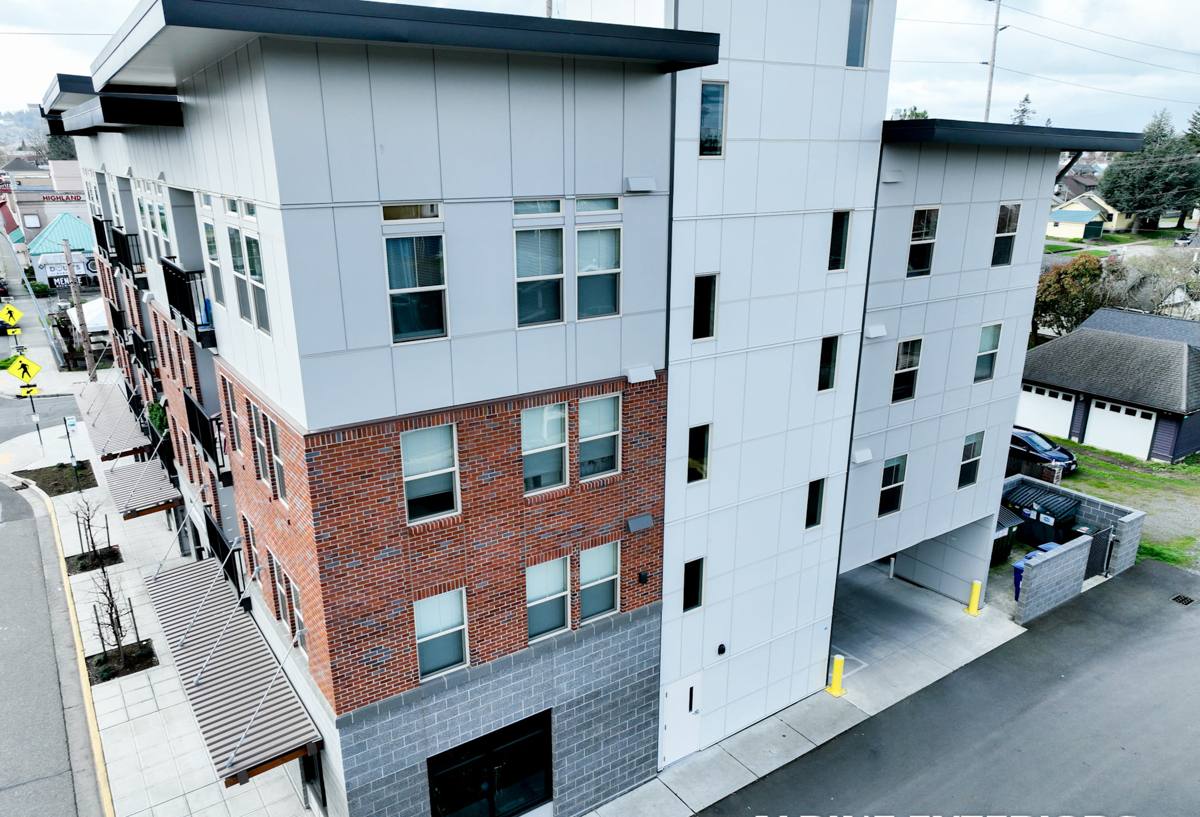
What James Hardie Siding Brings to a Ferndale Home
We install James Hardie fiber cement siding exclusively — not as a sales preference, but because it's the one product line built with this exact climate in mind. Hardie's manufacturing process produces a dense, cement-based board that doesn't absorb water the way wood-based or wood-fiber products can, and it's non-combustible, which matters given how many Whatcom County homes sit near dry brush or wooded lots in summer.
The HZ5 Engineering Advantage
James Hardie makes climate-specific versions of its siding, and the Pacific Northwest falls under their HZ5 engineering zone — formulated for regions with sustained moisture exposure. That's a meaningful distinction from a generic fiber cement board: the moisture resistance and durability testing behind HZ5 products is calibrated for weather like Ferndale actually gets, not a national average.
ColorPlus Factory Finish
Most of what fails first on a house isn't the siding material itself — it's the paint. Field-applied paint on any siding substrate is only as good as the surface prep and the weather on install day, and it starts breaking down against UV and moisture within a handful of years. Hardie's ColorPlus finish is baked on at the factory in a controlled environment, backed by its own finish warranty, and holds color and integrity far longer against the kind of damp, low-sun conditions Ferndale sees most of the year.
Why We Don't Install Vinyl, LP SmartSide, or Other Alternatives
We get asked why we've standardized on one product. It's a fair question, and the honest answer is that we've seen how each alternative performs in this specific climate over time.
Vinyl siding is inexpensive and easy to install, and in a drier climate it can be a reasonable choice. But vinyl expands and contracts significantly with temperature swings, its seams and laps are more forgiving of moisture intrusion than fiber cement, and it's a combustible plastic product. In a marine climate with driving rain, those seams are exactly where water finds its way behind the cladding.
LP SmartSide and other engineered wood products use a wood-strand substrate with a resin coating. When that coating is intact and the product is installed and maintained exactly to spec, it performs reasonably. But wood-strand cores are inherently more moisture-sensitive than cement, and any breach — a missed caulk joint, a cut edge left unsealed, a fastener that backs out — gives moisture a path into a substrate that swells and deteriorates faster than fiber cement does. Given how much sustained dampness and moss growth this area sees, we don't think that's a fair trade-off to put on a homeowner's house.
Cedar and primed spruce siding have real appeal — they look great and plenty of homeowners want that material specifically. But solid wood siding demands an ongoing maintenance commitment: refinishing on a cycle, vigilant caulking, and real risk of rot if that maintenance slips even a year or two, which is a common outcome once a house changes hands. We'd rather install a product where skipping a year of upkeep doesn't put the substrate at risk.
None of these products are "bad." They're just not what we're willing to warranty our workmanship on in a climate built to punish weak points.
James Hardie Product Lines: What Fits a Ferndale Home
| Product | Typical Use | Why It Works Here |
|---|---|---|
| HardiePlank Lap Siding | Primary wall cladding, most home styles | Traditional lapped profile sheds driving rain effectively; widest color and texture selection |
| HardiePanel Vertical Siding | Modern facades, gable accents, shop/outbuilding walls | Clean vertical lines, pairs well with board-and-batten detailing |
| HardieShingle Siding | Accent gables, Craftsman and cottage-style homes | Staggered or straight-edge shingle look without the moisture upkeep of cedar shakes |
| HardieTrim Boards | Corners, window and door casing, fascia | Matches the siding's moisture resistance so trim doesn't become the weak point |
What a Correct Installation Involves in This Climate
Fiber cement siding is only as good as the installation behind it. In a climate with this much driving rain and sustained dampness, a handful of details separate a siding job that lasts decades from one that causes problems in five to seven years.
Moisture Management Behind the Cladding
Correct installation starts with a weather-resistive barrier and properly integrated flashing at every window, door, and penetration — done in the right shingle-lap order so water is always directed outward and down, never behind the barrier. Rainscreen gaps or furring, where called for, let any moisture that does get behind the siding drain and dry instead of sitting against the wall sheathing.
Fastening and Clearances
Hardie specifies exact fastener types, spacing, and placement, plus minimum clearances from grade, roof lines, and decks so the bottom edge of the siding never sits where standing water or splash-back can reach it. Ferndale's mossy, damp ground-level conditions make that clearance detail especially important — siding installed too close to grade or a horizontal surface is siding that stays wet longer than it should.
Joints, Caulking, and Cut Edges
Every cut edge needs to be sealed, and butt joints need to be treated correctly rather than just butted and caulked over. Skipping this is one of the most common shortcuts in fiber cement installation, and it's invisible on install day — it only shows up years later as staining or soft spots at the seams.
Cost Factors for a Ferndale Siding Project
| Factor | How It Affects the Project |
|---|---|
| Home size and wall complexity | More corners, dormers, and gables mean more cutting, flashing, and labor time |
| Removal of existing siding | Tear-off and disposal of old vinyl, wood, or damaged cladding adds cost versus a bare wall |
| Underlying sheathing condition | Rot or moisture damage found once old siding comes off may need repair before new siding goes on |
| Product line and profile | HardieShingle and detailed trim work run higher than straight HardiePlank lap runs |
| Color selection | Factory ColorPlus finishes vs. field-applied paint affect both cost and long-term maintenance |
We give exact numbers only after walking a specific property — anything else is a guess that doesn't account for what's actually on the wall.
Our Process for Ferndale Siding Projects
We start with an on-site inspection and walk the exterior with the homeowner, looking at existing siding condition, trim, flashing, and any moisture staining that hints at problems behind the wall. From there we put together a written scope and estimate specific to that house — not a generic per-square-foot number.
Once a project is scheduled, our crew handles removal of old siding, inspection and repair of sheathing where needed, correct weather barrier and flashing installation, and then the Hardie siding, trim, and caulking to manufacturer spec. We clean up thoroughly at the end of each work day, not just at project close, since a work site sitting open overnight in Ferndale's rain is asking for trouble.
Maintaining James Hardie Siding in a Moss-Prone, Salt-Air Environment
Hardie siding is low-maintenance compared to wood, but "low-maintenance" isn't "no-maintenance," especially in this climate. A simple annual routine keeps it performing the way it should:
- Rinse the siding down once or twice a year with a garden hose and soft brush to clear salt residue, pollen, and early moss or algae growth before it takes hold
- Keep gutters clear so overflow doesn't run down the wall face and feed moss growth at the top courses
- Trim back shrubs and trees so foliage isn't holding moisture against the siding or shading it into permanent dampness
- Check caulking at trim joints, window casings, and butt joints every couple of years and re-caulk any cracked or pulled-away sections
- Walk the base of the walls after winter and look for splash-back staining, which usually means a gutter, downspout, or grading issue needs attention — not the siding itself
Why a Crew That Already Works Ferndale Matters
Siding installation done by the book on paper can still go wrong if the crew isn't thinking about how a specific site sits relative to wind, rain direction, and shade. A crew that already works in Ferndale and the surrounding Bellingham area has seen where moss establishes first on local homes, which wall orientations take the worst of the driving rain, and how grading and drainage issues on this kind of ground tend to show up at the base of a wall. That local pattern recognition is part of what keeps a siding job from having to be revisited in a few years.
It also means straightforward accountability — the same company that installed the siding is the one you call if a warranty question comes up down the road, without a longer trip or an unfamiliar face standing in for someone else's work.
If you're weighing siding options for a Ferndale home, we're happy to take a look and give you a straight, no-pressure assessment of what your house actually needs. Use the form below to request a free estimate.