 Bellingham Roofing
 Happy Valley's Roofs Work Harder Than Most
Happy Valley sits close enough to Bellingham Bay that homes here deal with a specific combination of stress most inland neighborhoods never see: salt-laden air moving in off the water, long stretches of driving rain through fall and winter, and a moss season that can run most of the year under the tree canopy common to this part of the neighborhood. None of these forces is dramatic on its own. Together, over years, they're what actually shortens a roof's life here — not one big storm, but a steady grind of moisture, organic growth, and metal fatigue that a roof built for a drier climate was never designed to handle.
When we talk about a new roof installation for Happy Valley specifically, we mean a roof assembled and detailed to shed constant moisture, resist salt-air corrosion on fasteners and flashing, and stay clean enough that moss doesn't get a foothold in the first place. That's a different set of decisions than a generic "install a roof" job, and it starts before a single shingle goes down.
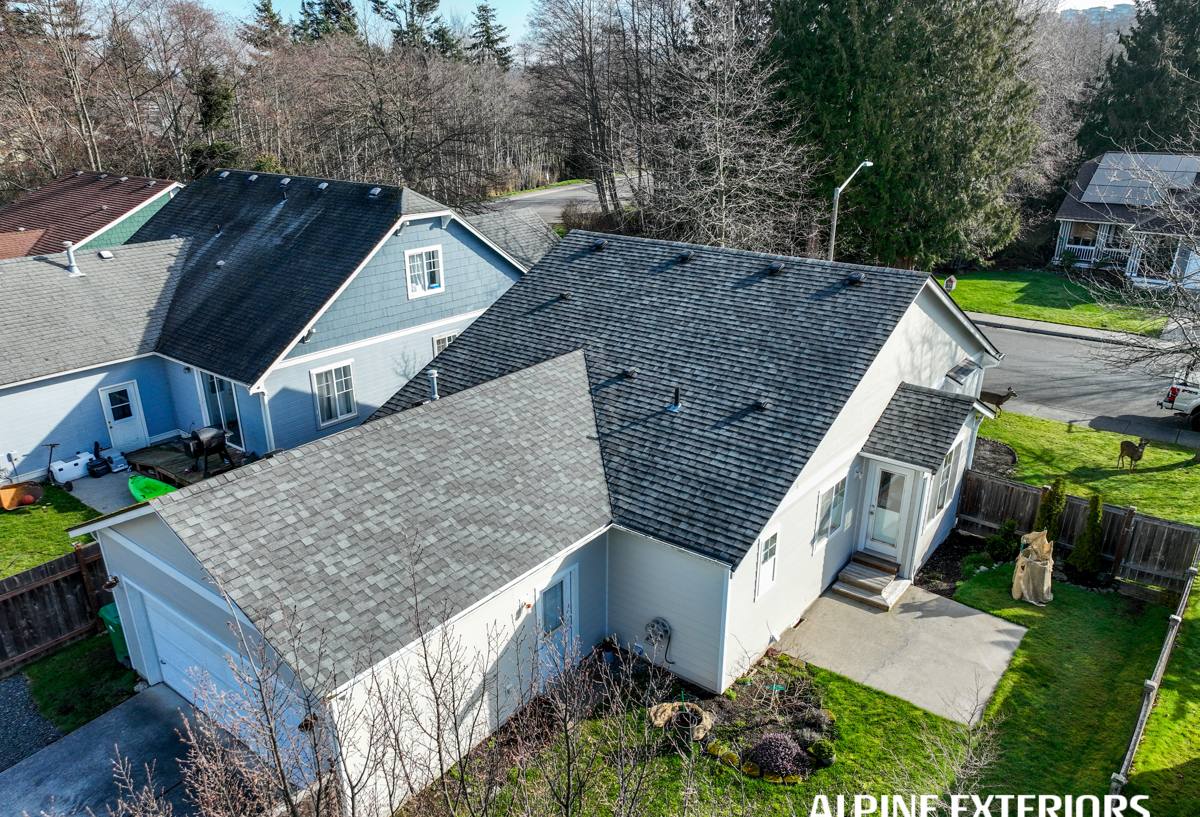
What Salt Air, Rain, and Moss Actually Do to a Roof
Salt Air
Airborne salt accelerates corrosion on any exposed metal — nails, flashing, vent stacks, and gutter hardware. Standard electro-galvanized fasteners can start showing rust streaks and weakening well before a roof's shingles are due for replacement. In a proximity-to-water neighborhood like Happy Valley, the fastener and flashing spec matters as much as the shingle brand.
Driving Rain
Bellingham's rain rarely falls straight down. Wind-driven rain gets pushed sideways and upward under laps, ridges, and around penetrations — which is exactly where a rushed installation fails first. Underlayment coverage, lap direction, and flashing detail at valleys and walls carry more weight here than in calmer climates.
Moss
Moss doesn't just look bad — it holds moisture against the roof surface, lifts shingle edges as it grows, and works into granule layers over time. Shaded, north-facing slopes and areas under overhanging trees are where it takes hold first, and Happy Valley has plenty of both.
Each of these problems is manageable individually. A roof that only accounts for one or two of them is the kind we get called out to repair a few years after another contractor's "new roof."
What a Correct Installation Involves
A new roof installation done right for this climate isn't just materials — it's sequencing and detail work that most homeowners never see once the roof is finished. The pieces that actually determine how long the roof lasts:
- Full tear-off to bare decking, with the decking inspected and any soft or delaminated sheathing replaced before anything new goes on
- Ice-and-water shield or high-quality synthetic underlayment at eaves, valleys, and any low-slope transitions, lapped to shed wind-driven rain rather than just gravity-fed rain
- Corrosion-resistant fasteners and flashing appropriate for a marine-influenced air environment, not the cheapest code-minimum option
- Balanced intake and exhaust ventilation so moisture-laden air actually leaves the attic instead of condensing on the underside of the deck
- Careful flashing at every chimney, skylight, wall intersection, and pipe penetration — these are the highest-failure points on any roof, and doubly so under sustained rain
- Drip edge and gutter apron detail that actually directs water into the gutter system instead of behind it
Skip or rush any one of these and the roof might look fine for a season or two before the real problems start showing up as stains, soft spots, or moss creeping in exactly where drainage or ventilation was shortchanged.
Choosing the Right Roofing Material for This Neighborhood
There's no single "best" roofing material for Happy Valley — the right choice depends on your home's slope, shade exposure, budget, and how long you plan to stay in the house. Here's how the common options actually perform under this neighborhood's conditions:
| Material | Moss Resistance | Salt-Air Durability | Typical Lifespan Here |
|---|---|---|---|
| Architectural asphalt shingle | Moderate — benefits from algae-resistant granules | Good with proper fastener/flashing spec | 25–30 years |
| Standing seam metal | Excellent — sheds moss with minimal upkeep | Requires marine-grade coatings/fasteners to avoid premature corrosion | 40–50+ years |
| Synthetic/composite shake | Good — resists organic growth better than wood | Good, low metal exposure | 30–40 years |
| Cedar shake (untreated) | Poor — moss and moisture are the primary failure mode | Neutral, but shortened lifespan due to moisture retention | 15–20 years, often less under heavy shade |
We're honest with Happy Valley homeowners about untreated cedar shake specifically because of how this neighborhood's shade and moisture combine — it's a maintenance-heavy choice here, not because the material is bad everywhere, but because the moss and rot risk under tree cover is real and ongoing. If you love the look, treated or composite shake alternatives give you a similar appearance with far less upkeep.
Our Installation Process
Every new roof we install in Happy Valley follows the same sequence, adjusted for your home's specific slope, shade, and drainage layout:
- Inspection and assessment — we walk the roof and attic, check for deck damage, ventilation gaps, and problem areas specific to your home's exposure
- Written scope and material selection — you get a clear breakdown of what's being replaced, what underlayment and flashing spec is used, and why
- Tear-off and deck inspection — old roofing comes off completely; any damaged decking is identified and replaced, not covered over
- Underlayment and flashing installation — the moisture-management layer goes down first, with extra attention at valleys, eaves, and penetrations
- Field material installation — shingles, panels, or shakes installed to manufacturer spec and adjusted for local wind-driven rain exposure
- Ventilation check — intake and exhaust are verified as balanced, not just present
- Final walkthrough — we go over the finished roof with you before we consider the job done
Ventilation and Long-Term Moisture Control
A new roof's biggest hidden failure point isn't usually the surface material — it's what's happening underneath it. Attics that don't exhaust moist air properly end up with condensation on the roof deck itself, which rots sheathing from the inside regardless of how good the shingles are. In a climate with Bellingham's rainfall and humidity, we treat ventilation as part of the roofing system, not an afterthought. That means checking soffit intake isn't blocked by insulation, ridge or box vents are sized correctly for the attic volume, and nothing is short-circuiting the airflow path.
What to Expect During the Project
Most single-family new roof installations in this size range take one to three days of active work, weather permitting — and weather is the operative variable in Whatcom County. We schedule with realistic buffer for rain days rather than promising a date we can't guarantee, because a roof rushed to finish ahead of a storm is exactly the kind of shortcut that causes problems later. You'll get a clear starting window, daily updates on progress, and a heads-up if weather pushes the schedule.
Cost Factors Homeowners Should Understand
Pricing on a new roof depends on more than square footage. The factors that move the number most for Happy Valley homes specifically:
| Factor | Why It Matters Here |
|---|---|
| Roof pitch and complexity | Steeper or multi-plane roofs take longer to install and detail correctly, especially around valleys |
| Deck condition | Homes with past moisture intrusion sometimes need sheathing replacement, which isn't visible until tear-off |
| Material choice | Metal and composite options cost more upfront but reduce moss and maintenance costs over the roof's life |
| Ventilation upgrades | Older homes often need intake or exhaust improvements bundled into the reroof |
| Access and tree cover | Shaded, tree-crowded lots can add setup and cleanup time |
We give you an itemized estimate so you know exactly what's driving the price — not a single lump number with no explanation behind it.
Signs Your Happy Valley Home May Need a New Roof
- Granule buildup in gutters or at downspout outlets
- Moss or dark streaking across shaded slopes, especially north-facing sections
- Curling, cupping, or missing shingles after wind events
- Daylight visible through the attic roof deck
- Soft spots or sagging when walking the roof (assessed by a professional, not a DIY walk)
- Interior ceiling stains that appear or worsen after heavy rain
- A roof approaching or past 20–25 years old with no major work done
Any one of these on its own might just mean a repair. Several together, especially on an older roof, usually mean it's time to talk about full replacement before a repair becomes a recurring expense.
Why Local Experience in Happy Valley Matters
A roofing crew that's worked this neighborhood before already knows which slopes hold moss longest, which streets sit closest to salt-air exposure, and how the local drainage and tree-shade patterns tend to play out on a roof over time. That's not something you get from a general contractor working from a generic spec sheet — it comes from having done the work here, seen what fails first, and adjusted the installation accordingly. For Whatcom County homeowners, that local pattern recognition is often the difference between a roof that needs attention again in eight years and one that goes the full distance of its expected lifespan.
If you're weighing a new roof for your Happy Valley home, we're happy to walk the roof with you, explain exactly what we're seeing, and put together a clear, no-pressure estimate — just fill out the form below to get started.