 Bellingham Roofing
 Birch Bay's Coastline Is Rough on Ordinary Siding
Birch Bay sits right on the water in Whatcom County, and that location comes with a specific set of challenges most inland siding jobs never have to deal with. Salt-laden air moves off the water and settles on everything facing the shoreline, wind-driven rain gets pushed sideways into wall assemblies that were only ever designed to shed water falling straight down, and the tree cover that gives so many Birch Bay properties their privacy also keeps siding shaded and damp for long stretches of the year. Add in a stretch of moss season that can run from late fall through spring, and you have a climate that actively works against whatever material is on the wall.
None of this is unique to one house or one block — it's the baseline condition for anything built near this stretch of the Whatcom County coast. Siding that performs fine forty minutes inland can fail early here, and the failure usually isn't dramatic. It's slow: fastener corrosion, soft spots at butt joints, moss creeping up from the bottom courses, paint that chalks and fades faster than it should. By the time it's visible, the damage has usually been building for a couple of seasons.
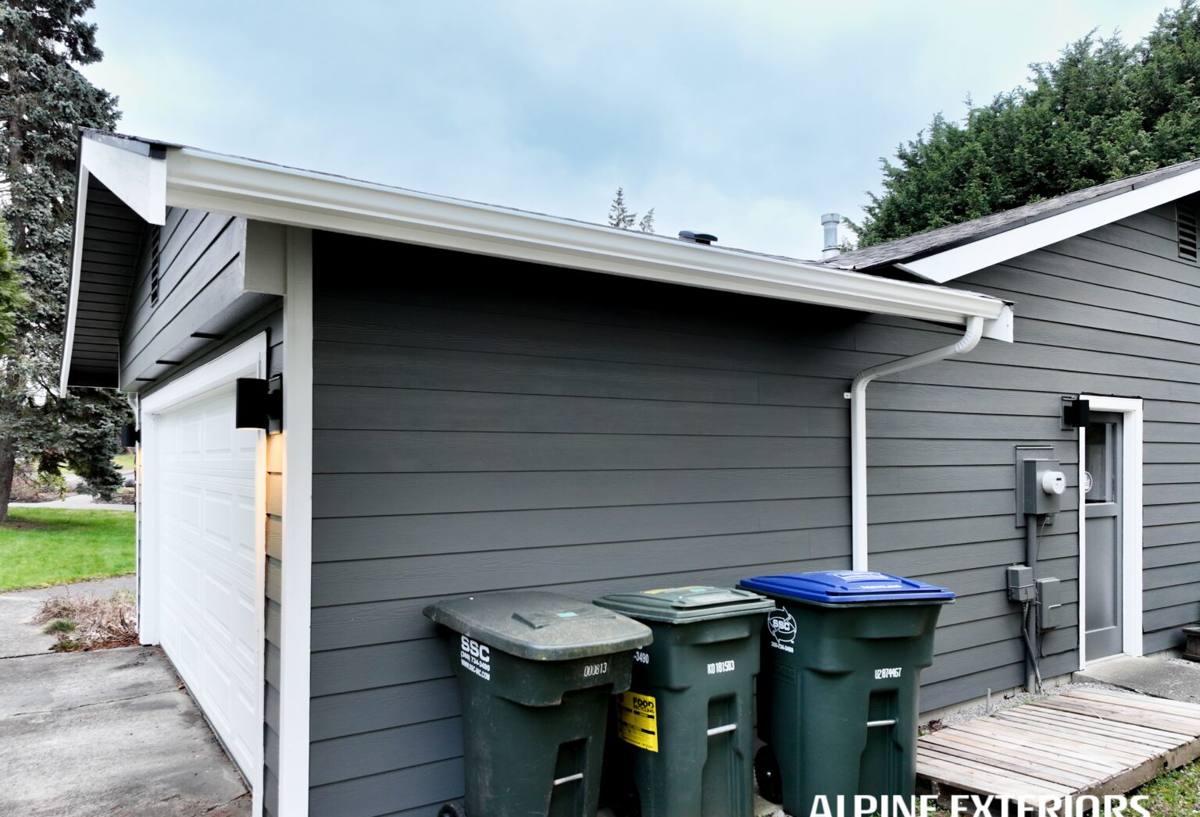
Why We Only Install James Hardie Fiber Cement
We standardized on James Hardie fiber cement siding for every home we work on, including here in Birch Bay, and we don't install vinyl, LP SmartSide, or cedar. That's not a marketing position — it's a decision based on what actually holds up in a marine climate over decades, not just years.
Fiber cement is made from cement, sand, and cellulose fiber, which means it doesn't absorb moisture the way wood-based products do, and it won't soften, delaminate, or feed the kind of fungal growth that drives moss and mildew problems on damp, shaded walls. It's also non-combustible, which matters on a coastline where summer wildfire smoke and drought conditions have become a more regular part of the calendar in the Pacific Northwest. James Hardie backs its siding with a strong, transferable limited warranty, and its ColorPlus factory-finish coating is engineered to resist fading and chipping far longer than field-applied paint — a real advantage when salt air is already working to break down lesser finishes.
Built for This Specific Climate
James Hardie engineers its products in climate-specific formulations, and homes on this part of the Washington coast fall into what the company designates its HZ5 zone — built for wet, freeze-prone regions rather than the hot, humid HZ10 formulation used in the Gulf South. That distinction matters more in Birch Bay than in most places, because the combination of marine moisture and winter freeze-thaw cycles is exactly the stress profile HZ5 fiber cement is formulated to handle.
What Correct Installation Actually Involves
James Hardie siding performs the way it's rated to perform only when it's installed to the manufacturer's specification — and in a coastal, high-moisture environment like Birch Bay, the details matter more than usual. A rushed or generic install can leave a technically "Hardie" home just as vulnerable to moisture intrusion as one sided in a lesser product.
- Weather-resistive barrier: a continuous, properly lapped house wrap or building paper behind the siding, with all penetrations sealed before a single board goes up.
- Rain-screen gap: furring or a drainage mat behind the siding so wind-driven rain that gets past the surface can drain and dry instead of sitting against the sheathing.
- Correct clearances: minimum gaps from grade, roofing, decks, and other trim so moisture can't wick up into the plank from below.
- Fastener selection: corrosion-resistant, coastal-rated fasteners driven at the manufacturer's specified pattern — a detail that's easy to shortcut and expensive to ignore near salt air.
- Sealed cut edges: every field cut primed or sealed before installation, since a raw cut edge is the fastest path for moisture into the board.
- Proper flashing at every penetration: windows, doors, hose bibs, and vents all get integrated flashing, not just a bead of caulk.
Skip any one of these steps and the siding itself can still be excellent — the wall assembly around it won't be. That's the gap between "we installed James Hardie" and "we installed James Hardie correctly for this climate."
What We See Going Wrong on Older Birch Bay Homes
On tear-offs and re-sides in this area, the recurring problems aren't usually about the siding material failing on its own — they're about how the wall was built underneath it. Missing or poorly lapped weather barriers, caulk used in place of real flashing, and no rain-screen gap behind the siding are the three issues we run into most. Combine any of those with years of salt exposure and shaded moisture, and you get rot at the sheathing level long before the visible siding looks obviously bad.
Siding Options in a Coastal Climate: An Honest Comparison
Homeowners in Birch Bay are usually comparing a handful of materials when they start pricing a re-side. Here's how they actually stack up against the conditions this location produces — salt air, sustained moisture, and heavy shade in a lot of yards.
| Material | Salt Air / Moisture Behavior | Moss & Mildew Resistance | Maintenance Burden | Typical Lifespan |
|---|---|---|---|---|
| James Hardie fiber cement | Does not absorb moisture or swell; factory finish resists salt-driven fading | High — cement-based, doesn't feed fungal growth | Low — occasional wash, no repainting on ColorPlus finishes | 30+ years to manufacturer warranty terms |
| Vinyl | Can warp, fade, and become brittle with UV and temperature swings | Moderate — moss grows on the surface but doesn't penetrate | Low, but panels are hard to color-match if damaged | 20–30 years, variable |
| Cedar / wood | Absorbs moisture readily; salt air accelerates weathering and checking | Low — organic material, moss and mildew take hold easily | High — regular staining, sealing, and spot repair | 15–25 years with diligent upkeep |
| Engineered wood (LP-style) | Resin-treated wood strand; vulnerable at cut edges and joints if not sealed perfectly | Moderate, but moisture intrusion at seams can cause swelling | Moderate — edge sealing and joint maintenance are critical | 20–30 years if installation is flawless |
Every material on that list can be installed well or poorly. What tips the balance for us is how a product behaves when the install isn't perfect — because no installation stays perfect forever, and this climate finds every weak point eventually. Fiber cement gives you the widest margin for error over time.
James Hardie Product Lines That Fit Birch Bay Homes
Most homes in this area are well suited to HardiePlank lap siding, which handles the region's traditional and craftsman-style exteriors and comes in a range of textures, from smooth to a cedar-like woodgrain. Homes with gable ends, dormers, or accent areas often pair it with HardieShingle for a shingled look that doesn't carry the moisture risk of actual wood shakes. For modern or clean-lined homes, HardiePanel vertical siding gives a board-and-batten look that also sheds wind-driven rain efficiently along vertical seams.
ColorPlus factory finishes are worth prioritizing here specifically because of the salt air. A factory-baked finish is more uniform and more fade- and chip-resistant than field-applied paint, which matters when the air itself is working to break coatings down faster than it would twenty miles inland.
Our Process for a Birch Bay Job
- On-site assessment: we look at wind exposure, shade patterns, drainage around the foundation, and the condition of the existing wall assembly before quoting anything.
- Tear-off and sheathing check: old siding comes off and we inspect the sheathing underneath for rot or moisture damage before covering anything back up.
- Weather barrier and rain-screen installation: a continuous, properly detailed barrier and drainage gap go in first — this is the step that determines how the wall performs for decades.
- Flashing at every penetration: windows, doors, and any wall-mounted fixture get real flashing, not caulk as a substitute.
- Hardie installation to manufacturer spec: correct fastener type and pattern, correct clearances, sealed cut edges.
- Final inspection and cleanup: we walk the exterior with the homeowner before calling the job done.
What to Expect From a Properly Installed Job
- A written scope that specifies rain-screen or furring detail, not just "install siding"
- Manufacturer-appropriate, corrosion-resistant fasteners specified for a marine environment
- Flashing integration at every window, door, and penetration — visible in the scope, not assumed
- Sealed or primed cut edges on every field-cut board
- A copy of the James Hardie limited warranty terms and how the installer's workmanship warranty layers with it
- A clear plan for existing moisture or rot found once old siding comes off, before work continues
Why Local Experience in Birch Bay Matters
A crew that already works this stretch of the Whatcom County coast knows what to check for before the first board comes off — where moss tends to build up fastest, which sides of a house take the worst of the wind-driven rain, and how much drainage detailing a given lot actually needs based on tree cover and slope. That's not something a crew coming from an inland market picks up on their first job here. It usually shows up as a callback a year or two later, once the moisture that was never properly managed finds its way into the wall.
It also matters for scheduling and access. Waterfront and near-waterfront properties often have tighter site conditions, seasonal considerations, and sometimes shared access or setback issues that a crew familiar with the area anticipates rather than discovers mid-project.
If you're planning a siding project on a Birch Bay home, we're happy to walk the property with you, take a real look at how the current siding and wall assembly are holding up, and put together a straightforward, no-pressure estimate for a James Hardie installation built for this specific coastline.