 Bellingham Roofing
 Why Siding in Sudden Valley Wears Differently Than Siding Elsewhere in Bellingham
Sudden Valley's wooded, lakeside setting is a big part of why people live there, and it's also the reason siding here fails in a specific, predictable way. Mature tree canopy keeps whole wall sections in shade for most of the day, which means siding stays damp far longer after a storm than it would on an open, sun-exposed lot. That extended dampness is exactly what moss and algae need to take hold, and once a colony establishes itself on a wall, it holds moisture against the surface around the clock instead of just after it rains.
Layer in the driving rain that moves through Whatcom County most of the fall and winter, plus the damp marine air that settles over the region during storm systems, and you get a siding environment that punishes anything with a weak moisture defense. We're not describing a hypothetical — it's the pattern we see over and over on repair calls in this neighborhood: north- and east-facing walls with heavier moss growth, trim boards that have absorbed water for years before anyone noticed, and caulk joints that gave out long before the siding itself did.
None of this means Sudden Valley homes are doomed to constant siding problems. It means the repair work has to account for shade, moss, and sustained moisture as the default condition, not the exception — and that the material going back on the wall needs to be able to handle it.
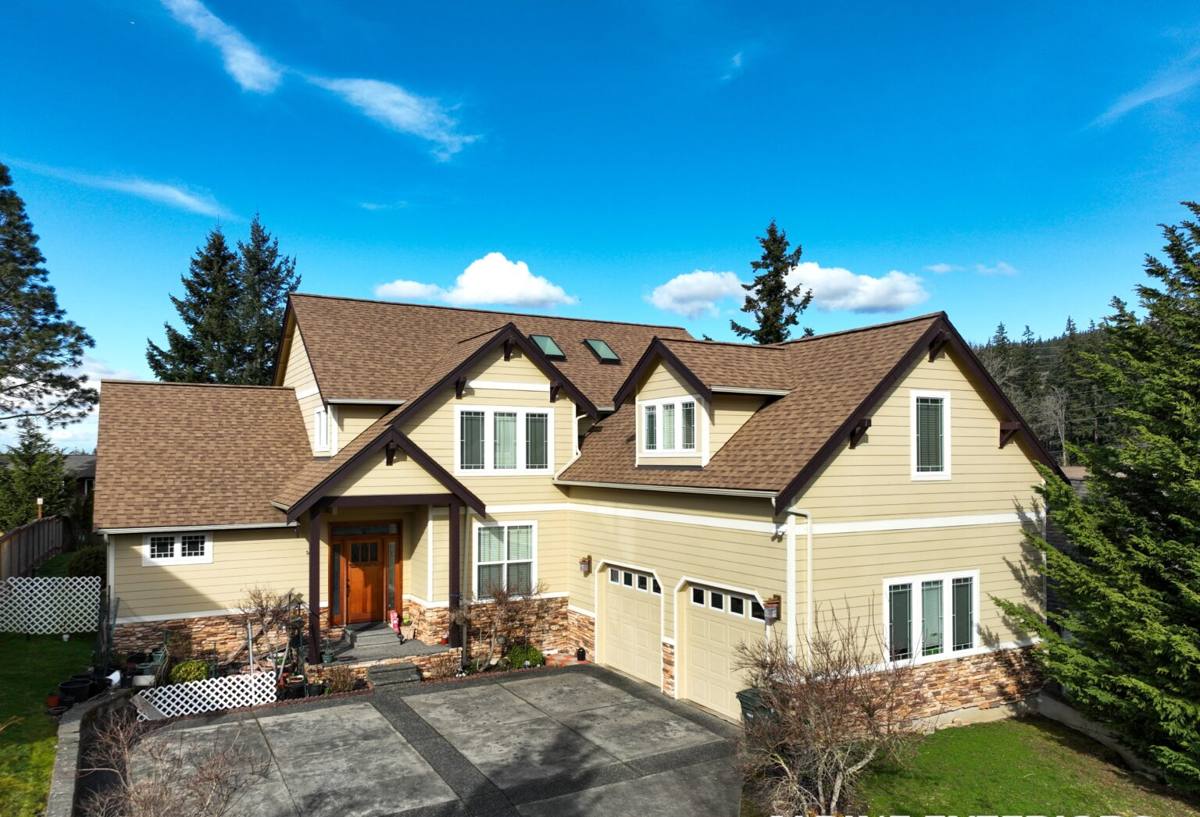
The Siding Repair Issues We Actually See in This Neighborhood
Moss and Algae Staining That's More Than Cosmetic
A green or black film on siding isn't just an eyesore. Moss holds water against the surface, and on materials that aren't dimensionally stable or properly sealed, that trapped moisture works its way into seams, fastener holes, and butt joints over time. By the time staining is heavy enough to notice from the street, the moisture behind it has often been active for a season or two already.
Moisture Trapped Behind the Cladding
Shaded walls near tree lines don't just get wet on the surface — they stay damp in the wall cavity longer, too. When house wrap, flashing, or caulking has failed, that moisture has nowhere to go, and the first visible sign is often soft trim, bubbling paint, or siding that feels spongy at the bottom edge.
Caulk and Sealant Failure at Trim and Penetrations
UV exposure is lower under tree cover, but moisture cycling is higher, and that combination breaks down caulk joints faster than most homeowners expect. Failed caulking around windows, doors, and utility penetrations is one of the most common single causes of a siding repair call we get in this area.
Impact and Debris Damage
Wooded lots come with falling branches, wind-blown debris, and the occasional impact from yard equipment or storm activity. A cracked or punctured panel is usually a simple fix on its own — but only if it's caught and repaired before water gets behind it.
What a Correct Siding Repair Actually Involves
Diagnosing the Cause, Not Just Patching the Symptom
Anyone can screw a new piece of siding over a damaged spot. The harder — and more important — part is figuring out why that spot failed in the first place. Was it a flashing detail that was never installed correctly, a caulk joint that aged out, grade or landscaping holding moisture against the bottom course, or a gutter that's been overflowing onto the wall below? Repairing the visible damage without addressing the cause just buys a year or two before the same spot fails again.
Checking What's Underneath
Any time we open up a damaged section, we're looking at the house wrap or weather-resistive barrier underneath, the flashing around any nearby openings, and the condition of the sheathing itself. If moisture has already reached the wall structure, that has to be addressed before new siding goes back on — otherwise you've covered a problem instead of fixing it.
Matching Material the Right Way
James Hardie's factory-applied ColorPlus finish is baked on and warrantied, which is a real advantage during a repair — but it also means a patch has to be sourced and cut correctly to blend in rather than standing out as an obvious repair. That includes matching the plank profile and exposure, not just the color, and properly sealing cut edges according to Hardie's installation specifications so the repaired section performs as well as the original siding around it.
Why We Only Repair and Install James Hardie Fiber Cement
In an environment where shade, moss, and sustained moisture are the norm rather than the exception, the material matters as much as the workmanship. James Hardie fiber cement is non-combustible, dimensionally stable, and engineered specifically for wet Pacific Northwest climates through its HZ5 product line — it doesn't absorb water the way wood-based or wood-composite products can, and it doesn't warp, swell, or rot the way those materials can when they stay damp for extended periods.
We've made a deliberate decision not to install or patch-repair vinyl siding, LP SmartSide, primed wood, or cedar. Each of those products has legitimate strengths, and we're not going to pretend otherwise — vinyl is inexpensive and low-maintenance in dry climates, wood has real curb appeal, and engineered wood products have improved over the years. But in a shaded, moisture-heavy setting like Sudden Valley, their weak points are exactly the ones that cause the most repeat repair calls: seam and moisture sensitivity in engineered wood products, expansion and contraction issues in vinyl that can loosen fastening over time, and ongoing maintenance demands in solid wood that most homeowners don't have the time or budget to keep up with. Standardizing on Hardie lets us give a straight answer about how a repair will hold up, backed by a manufacturer warranty that transfers if the home sells.
Repair or Replace? How We Help Sudden Valley Homeowners Decide
Not every siding problem calls for a full re-side, and we don't push replacement when a targeted repair will genuinely hold up. The honest answer depends on a handful of factors we walk through on every inspection.
| Factor | Leans Toward Repair | Leans Toward Replacement |
|---|---|---|
| Extent of damage | Isolated to one or two wall sections | Recurring damage across multiple elevations |
| Moisture readings | Localized, sheathing unaffected | Elevated readings spreading through the wall |
| Age of existing siding | Newer Hardie install, matching material available | Older, discontinued profile or a different material entirely |
| Underlying cause | A single fixable detail (flashing, caulk, gutter) | Systemic issue affecting the whole weather barrier |
| Cosmetic match | Repair will blend in acceptably | Patch would be visibly mismatched |
Most of the calls we get in Sudden Valley are genuine repair situations — a section of trim, a run of siding near grade, or a wall that took damage from a fallen branch. We'll tell you plainly when a repair is the right call, and we'll tell you plainly when it isn't.
Our Siding Repair Process
- On-site inspection. We look at the damaged area, the surrounding siding, trim, flashing, and any drainage or grading issues nearby.
- Moisture check. Where there's any sign of water intrusion, we check moisture levels in the affected area before deciding on scope.
- Sourcing the match. We identify the correct Hardie profile, exposure, and ColorPlus color, or a compatible substitute where an exact match isn't available.
- Repair or replacement of the damaged section. Damaged material comes out, any underlying issue with the barrier or flashing gets corrected, and new material goes in to Hardie's installation specifications.
- Sealing and finishing. Cut edges are sealed, joints are caulked with the correct sealant, and the area is cleaned up before we leave.
Keeping Repaired Siding Ahead of Sudden Valley's Shade and Moss
A correct repair will hold up on its own, but a little seasonal attention keeps it — and the rest of the siding — from developing the same problem again. This matters more here than in sunnier parts of Bellingham, simply because tree cover slows drying time year-round.
- Trim back branches and shrubs that keep siding in constant shade or brush against the wall
- Clean gutters at least twice a year so overflow isn't running down the siding face
- Rinse moss and algae buildup with a soft wash approach rather than a pressure washer, which can force water behind panels and joints
- Check caulk at trim, windows, and penetrations annually and re-caulk before it fully fails
- Keep mulch and landscaping pulled back from direct contact with the bottom siding course
- Walk the exterior after major storms and note any new staining, soft spots, or damage early
Why It Matters to Hire a Crew That Already Works in Sudden Valley
Siding repair done right depends on recognizing patterns, and a crew that's already worked on homes in this neighborhood has seen which walls take the worst of the shade and moisture, which older Hardie profiles are still available to match, and how community access and site conditions around Lake Whatcom affect scheduling and material staging. That local familiarity shows up in small ways that matter — knowing to check a north-facing wall more carefully, or recognizing a caulk failure pattern before it turns into a bigger repair.
It also means a contractor who isn't guessing at what Whatcom County's weather does to a wall over a few years. We install and repair Hardie siding across Bellingham, and Sudden Valley's tree cover and lake-adjacent humidity are conditions we plan for, not surprises we react to.
If you've got moss buildup, a soft spot in your trim, or storm damage on your siding, we're happy to take a look and give you a straight assessment — repair or replace, no pressure either way. Reach out for a free estimate using the form below.