 Bellingham Roofing
 Composite Decking in Columbia: Built for a Damp, Marine-Influenced Neighborhood
Columbia is one of Bellingham's established neighborhoods, and like most of the city it sits within reach of the marine air moving in off Bellingham Bay and the Salish Sea. That air carries a mild salt content, and combined with Whatcom County's steady rainfall, it creates conditions that are hard on any exterior surface that stays wet for long stretches. A deck takes more of that punishment than almost any other part of a house — it's horizontal, it's exposed on top and underneath, and it sits low to the ground where moisture lingers longest.
We build and replace decks throughout Columbia using composite decking, and we've settled on that material specifically because of what this climate does to lower-grade wood decking over time. This page covers what Columbia homes actually need from a deck given the local weather, what a correct composite installation involves, and why it's worth hiring a crew that already understands this neighborhood's exposure rather than treating every deck the same.
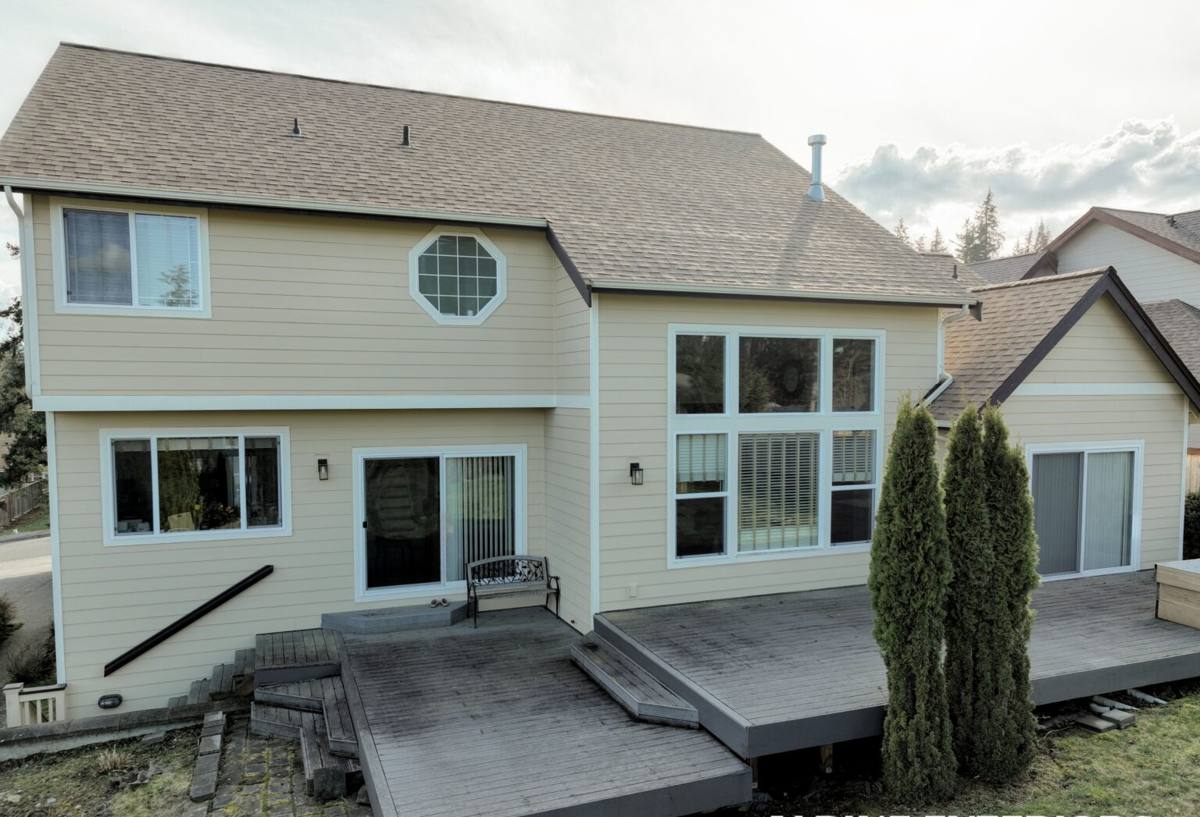
What Bellingham's Climate Does to a Deck
Salt-Tinged Marine Air
Whatcom County's proximity to the water means the air moving through Columbia carries more moisture and mineral content than a comparable inland location. Over years, that steady exposure works on any deck hardware that isn't rated for it — fasteners, brackets, and connectors can corrode faster than homeowners expect, and a fastener failure is one of the more serious problems a deck can develop, since it's a structural issue rather than a cosmetic one.
Driving Rain
Rain in this region rarely falls straight down for long. Wind off the bay pushes it sideways into railings, fascia boards, and the gaps between deck boards, and a deck surface that can't shed that water quickly stays damp far longer than it should. Standing water and trapped moisture between boards are what drive rot, cupping, and mildew growth in traditional wood decking, and they're the main reason a deck that looked fine when it was installed can be soft and failing within a decade.
A Long Moss Season
Between the marine humidity and the region's extended stretch of overcast, rainy months, Columbia properties — especially those with any tree cover or shade — rarely get a long enough dry period for moss and algae to fully die back. Moss on a deck surface isn't just an appearance issue; it holds moisture against the boards underneath it and turns a walking surface slick and genuinely dangerous when wet. Materials that hold water at the surface give moss a longer window to establish itself before the next dry spell arrives.
Why Composite Decking Makes Sense for Columbia Homes
Traditional wood decking — pressure-treated lumber, cedar, or anything similar — can look great when it's first installed, but it depends entirely on the homeowner keeping up with sealing, staining, and cleaning on a schedule that most people find hard to maintain year after year. In a climate that stays damp as much of the year as Whatcom County does, gaps in that maintenance schedule show up fast as splintering, graying, cupping, or soft spots. Composite decking doesn't remove maintenance entirely, but it removes the dependency on frequent refinishing to keep moisture out of the board itself.
- Moisture resistance: Composite boards, particularly capped versions, don't absorb water into the core the way solid wood does, which matters directly in a climate where boards are wet more often than they're dry.
- No sealing or staining cycle: There's no annual sealing schedule to fall behind on, which is the single biggest reason wood decks in this region deteriorate faster than they should.
- Resistance to splintering and cupping: Composite doesn't dry out and splinter or absorb water unevenly and cup the way lower-grade wood does after repeated wet-dry cycling.
- Consistent appearance over time: Capped composite holds its color and surface texture far more consistently through repeated damp seasons than field-finished wood.
- Manufacturer warranties: Most composite product lines carry meaningful stain, fade, and structural warranties that stay with the material as long as it's installed to spec — something field-finished wood simply doesn't offer.
Composite isn't the right call for every homeowner or every budget, and we're upfront about that. It costs more up front than pressure-treated lumber. But for a deck that's going to sit in Whatcom County's rain and marine air for the next twenty-plus years, the reduced maintenance burden is what most Columbia homeowners actually want once they understand the trade-off.
Capped vs. Uncapped Composite
Not all composite decking is built the same. Capped composite has a polymer shell fully wrapping the wood-plastic core, which is what actually blocks moisture absorption at the board surface. Uncapped or partially capped composite exposes more of that core to weather, and in a climate this consistently wet, that difference shows up in staining and moisture uptake over time. We install fully capped composite product lines specifically because of how much of the year Columbia decks spend wet.
What a Correct Composite Deck Installation Actually Involves
The composite board itself is only part of what makes a deck last in this climate. A capped composite surface installed over a poorly built substructure will still develop problems — just underneath the boards instead of on top of them.
Framing and Joist Spacing
Composite decking has different structural properties than solid wood and generally requires tighter joist spacing than a traditional lumber deck to prevent flexing and long-term sagging. Manufacturers publish specific span tables for their products, and following them is what keeps a composite deck feeling solid underfoot for its full lifespan rather than developing a bounce a few years in.
Ledger Board Flashing
Where a deck attaches to the house, the ledger board connection is one of the most common places water finds its way into a wall assembly if it isn't flashed correctly. Given how much wind-driven rain Columbia homes see off the bay, we treat proper ledger flashing as a baseline requirement, not an upgrade — it's the difference between a deck that sheds water away from the house and one that quietly feeds moisture into the wall behind it.
Hidden Fasteners and Corrosion-Rated Hardware
Given the marine-influenced air in this region, we use fasteners and structural hardware rated for coastal or high-moisture exposure rather than standard-grade hardware. Hidden fastener systems also keep the board surface free of exposed screw heads, which both looks cleaner and removes another point where water can sit and work its way into the board.
Drainage and Airflow Underneath
A deck built low to the ground or over unimproved soil needs a way for air to move and moisture to drain from underneath, not just off the top surface. Without it, the underside of the joists and the ground beneath the deck stay damp far longer after rain than they should, which shortens the life of the substructure even when the composite decking on top is performing exactly as designed.
Comparing Decking Materials for a Columbia Property
| Material | Moisture Behavior | Maintenance in This Climate | Typical Longevity |
|---|---|---|---|
| Capped composite | Resists moisture absorption at the surface; core is shielded | Low; occasional washing, no sealing or staining | 25-30+ years with correct installation |
| Pressure-treated lumber | Absorbs and releases moisture readily; prone to cupping | High; needs regular sealing and cleaning to slow rot and moss | 10-15 years, often less without disciplined upkeep |
| Cedar | Naturally moisture-resistant but still absorbs water over time | High; needs periodic refinishing to hold color and resist splitting | 15-20 years with consistent maintenance |
| PVC decking | Fully synthetic; does not absorb moisture | Low; similar upkeep to composite, different look and feel | 25-30+ years with correct installation |
Our Process for a Columbia Deck Project
We start with an on-site walk of the property to look at grade, drainage, sun and shade exposure, and how the deck will tie into the house. Shaded, tree-covered lots in Columbia hold moisture longer than open, sun-exposed ones, and that affects both framing decisions and how we talk through maintenance expectations with the homeowner. From there, we put together a clear written scope covering the composite product line, substructure materials, fastener hardware, and a realistic timeline before any work begins. Correct flashing, joist spacing, and drainage detailing are standard on every deck we build here, not optional add-ons priced separately.
A Practical Checklist for Maintaining a Composite Deck in This Climate
- Rinse or sweep the surface periodically to keep organic debris and pollen from feeding moss and mildew growth
- Keep gutters and downspouts near the deck clear so runoff isn't draining directly onto or under the decking
- Trim back overhanging branches where possible to let more sun and airflow reach shaded sections
- Check railing posts and fastener points periodically for looseness, especially after the wettest winter months
- Confirm under-deck airflow paths stay clear of stored items, debris, or overgrowth
Why a Local Crew That Already Works Columbia Matters
A deck in a shaded, tree-lined section of Columbia faces a different moisture and moss load than one on an open, sun-exposed lot a few streets over. A crew that regularly builds decks in this neighborhood already knows to account for that variation — adjusting drainage detailing, fastener choices, and even board spacing based on how much sun and airflow a given site actually gets — rather than applying one generic build to every property. That local judgment is what separates a deck that looks good for a season from one that's still solid decades later.
Questions Worth Asking Before Hiring a Deck Contractor
- Ask what decking material they install and why, and whether it's fully capped composite or a lower-grade alternative
- Confirm current Washington contractor licensing and active liability insurance
- Ask about joist spacing and whether they follow the manufacturer's published span tables for composite
- Ask how they handle ledger board flashing where the deck attaches to the house
- Get a written scope of work, materials list, and timeline before signing anything
If you're weighing a new deck or a replacement for a property in Columbia, we're happy to walk the site with you and give an honest read on what it needs given the sun, shade, and drainage on your specific lot. Reach out below for a free, no-pressure estimate.