 Bellingham Roofing
 Edgemoor's Waterfront Climate Is a Tough Test for Siding
Edgemoor sits right along Bellingham Bay, and that location cuts both ways. The views are hard to beat, but the exposure that comes with them — salt-laden air off the water, wind-driven rain that hits walls sideways instead of falling straight down, and a heavy tree canopy that keeps north- and west-facing walls shaded and damp for months at a time — is exactly the kind of environment that exposes weak siding fast. Add in Whatcom County's long, wet shoulder seasons, and you get a stretch from roughly October through April where exterior walls rarely get a real chance to dry out between storms.
That combination of salt exposure and sustained moisture is why siding choice matters more in Edgemoor than it does a few miles inland. A product that performs fine in a drier part of the state can still struggle here, and the failures usually aren't dramatic — they're slow. Trapped moisture, softened trim, moss colonizing shaded siding, and finish that chalks or fades faster than it should near the water. By the time it's obvious, the damage is often already behind the wall.
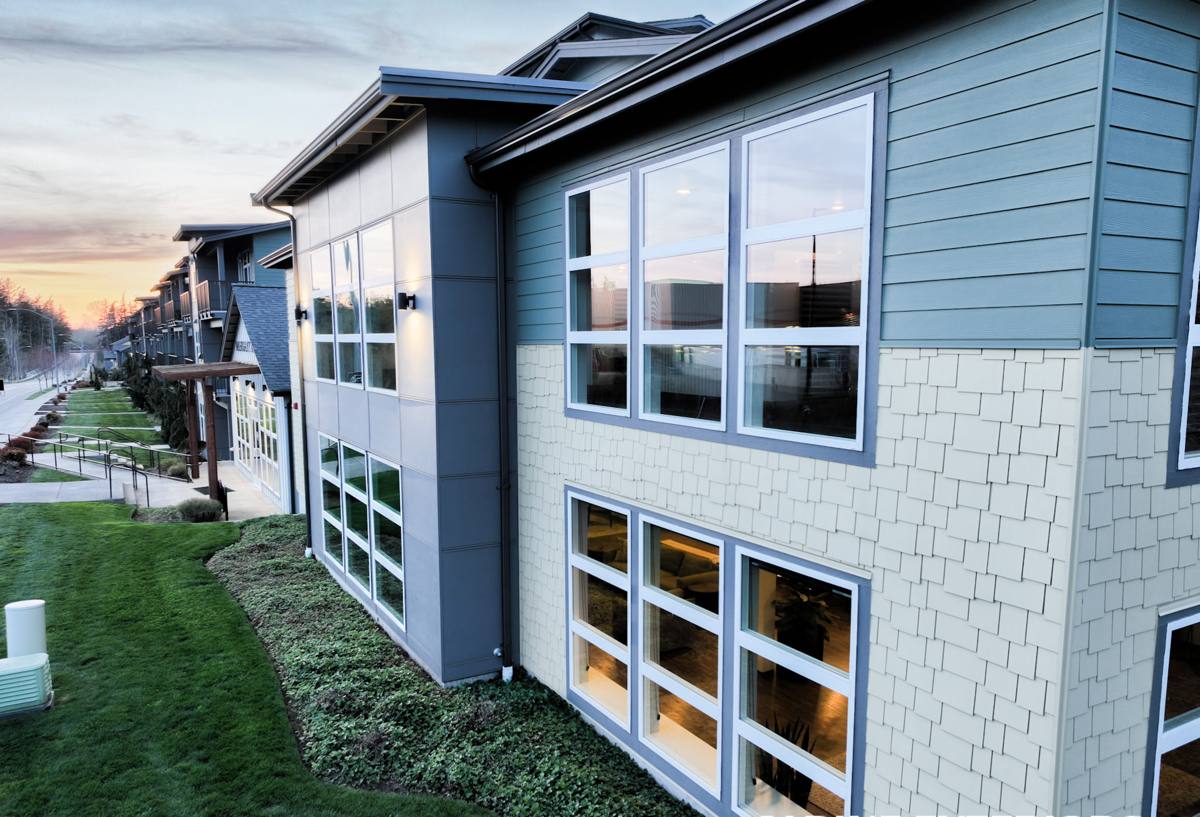
Why We Install Only James Hardie Fiber Cement
We install James Hardie fiber cement siding exclusively. We don't offer vinyl, LP SmartSide, Cemplank, Allura, primed spruce, or cedar, and that's a deliberate standard, not a lack of options. Each of those alternatives has real strengths, but each also has a trade-off that shows up specifically in a climate like Edgemoor's:
- Vinyl expands and contracts with temperature swings, and its seams and J-channels give wind-driven rain a path inward over time; it also softens and can warp in direct afternoon sun on west-facing walls.
- LP SmartSide is an engineered wood product — well-engineered, but wood-based, which means any breach in the factory coating or field-cut edge is a moisture entry point in a marine climate.
- Primed spruce and cedar are natural wood. They look great fresh, but they need active maintenance — recoating, caulk checks, moss removal — to hold up against salt air and shade, and skipping a cycle costs more than it saves.
- Cemplank and Allura are fiber cement competitors to Hardie and can be reasonable products, but we've standardized on one system so our crews, flashing details, and warranty process are consistent on every wall we touch.
Fiber cement itself — cement, sand, and cellulose fiber — doesn't rot, delaminate, or feed moss the way wood fiber does, and it doesn't expand and contract the way vinyl does. James Hardie backs it with a factory-applied finish and a transferable warranty, which matters on a waterfront street where homes change hands and buyers ask hard questions about the exterior.
The James Hardie System, Explained
Product Lines for This Climate
James Hardie engineers its siding by climate zone, and homes in Bellingham and Whatcom County fall in the HZ5 zone — the line built for cold, wet, coastal Pacific Northwest conditions. HZ5 board is formulated to resist moisture absorption and freeze-thaw stress better than the versions sold in drier, warmer regions of the country. That distinction matters on a bay-front lot where the siding is dealing with salt spray, rain, and cool temperatures simultaneously for much of the year.
ColorPlus Factory Finish
Most Edgemoor installs we recommend use Hardie's ColorPlus finish — color baked onto the board at the factory under controlled conditions, rather than field-painted after installation. It resists fading and chalking better than a job-site paint job, and touch-up product is available for the rare nick or scratch, so the whole wall doesn't need repainting to fix a small mark. For homeowners who want a specific custom color that ColorPlus doesn't offer, primed Hardie board painted on-site with a quality exterior coating is also an option.
Panel and Plank Choices
Lap plank (horizontal boards) is the most common choice for Edgemoor's mix of traditional and updated coastal homes, but Hardie panel products work well for accent walls, gables, or a more contemporary look. Trim, soffit, and fascia are available in matching Hardie products so the whole envelope — not just the field siding — is built to the same standard.
What a Correct Installation Actually Involves
Fiber cement siding is only as good as the water management behind it. A beautiful wall with the wrong flashing detail will still let water in — and in Edgemoor's rain and salt exposure, a mistake like that gets found faster than it would somewhere drier.
Water Management Comes First
Before a single board goes up, the wall needs a correctly lapped weather-resistive barrier, properly flashed windows and doors, and drainage space where the siding needs to breathe and shed incidental moisture. This is the part of the job that's invisible once the siding is on, and it's also the part that determines whether the wall lasts twenty years or has problems in five.
Fastening and Joints
James Hardie specifies fastener type, spacing, and placement for a reason — done wrong, boards can crack, work loose in wind, or trap water at the fastener head. Butt joints and board ends need to be treated with the correct sealant or joint flashing, not just caulked and hoped for. On a windward wall facing the bay, joint detailing is one of the first things that gets tested by weather.
Clearances That Matter Near the Water
Manufacturer guidelines call for minimum clearances between the bottom of the siding and grade, roof lines, decks, and other horizontal surfaces. In a wetter, shadier microclimate like Edgemoor's, we tend toward the generous end of those clearances rather than the bare minimum, because tight clearances are where moss and moisture problems start first.
Our Process for an Edgemoor Siding Project
- On-site assessment. We look at existing siding condition, wall orientation relative to the bay and prevailing weather, shade patterns, and any signs of trapped moisture or moss before recommending a scope.
- Tear-off vs. overlay decision. In most cases we recommend full tear-off so we can inspect and repair the sheathing and weather barrier underneath — you can't fix a bad water management layer by covering it up.
- Repair and prep. Any damaged sheathing, framing, or flashing found during tear-off gets repaired before new siding goes on, not patched around.
- Installation to spec. Boards, panels, and trim go up per James Hardie's fastening, clearance, and joint requirements, adjusted for the specific wall's sun and wind exposure.
- Final walkthrough. We review the finished work with the homeowner, including care guidance specific to a waterfront lot.
Comparing Siding Options in a Salt-Air, High-Moss Climate
| Factor | James Hardie Fiber Cement | Vinyl | Wood / Engineered Wood |
|---|---|---|---|
| Salt air resistance | Strong — non-organic, doesn't corrode or feed on salt exposure | Moderate — can chalk and become brittle over time | Weak without regular recoating |
| Moss resistance (shaded walls) | Strong — cement base doesn't feed moss growth | Moderate — moss grows on surface grime, not the material itself | Weak — organic material is more hospitable to growth |
| Wind-driven rain performance | Strong when correctly flashed and jointed | Moderate — seams and channels are entry points | Depends heavily on coating maintenance |
| Finish longevity | 15+ years typical before touch-up needed (ColorPlus) | Fades and chalks; not repaintable in the traditional sense | Repaint or recoat every few years |
| Fire resistance | Non-combustible | Combustible, can melt/deform near heat | Combustible |
Living With Fiber Cement Siding on the Bay
Moss and Grime
Fiber cement won't feed moss the way wood does, but moss and algae can still take hold on the surface in shaded, damp spots — that's true of any siding material in this climate. A yearly soft wash (garden hose and mild detergent, no pressure washer aimed directly at joints or up under boards) keeps growth from building up and preserves the ColorPlus finish.
Salt Residue
Homes closer to the water tend to collect a fine salt film over the winter storm season. It's mostly cosmetic on Hardie board, but rinsing it off during routine cleaning keeps the finish looking fresh and makes it easier to spot any caulk or joint issue early, while it's still a small fix.
Checking Joints and Caulk
No siding system is entirely maintenance-free. Once a year, it's worth a quick visual check of caulked joints, trim edges, and anywhere siding meets a window, door, or roofline — the same spots that take the worst of Edgemoor's driving rain.
Signs Your Current Siding May Be Failing
- Soft or spongy spots when pressed, especially near the bottom courses or under windows
- Paint or coating that's peeling, bubbling, or chalking heavily on bay-facing walls
- Persistent moss or dark staining that returns quickly after cleaning
- Visible gaps, cracked boards, or warped panels
- Musty smell or discoloration on interior walls that back up to exterior siding
- Siding that's noticeably colder or damper to the touch than the rest of the wall
Any one of these is worth a look before it turns into a sheathing or framing repair.
Why Local Installation Experience Matters
Edgemoor's exposure isn't uniform — a wall facing the open bay handles different wind and rain loads than one tucked behind trees a block inland, even within the same neighborhood. A crew that regularly works this stretch of Bellingham knows to read those differences on-site: where to add extra flashing attention, where clearances need to be generous rather than minimum-code, and which walls are going to take the brunt of a winter storm off the water. That local pattern recognition, paired with installation done to James Hardie's actual specifications rather than shortcuts, is what determines whether siding here lasts the way it's supposed to.
If you're weighing a siding replacement or repair in Edgemoor, we're happy to take a look and talk through what your home's specific exposure calls for. Reach out for a free, no-pressure estimate — there's a form below to get started.