 Bellingham Roofing
 Ferndale Siding Takes a Different Kind of Beating
Ferndale sits close enough to the water and open farmland that homes here deal with a combination of stresses most inland Whatcom County properties don't see as intensely. Salt-laden air off the coast accelerates corrosion on fasteners and trim metal. Wind-driven rain off the Strait pushes moisture sideways into seams and laps that were never designed to handle water coming from that angle. And the long, gray moss season — stretching from fall through spring in this part of the Pacific Northwest — keeps north-facing and shaded walls damp for weeks at a stretch, giving organic growth exactly the environment it needs to take hold.
None of that means Ferndale homes fall apart faster than anywhere else. It means the siding on them has to be installed correctly, maintained on a realistic schedule, and repaired promptly when something starts to fail — because small problems here don't stay small. A gap that would sit harmless in a drier climate becomes a moisture pathway in Ferndale within a season or two.
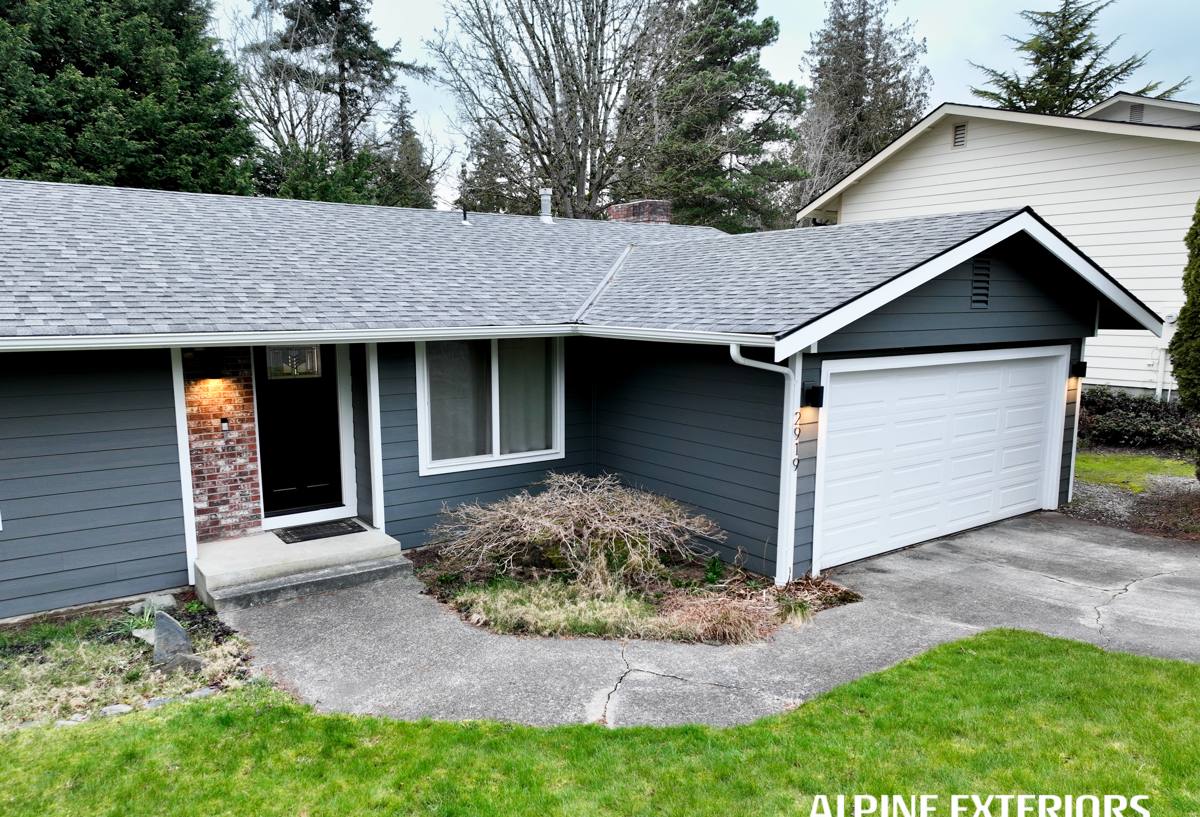
Signs a Ferndale Home Needs Siding Repair
Most siding repair calls we get in this area start with something the homeowner noticed but wasn't sure how serious it was. A few patterns show up again and again:
- Soft or spongy spots when you press on a wall, usually near the bottom courses or under windows
- Dark streaking or green-black growth concentrated on the north or west-facing walls
- Cracked, split, or bowed boards, especially on walls that catch direct wind and rain
- Paint that's peeling, bubbling, or failing faster on one side of the house than the others
- Rust bleeding from nail heads or trim fasteners
- Gaps opening up at seams, corners, or where siding meets window and door trim
- A musty smell or visible staining on interior walls that back up to exterior siding
Any one of these on its own might be cosmetic. Several together, or any sign of softness when you press on the material, usually means water has already gotten past the surface and into the wall assembly. That's the point where a repair call is worth making before it turns into a much larger project.
Why Moss Season Specifically Matters
Moss and algae don't just look bad — they hold moisture directly against the siding surface for weeks at a time instead of letting it shed and dry. On wood-based or lower-grade siding products, that constant dampness is what actually causes rot underneath a growth patch that looks purely cosmetic from the ground. By the time the green is visible, the damage underneath may already be a season or two old.
What a Correct Siding Repair Actually Involves
A proper repair isn't just pulling a bad board and nailing up a new one. It's a short investigation followed by a fix that addresses the cause, not just the symptom. On a typical Ferndale repair call, that means:
- Diagnosing the actual source — failed caulking, a flashing gap, a clogged gutter dumping water onto a wall, or moss holding moisture against the surface. Replacing a board without fixing the source just buys a year or two before the same spot fails again.
- Checking what's behind the siding — house wrap, sheathing, and framing at the damaged area get inspected once the siding is pulled back. If there's rot in the sheathing or framing, that gets addressed before anything new goes back on.
- Correcting water management details — flashing above windows and doors, kick-out flashing where rooflines meet walls, and proper lap and gap spacing all get checked and corrected as part of the repair, not just replaced as-is.
- Matching materials appropriately — for James Hardie fiber cement homes, that means using compatible Hardie trim and siding profiles and following Hardie's fastening and clearance specifications so the repair performs the same as the original installation.
- Finishing correctly — proper caulking at the right joints (and not at joints that should be left open to drain), and a factory-matched or properly primed and painted finish so the repaired section doesn't visibly stand out or fail early.
Repair or Replace: How We Actually Decide
Not every damaged area needs a full re-side, and not every "just patch it" job is the right call either. We look at the scope, the cause, and the age and condition of the rest of the siding before recommending either path.
| Situation | Repair Usually Makes Sense | Replacement Usually Makes Sense |
|---|---|---|
| Damage extent | Isolated to one wall, corner, or a few boards | Multiple walls or spread across most of the exterior |
| Underlying material | Wall sheathing and framing are still sound | Rot has spread into sheathing or framing in multiple areas |
| Siding age/type | Newer material or Hardie product still under warranty | Older wood, vinyl, or engineered wood nearing end of service life |
| Root cause | A single fixable issue — one flashing gap, one bad seam | A systemic issue — original installation errors repeated house-wide |
| Cost consideration | Targeted repair, typically a few hundred to a few thousand dollars depending on scope | Full re-side often makes more financial sense than repeated repairs over time |
We'll tell you honestly which category your home falls into. If a repair will genuinely hold, that's what we recommend — there's no reason to push a full replacement on a homeowner who doesn't need one yet.
What We See Repeatedly in This Area
Working in and around Ferndale regularly means recognizing patterns other crews might miss on a one-time visit. A few things come up often enough to call out specifically:
Salt Air and Fastener Corrosion
Homes closer to the water tend to show fastener corrosion — rust streaking, loosened nails, or trim screws that have started to back out — well before the siding material itself shows real wear. Left alone, a corroded fastener stops holding siding tight against the wall, which opens a gap for wind-driven rain to get behind the material.
Driving Rain on Exposed Walls
Walls facing open exposure toward the water or across flat farmland take rain at a steeper angle than a typical sheltered wall. Laps, seams, and trim joints that would be fine on a protected elevation need tighter execution here, and it's usually those exposed walls where we find the earliest failures.
Shaded, North-Facing Walls and Moss
Walls that stay shaded through the shorter winter days rarely get enough sun and airflow to dry out between rain events during moss season. These are the walls most likely to develop sustained moisture problems if gutters, downspouts, or ground-level drainage aren't also functioning correctly.
Our Process for a Ferndale Siding Repair
We keep the process straightforward and try not to waste a homeowner's time with anything more than it needs:
- An on-site inspection of the damaged area and a quick check of the rest of the exterior for related issues
- A plain-language explanation of what's causing the problem, not just what's visible
- A written estimate that separates the repair scope from anything unrelated we may have noticed
- The actual repair, including correcting the underlying water-management issue, not just replacing the visible material
- A final walk-through so you can see exactly what was done and why
If we find a home where the siding damage points to a systemic problem — original construction shortcuts, or a product that's simply reaching the end of what it can reasonably do — we'll say so directly rather than doing repeated patch jobs on something that needs a real fix.
Why We Repair (and Replace) With James Hardie Fiber Cement
When a repair requires replacing a section of siding rather than just resealing or refastening the existing material, we use James Hardie fiber cement — it's the only siding product we install, on repairs and full projects alike. In a climate like Ferndale's, that choice matters for a repair specifically because fiber cement doesn't absorb and swell with moisture the way wood-based products do, and it's non-combustible, which matters increasingly as wildfire smoke seasons stretch further north each year. Hardie's ColorPlus factory finish also means a repaired section can be color-matched far more reliably than field-painted alternatives, so a patch doesn't stand out as an obvious patch. Hardie's HZ5 product line in particular is engineered for the kind of wet, moisture-heavy climate zone Whatcom County sits in.
We won't install vinyl, LP SmartSide, primed wood, or other fiber cement brands as part of a repair, even as a quick fix — not because those products can't perform anywhere, but because we've standardized on one system we can install correctly, warranty confidently, and match reliably on repeat visits to the same home.
Why It Matters to Hire a Crew That Already Works This Area
Siding repair is diagnostic work as much as it's carpentry. A crew that's worked a handful of Ferndale homes already knows which wall orientations tend to fail first, how aggressive the moss growth gets on shaded elevations, and what corrosion looks like on fasteners that have been through a few winters of salt air. That local pattern recognition shortens the diagnosis and reduces the odds of a repair that only addresses what's visible on the surface. It's also easier to stand behind a repair — and to come back and check it — when the crew is already working in the area regularly rather than driving in once for a single job.
Ready for an Honest Look at Your Siding
If you're seeing soft spots, moss buildup, rust streaking, or gaps opening up anywhere on your Ferndale home's exterior, it's worth having it looked at before the next wet season makes the problem bigger. We offer free, no-pressure estimates — we'll tell you plainly whether you're looking at a targeted repair or something more, and why. Use the form below to get started.